Trusted by 237K+ Business Worldwide. Find a Location
Trusted by 237,000+businesses worldwide across 250 locations delivering uniforms, linens and more. Find a Location Near You


Delivering Excellence Since 1910
Contact Us
discomfort (research-backed)
from standing 4+ hrs/day
rental from just $1/day
from Auckland to Invercargill
Do Anti-Fatigue Mats Actually Work?
Short answer: yes, when they are the right mat for the job. The evidence is not anecdotal. Multiple peer-reviewed studies, including research published in the journal Ergonomics, have found that anti-fatigue matting meaningfully reduces fatigue, musculoskeletal strain, and injury risk in workers who stand for extended periods.
The mechanism is straightforward. Hard concrete and tile floors cause micro-circulation problems in the legs and lower back because standing muscles constantly contract to maintain balance on rigid surfaces. A properly engineered anti-fatigue mat introduces subtle instability that keeps those muscles gently active, improving blood flow and reducing the static load that causes pain and injury.
A study by the University of Waterloo found workers standing on anti-fatigue mats reported 50% less lower back discomfort after a full working shift compared to workers on concrete. Discomfort in the legs and feet was reduced by a similar margin.
Measurable Benefits: What the Research Shows
WorkSafe NZ: What Are Your Obligations?
The Health and Safety at Work Act 2015 (HSWA) requires every PCBU to manage risks to workers, including risks from prolonged standing. WorkSafe NZ’s guidance on hazardous manual handling specifically identifies static standing postures as a risk factor for musculoskeletal disorders (MSDs).
This does not mean anti-fatigue mats are legally mandated in every workplace. It does mean that if your workers stand for more than 2 hours per shift on hard surfaces, you are expected to have controlled that risk. Providing anti-fatigue matting is the primary recognised control measure for standing workstations.
MSD risk is your responsibility. Musculoskeletal disorders are the single largest category of workplace injury in New Zealand. If a worker develops a back or leg injury from prolonged standing and no controls were in place, WorkSafe can and does take enforcement action.
Which Industries Need Anti-Fatigue Mats Most?
Any role where workers stand for extended periods on hard surfaces benefits. The industries with the highest MSD risk from standing work in NZ are:
Production Line & Processing
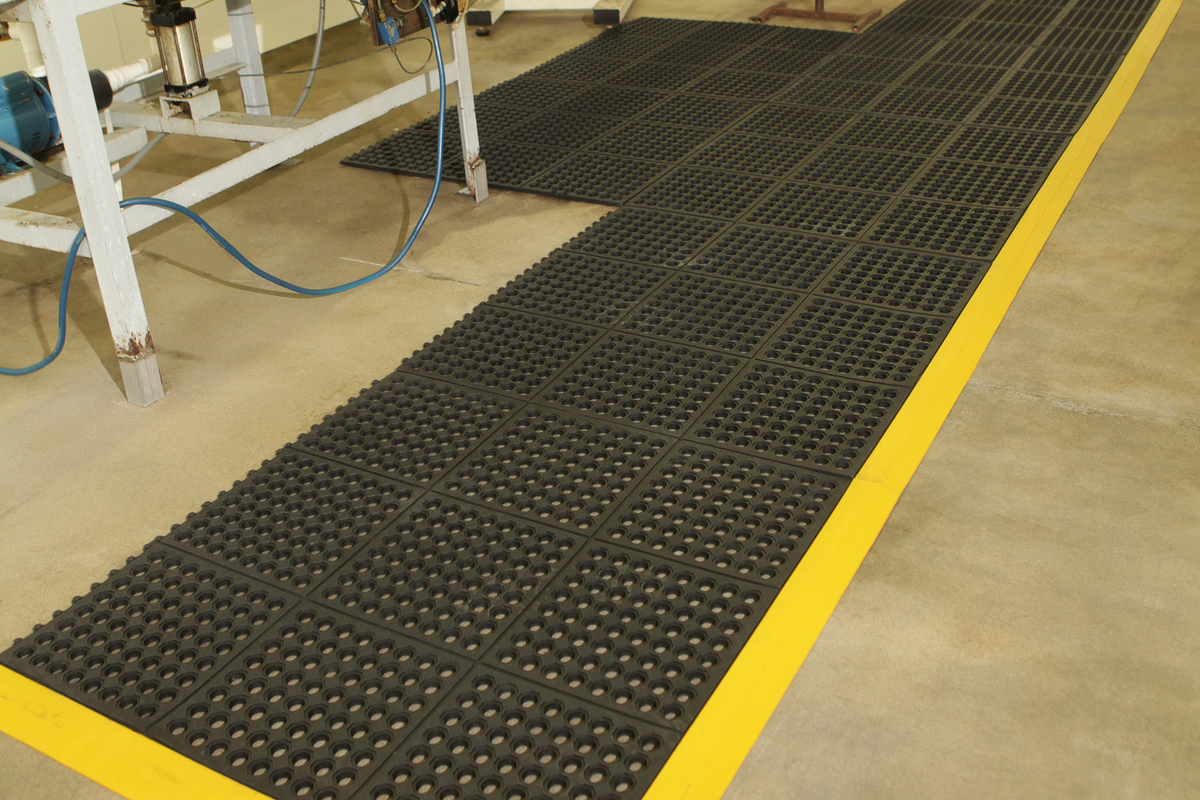
Workers stand 6-10 hours on concrete or tile. Food-grade, anti-slip, oil-resistant mats are required. Alsco’s food prep range meets HACCP hygiene standards.
Kitchen & Bar Staff
Chefs and kitchen hands stand on hard tile for entire shifts. Anti-fatigue mats also reduce slip-and-fall risk in wet kitchen environments.
Operating Theatres & Wards
Surgeons and nursing staff often stand for 4-8 hour procedures. Clean-room grade mats with non-linting surfaces are standard in clinical environments.
Manufacturing & Assembly
Assembly-line and machine-operating roles involve prolonged standing with repetitive movements. Anti-fatigue mats reduce cumulative injury over multi-year employment.
Checkout & Service Counters
Retail staff and baristas may stand 8+ hours. Lighter-duty anti-fatigue mats work well in these environments and fit under counters and workstations.
Reception & Front Desk
Often overlooked. Reception staff who stand at desks experience the same cumulative fatigue as industrial workers — a lightweight mat makes a real difference.
Choosing the Right Anti-Fatigue Mat
Not all anti-fatigue mats are the same. The wrong mat in the wrong environment wears out quickly, creates a slip hazard, or simply does not deliver the ergonomic benefit. Here is how to match mat type to environment:
Alsco’s managed mat service covers all the above types. Our technicians assess your workstation environments and specify the correct mat for each location — you do not need to work it out yourself. Available in sizes from S 3×2 (90cm x 60cm) to XL 8×3 (90cm x 240cm).
Buying vs Renting: What Makes More Sense?
| Factor | Buying | Alsco Managed Rental |
|---|---|---|
| Upfront cost | High ($80–$500+ per mat) | None — from $1/day |
| Cleaning | Your responsibility | Included — collected and laundered |
| Replacement when worn | You pay again | Included in service |
| Correct mat for each zone | You research and specify | Alsco assesses and specifies |
| Hygiene compliance | On you to maintain | Professional industrial laundering |
| Scaling up or down | Fixed investment | Flexible — adjust as headcount changes |
| Admin burden | You manage inventory | Zero — Alsco handles everything |
What to Look for in a Quality Anti-Fatigue Mat
If you are assessing mats — whether purchasing or specifying for a managed service — these are the features that separate effective mats from cheap ones that wear out in six months:
- Nitrile rubber backing — resists oils, solvents, and greases. Cheaper mats use PVC which degrades quickly in industrial environments.
- Bevelled edges — tapered edges prevent trip hazards. A flat-edged mat on a busy floor creates a lip that catches feet.
- 15–20mm thickness — the optimal range for anti-fatigue effect. Thinner mats offer little benefit; thicker ones create instability for some tasks.
- Non-slip surface texture — particularly important in kitchens and wet environments. A smooth-top mat in a wet kitchen is a liability.
- Appropriate size for the workstation — the mat must be large enough that workers do not step off it during normal work movement.
- Easy to clean — mats that trap dirt and cannot be properly cleaned become a hygiene risk over time, particularly in food environments.
Frequently Asked Questions
How long does an anti-fatigue mat last?
Are anti-fatigue mats required by WorkSafe NZ?
Can anti-fatigue mats be used outdoors?
What is the difference between an anti-fatigue mat and an entrance mat?
How often do the mats get cleaned in Alsco’s service?
Do anti-fatigue mats help with slip prevention as well?
Protect your team. Remove the admin. Start a free trial.
Alsco’s managed mat rental covers supply, industrial laundering, and scheduled replacement. From $1 a day, with a two-week free trial. NZ-wide coverage.
Read More

What Alsco Brings To Your Business

A Greener Workplace Through Leveraging Technology – Is It Possible?


