Trusted by 237K+ Business Worldwide. Find a Location
Trusted by 237,000+businesses worldwide across 250 locations delivering uniforms, linens and more. Find a Location Near You


Delivering Excellence Since 1910
Contact Us
Workplace Hygiene: 4 Ways Germs Spread and Kill Your Workplace Productivity
Have you ever visited a workplace washroom and suddenly no longer felt the desire to go? A dirty toilet can put you off, and worse, cause you bladder infections for holding it in for too long simply because you don’t want to use the unhygienic office toilet.
Your workplace hygiene and cleanliness is of the utmost importance. It isn’t just for creating a good impression, but also for ensuring that your employees’ safety, health and wellbeing is being safeguarded.
Maintaining a clean and hygienic workplace goes hand in hand with your employees’ productivity.
One way to ensure workplace hygiene is to stop germs from spreading. Maintain clean and hygienic washrooms, and you’ll be one step closer to a germ-free workplace.
To have a hygienic and clean washroom, you’ll need properly maintained toilets. Ensure that your employees have hand washing and drying facilities, provide the required consumables and have effective odour control mechanisms in place.
Have your washroom hygiene taken care of by qualified personnel through Managed Washroom Services.
Learn what germs are and four ways they can spread, killing your workplace productivity.
What Are Germs?
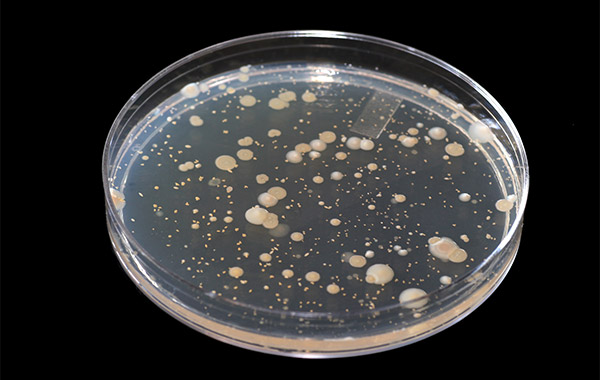
Image from: Freepik by stockvault
Germs are tiny microorganisms that can only be seen under a microscope. There are two types of disease-causing germs, bacteria and viruses. Most germs, such as Salmonella and hepatitis A, cause illnesses in humans.
Germs, just like humans and animals, need moisture, warmth and food to survive. They can access all these from various places, including food scraps, faecal matter, rubbish and our bodies, too.
However, human bodies harbour many helpful bacteria, including good gut bacteria, which allows our bodies to utilise the nutrients in the food we consume while making waste from what’s leftover.
There are also good germs found in our environment, including the Lactobacillus germ. It ferments milk, turning it into yoghurt. There are also other germs that break down vegetable matter into compost.
You’ll encounter many harmful germs all over your workplace. They kill your employees’ productivity in these four ways:
#1 Way Germs Are Spread and Kill Your Workplace Productivity: Airborne
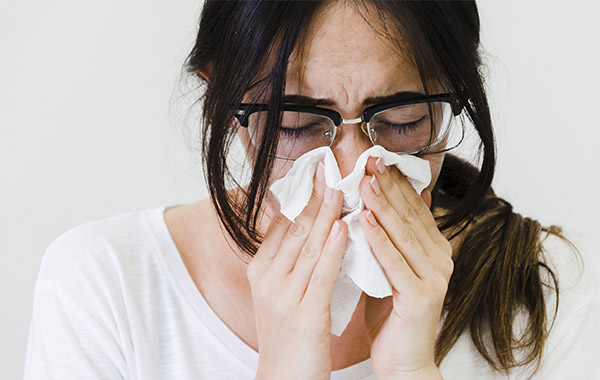
Image from: Freepik
The air you are breathing in right now could be full of harmful bacteria and viruses. When people sneeze or cough around you without covering their mouths, they expose you and everyone in the workplace to harmful germs.
There is also the ‘sneeze effect’ in washrooms, meaning that a flush can spread germs around a stall, over the toilet paper and up to six metres from the toilet bowl. The sneeze effect can make germs spread to your hands and later onto other surfaces.
The initial ‘sneeze effect’ study was done by Dr Charles Gerba in 1975, and he entitled it Microbiological Hazards of Household Toilets. It demonstrated that when a toilet was flushed, it produced a cloud that could remain airborne for a maximum of two hours, travelling up to eight feet up and around the toilet.
He recommended that people should refrain from storing their toothbrush in the open and instead lock it up in a cabinet. You should also put the toilet lid down before flushing.
Other ways to deal with the sneeze effect is by:
- Cleaning the washroom regularly and after a user had diarrhoea or vomited in it.
- Keeping the wall and ceilings around the toilet clean.
- Cleaning thoroughly, especially under the bowl’s rim and the bottom side of your toilet seat.
#2 Way Germs Are Spread: Contaminated Surfaces and Objects
Viruses and bacteria can survive on surfaces for up to 24 hours. Studies have also shown there are germs living on your computer keyboard as well as the mouse.
As you go about your work, you are likely to pick up some of the bacteria and pass it to your mouth or nose.
Washroom surfaces are one of the most contaminated areas in your workplace. People are exposed to bodily fluids and other wastes such as feminine products. If not properly maintained, these can spread germs.
Other surfaces full of germs include:
- Doorknobs
- Kitchen sponges
- Faucet handles
- Refrigerator handles
#3 Way Germs are Spread: Skin Contact
Skin contact is a common way germs are spread around the workplace, as every time you shake hands with a colleague, you are risking spreading or coming into contact with germs.
Even holding open a door for a colleague as a show of courtesy exposes you to germs!
Your hands carry up to 80 million bacteria per square centimetre after using the toilet. You can then transfer these germs from your hands to more than five surfaces or even 14 other objects in the office.
These germs can make you and/or your co-workers sick, keeping them out of the office as they recuperate either at home or the hospital. The result is decreased productivity in the office.
#4 Way Germs are Spread: Contaminated Food
Communal kitchens are breeding grounds for bacteria. Undercooked food and dirty kitchen surfaces are the biggest culprits. Kitchens receive high human traffic and the higher the number of people, the more germs there will be.
Norovirus is another threat in kitchens. Around 16% of people carry the norovirus without exhibiting any symptoms. They’ll feel healthy, but they might be spreading the microorganisms to other surfaces, including the kitchen, which in turn makes other people sick.
Why Good Hand Hygiene Is Important for Your Employee Productivity
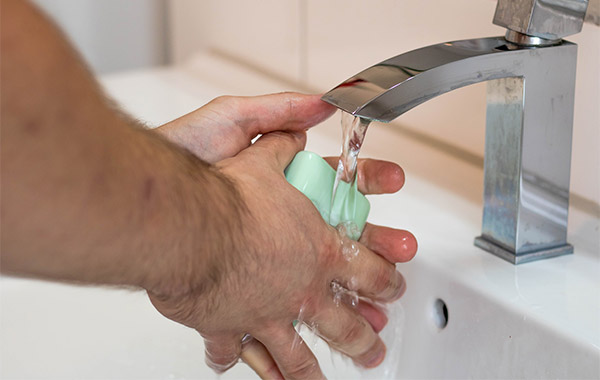
To minimise employees’ sick leaves and their productivity, you should start with good hand hygiene.
Why Hand Hygiene Is Paramount in the Workplace
People become ill from using shared washrooms. Bacteria and viruses common in washrooms are the biggest culprits.
Common stomach infections are caused by Salmonella, Gastrointestinal viruses, respiratory organisms and Escherichia coli. When your employees are exposed to bad health conditions, they become less productive.
There is also the risk of spreading illnesses to other healthy co-workers. Handwashing is considered the most basic step in becoming more healthy.
You can improve your overall workplace productivity by practising good hand hygiene.
According to various studies, regular and proper handwashing greatly reduces cases of people getting sick with diarrhoea and respiratory diseases. For companies, hand washing results in higher productivity and fewer employee sick days.
When Should You Wash Your Hands While at Work?
There are people who don’t know the importance of proper hand hygiene to stop the spread of harmful germs that can make people ill. Here are some instances when you should wash your hands while at work to stay healthy and ensure the health of others around you.
- After visiting the washroom
- After coming into contact with old printed materials
- Before and after meetings
- After using shared equipment
- After using borrowed devices or tools
Maintain High Levels of Hand Hygiene to Increase Workplace Productivity
Proper hand hygiene offers an easy, effective and affordable way to stop the spread of germs and keep your workers healthy. A healthier working environment makes your employees more productive.
Make use of posters to remind your employees of the importance of handwashing.
By promoting good hand hygiene, you will benefit from good employee health and your business productivity.
How to Keep Germs From Spreading
To stop germs from spreading and killing your workplace productivity, consider cleaning the most affected areas. These include the kitchen area and your washrooms where germs are more likely to spread.
Disinfect your kitchen and washroom and have it sanitised frequently. Train your staff to always dry surfaces such as chopping boards and worktops after cleaning them.
Leaving these surfaces damp helps germs to thrive and even multiply if the moisture is enough.
Encourage your employees to practice good hand hygiene. They should always wash their hands before handling food and after visiting the toilet among the other aforementioned instances.
This will help stop germs from spreading and affecting your workplace productivity negatively.
Embrace Good Hygiene and Sanitation
Maintaining a clean and hygienic workplace doesn’t have to be rocket science, as you don’t have to worry about every little detail.
If you are in New Zealand, let Alsco take care of all your workplace washroom needs. We have vast experience in delivering exceptional managed rental services for different industries.
Our services include:
- Hygiene
- Linen
- Uniforms
- Consumables
- First aid
- Floorcare
- And more
Get in touch with Alsco today for a customised quote to suit your business needs.
Photo: Free-Photos
How to Save Yourself When Everyone Else in Your Office is Getting Sick
There is nothing worse than having to report to work feeling under the weather. But almost everybody will go through this at some point in their professional lives.
In fact, according to the Business NZ Wellness in the Workplace 2017 Survey, the average number of time employees took off work due to illness was 4.4 days at a time.
The survey also shows that New Zealand has lost about 6.6 million working days to sickness between 2012 and 2017. Companies lose up to $1,000 per employee on sick leave. This translates to a direct loss of over $1 billion in 2016 alone.
While companies encourage employees to stay home when unwell, studies have shown that up to 40% of staff will still show up sick. The report shows that employees are usually absent due to sickness or taking care of a sick family member.
In order to be a productive employee, your wellness must come first. It’s important to save yourself when your colleagues are feeling unwell. There are a few tips and tricks you can turn to for your wellness at work.
Take the Shot
During flu season, there is usually a mass immunisation drive in most countries. The flu shot is usually administered to prevent you from catching the virus. It will be best for you to line up and take the shot in order to protect yourself from that sneezing deskmate at work.
There are outbreaks that happen from time to time depending on which part of the world you are in. Conditions like Meningitis, Hepatitis and many other contagious diseases can take you down. Keep your ear open for vaccination drives to make sure you are virus-free.
Have Your Hand Sanitiser Ready
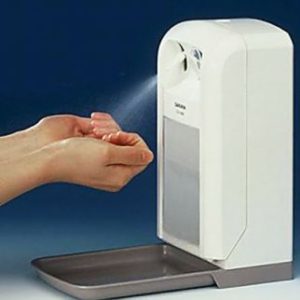
The best way to keep your hands germ-free is to thoroughly wash them as many times as possible during working hours. However, if you are unable to do so, have some alcohol-based hand sanitiser handy. A rub of sanitiser on your hands will keep germs from pitching camp and making you ill.
You can put in a request to your company to provide hand sanitisers. Alsco New Zealand offers heavy-duty sanitisers which are soft on the skin but tough on germs.
A sure way of keeping yourself sick-free is to avoid touching your face, biting your nails or working on a desk that you have not taken the time to wipe down – these are some of the ways that you can transfer germs to your eyes, mouth and nose and risk becoming sick.
Encourage a Sick Colleague to Take Time Off
This may sound a little mean but think of it as doing a greater good. If you encounter a colleague who is showing signs of sickness, encourage them to take some time off in order to be more productive and prevent spreading it to the rest of the team.
A good team leader or manager should also reinforce the wellness policy in the workplace and remind staff members to take much needed time off to recuperate. Employees must take advantage of their right to time away from work due to injury or illness in order to be more productive upon their return to work.
Seek an Alternate Workspace
There are those colleagues who will stick it out at work even when they are feeling sick. In such a case, you can find another workspace to get your work done. It can be an empty desk elsewhere or an available office space.
During the flu season, you can request a work-from-home day to stay away from sick colleagues. This is obviously dependent on the employee policy in place at your workplace. This workday from home is best taken when you feel you are coming down with something.
Take Care of Yourself if You Start Feeling Unwell
The moment you start feeling the sniffles coming on, take extra care of yourself. It can involve going to bed earlier, staying hydrated, taking vitamin supplements, eating more citrus fruits for that extra vitamin C or getting some medication to alleviate the symptoms. At this point, it’s also better to request some time off to take care of yourself. Remember, you’re more valuable to your family and workplace when you’re healthy.
Promoting Health And Wellness in The Workplace
According to a Regional Public Health (RPH) Guide to Promoting Health and Wellness in The Workplace, companies should consider having a Health and Wellness policy in place to ensure that employees give their best while on duty.
Wellness programmes promote job satisfaction, physical fitness, nutritional benefits, energy, high morale and less sickness or injury in the workplace. Some of the ideas the companies can try include:
- Let’s Get Physical: According to the RPH report, sickness in the workplace can be exacerbated by being sedentary in the workplace. Companies should have a physical activity plan in place. It can be fitness programmes, no-elevator days and encouraging staff to get off their seats at regular intervals during the day. In short, just get moving!
- Eating Right: Companies can have healthy meal options in place for employees. This means discouraging vending machine snacks. Companies can liaise with a local vendor who can deliver or prepare healthy meals for staff members. They can also have memos that talk about healthy eating hacks around the office to encourage healthy eating.
- Smoking Zones: In an ideal workplace, there would be no smoking allowed on the premises. However, companies usually try and accommodate their smoking team members. In such a case, make sure that the smoking zones are far away from the main workspaces. Second-hand smoke impacts health just as direct smoking does.
- Mental Wellness is a Must: Aside from physical injuries or illness, one of the things on a steady rise in mental illness. Stress, anxiety, depression and other mental illnesses have started to impact many people, especially in the workplace.
Mental wellness can be promoted by recognising work well done from time to time. Having a professional counsellor hired in-house or sourced from outside the company to come and speak to staff members is a great way to promote mental wellness.
- What Else?: Another thing companies can do to promote health and wellness is to have breastfeeding and baby care facilities on site. Many parents have anxiety issues if they can’t attend to their young children’s needs in a way that doesn’t negatively impact their working day.
Most importantly, encourage all team members to check in with each other. This is a great way of monitoring any changes to team mental wellness. Promote discussion on the topic to remove the taboo.
And encourage good hygiene by printing some eye-catching workplace hygiene posters and placing them in the washroom and around the office.
[b3_row class=”hygiene-posters-tile”]
[b3_column lg=”4″ md=”12″ sm=”12″ xs=”12″ ][/b3_column]
[b3_column lg=”4″ md=”12″ sm=”12″ xs=”12″ ][/b3_column]
[b3_column lg=”4″ md=”12″ sm=”12″ xs=”12″ ][/b3_column]
[/b3_row]
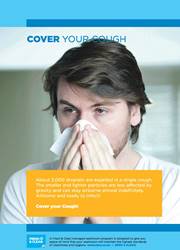

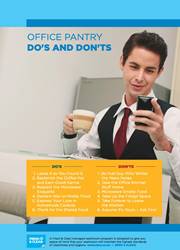
Photo courtesy of Freepik
Washroom Rights Every Employee Should Know
Even though the topic of employees’ workplace washrooms rights isn’t something that’s usually discussed, it is important for every worker to know their rights.
With that in mind, here are some things related to the topic of washroom rights that every employee should be aware of.
You Must Have Workplace Washrooms
Every workplace must have a washroom for the employees (except if your work includes constant travelling between different locations).
If you’re working at one location, like in an office, then your rights about having a washroom available are pretty clear. Your building must have a washroom facility you and your colleagues can use, and it must have both a toilet and a basin for you to wash your hands.
For example, if a school is your workplace, here’s all you need to know about your school washroom requirements.
However, if you are a part of a mobile work crew, then a washroom with all the necessary elements must be available within a quarter mile of your working site.
There Must Be Enough Facilities
The number of washroom facilities you should have depends on how many employees there are, regardless of their gender.
In this section, the numbers are related to female employees, but they do apply in gender-neutral washrooms as well.
- Between 1 and 5 employees, 1 toilet and 1 hand-washing facility.
- Between 6 and 25 employees, 2 toilets and 2 hand-washing facilities.
- Between 26 and 50 employees, 3 toilets and 3 hand-washing facilities.
- Between 51 and 75 employees, 4 toilets and 4 hand-washing facilities.
- Between 76 and 100 employees, 6 toilets and 5 hand-washing facilities
When it comes to male employees, the numbers are:
- Between 1 and 15 employees, 1 toilet and 1 urinal.
- Between 16 and 30 employees, 2 toilets and 1 urinal.
- Between 31 and 45 employees, 2 toilets and 2 urinals.
- Between 46 and 60 employees, 3 toilets and 2 urinals.
- Between 61 and 75 employees, 3 toilets and 3 urinals.
- Between 76 and 90 employees, 4 toilets and 3 urinals.
- Between 91 and 100 employees, 4 toilets and 4 urinals.
You Must Have Washroom Breaks
We all have washroom-related needs, even at work. A study has shown that an average worker spends about 41 hours every year in the washroom. Every employee should be provided with a few breaks in order to be able to take care of their needs, freshen up, and regain energy. Washroom breaks are no exception here.
There Should Always Be Hygiene Supplies In The Washroom
This might seem like common sense, but it’s surprisingly often overlooked. In every workplace washroom, there should be both cold and warm water available as well as soap. Also, there should be either a hand dryer or paper towels for employees to dry their hands.
In the workplace, taking take care of health and hygiene is essential. So, every employee should and must have access to hand hygiene facilities and supplies.
You Should Have Privacy
The way washroom is designed is extremely important, as it should be done appropriately. This has nothing to do with the quality of the facilities, but with the placement of the toilets. Needless to say, the toilets should be separated by a cubical and a door, so whoever is using them can have some privacy. This is a standard design for all workplace washrooms and there are no reasons not to follow it.
The Washroom Should Be Clean and Well-Maintained
All the washroom facilities should be cleaned every day, and the supplies (toilet paper, soap, etc.) should be checked regularly and refilled if needed. It’s also a good idea to clean up all the washroom facilities at the end of every workday. It might not be necessary but it’s highly recommended in order to ensure the cleanliness of the washroom. This includes mopping the floors, cleaning the toilets and basins, emptying the trash bin, refilling the soap, replacing the toilet paper, etc.
You Don’t Need Showers In The Workplace
In most workplaces, showers are not necessary. However, if you’re working in a lab with lots of chemicals that could be harmful or in a gym where people sweat a lot, then you should be provided with shower facilities (with both cold and warm water). In those cases, showing helps employees maintain their hygiene and safety.
What Employers Can Do To Improve Their Washrooms
Unfortunately, in terms of washroom rights, there are some companies who do the very least, just enough not to get in trouble. They are only looking for ways to save money, but that is a bad way to do it. The washroom is not a place where you should try to save up, as it doesn’t really require much. Most of the things it does require are pretty much the bare necessities for maintaining the hygiene of the users. Plus, it is possible to provide your employees with everything they might need, from the facilities to enough breaks, and still spend much less money than you might expect.
When it comes to saving money, one thing you could and should do is go green. If you choose eco-friendly options for your washroom, you’ll be able to use toilet paper made of recycled materials, natural soaps, and if you want to go one step further, even solar panels that can help you save money on electricity. There are a lot of benefits, and going green is not necessarily expensive.
As the one in charge, it’s your job to ensure that your washroom is up to the highest standards. It’s not just about having a place to go when you need to go, there’s much more to it.
If you truly do want to optimise your workplace and improve the productivity at your office, the best thing you can do is ask your employees what they would change. Talk to them about anything they might be unhappy about and see what you can do to solve the issues and make them happier. This way, you will create a much more positive atmosphere and boost your employees’ motivation as well as their respect for you and your company.
The chances are, there probably is something they would change, even if it’s something small and seemingly insignificant. Some of the most common complaints are related to the washroom conditions, so do your best to improve your washroom as much as you can.
Improve your washroom facilities, partner with Alsco. With our fully-managed washroom systems, you’re sure to have a clean, hygienic and well-maintained washroom for your workplaces. Contact us now!
Hygiene Condition Of Your Workplace Is Dictated By Restroom Facilities
Workplace hygiene is of utmost importance, just as equipment is to getting work done. If you wonder why, well, there are a lot less chances of getting ill when working in a neat and clean space. This creates a more positive working environment for everyone.
It is clear that many businesses have put a lot of effort into increasing their hygiene levels, especially in the toilets. However, much more is needed to achieve this than a few towels and some toilet paper.
It’s all about providing proper facilities. Two principal types of facilities, to be exact. Practical facilities are related to certain hygiene items.
Meanwhile, design ones are related to how the restroom is put together.
Are you willing to create better workplace hygiene for your workers? Good! We’ve created a brief guide to the things your workplace restroom must have.
Facility maintenance
Getting the facilities right is important, but restroom maintenance is crucial too. After all, anything that is not in perfect condition is not going to be as effective as it should be.
Appointing a facility manager from your staff helps to keep everything in shape. But, is your workplace is larger than the average? If it is, we advise you to consider renting rather than buying facilities.
Practical bathroom facilities
1) Hand Dryers
Three methods of drying hands in the workplace restroom are possible. These are electric hand dryers, cloth roller towels and disposable paper towels. Electric hand dryers are very effective in drying your hands. However, it has been shown that bacteria levels actually increase by up to 254% on palms and 194% on finger pads.
Meanwhile, modern jet air dryers can extend contamination distance by 2 meters. On the other hand, disposable paper towels are much more effective. They reduce bacteria by 76% on finger pads and by 77% on palms. But most importantly, being disposable makes the risk of contamination negligible. At least as long as the bins have proper and functional lids.
The cloth roller towel is highly hygienic too. Since cloth towel dispensers are closed, the used section of a roller towel is unreachable, which reduces contamination significantly. It was found in 2007 that with cotton roller towels bacterial levels decreased by 85% on the hands.
2) Hand Soap Dispensers
Soap is the fundamental agent in cleaning hands, but the old version of a soap bar is not the best option. These tend to gather dirt on their surface. This does not mean cross-contamination is possible (lather washes away the bacteria). It just doesn’t look hygienic so workers usually don’t like it.
Far better version of soap is in liquid, foam or spray form, made available in hand soap dispensers. The dispensers completely protect the actual soap from getting contaminated. Meanwhile, the push-button release mechanism minimises the contamination.
3) Hand Sanitizers
The hand sanitiser is an addition of value required to maintain high hygiene levels. Therefore, it is important to know that it should be used only as an addition to the soap and hand drying system. That’s because sanitising dispensers only remove the transient bacteria that live only on the skin’s surface. More dangerous bacteria lie beneath the surface and can be eliminated more effectively by soap.
Facility design
A lot of things are covered by the restroom design. From the type of doors to the actual combination of colours chosen for a particular facility.
For example, while soap dispensers effectively help workers clean their hands, having a hands-free soap dispenser lowers the risk of contamination from the dispenser button a lot.
Similarly, an automatic flush on a toilet prevents contamination since there is no handle to be contaminated.
Hygiene starts at the restroom threshold, that’s why the swing doors are the most suitable. The design is a walk-in entrance which uses dividers that block the view from the outside but requires no doors.
It is obvious that cubicle doors need to have a lock. Slide latches or push button locks are more hygienic than twist mechanism latches. They need to be gripped.
Work in a school? Here’s all you need to know about school washrooms from the necessary facilities, cubicle sizes, health and safety concerns, washroom design and best workplace hygiene practices.
A Clean And Hygienic Toilet Room
Alsco provides restroom stock and maintenance management services as part of a rental program, which means your staff can focus on their primary tasks instead of wasting time on washroom hygiene and maintenance.
For more inquiries contact Alsco now, our friendly representatives are available to you!
Sources:
- ‘Washing with Contaminated Bar Soap is Unlikely to Transfer Bacteria’, JE Heinze and F Yackovich (1988), US National Library of Medicine
- ‘A Comparative Study of Three Different Hand Drying Methods: Paper Towel, Warm Air Dryer, Jet Air Dryer’, K Redway and S Fawdar, School of Biosciences, University of Westminster, London (2008)
Photo courtesy of Flickr Images by simone.brunozzi
Hand Drying: Paper VS. Technology
These days, people prefer technological solutions. Anything that belongs to the so-called ‘old world’ is out the window. This is often the reasonable side of the argument.
However, forgetting that gadgets don’t always outperform non-technological solutions is a mistake.
One of the areas in which this is really relevant is hand drying. Old school hand drying techniques such as paper towels are still very much relevant in the world of automatic hand dryers.
There is a very good reason for that – they simply do their job. And not just that, they are also more hygienic!
In a 2008 research conducted by the University of Westminster in London, it was concluded that the advancements in the field of hand drying didn’t go far enough to completely eliminate the need for paper.
Here are some aspects in which automatic hand dryers and paper towels can be compared:
Contamination Risk
The chasm in drying efficiency and bacteria removal comes down to hard graft. The rubbing motion on the skin physically removes more bacteria.
The paper hand towel absorbs moisture from the skin, thereby lifting the water-bound bacteria off. But hand dryers rely on powerful streams of air blowing the moisture and bacteria off the skin, a method of hand drying that could never be fully effective.
What is more, ‘blowing’ moisture off the skin is not a hygienic option either. As any microbiologist will testify, air movement only disperses micro-organisms, so contamination is increased dramatically.
And since drying with paper hand towels involves no air movement at all, there is no contamination, making it the most hygienic method of hand drying.
The air streams produced by jet air hand dryers, for example, travel at 400 mph. This blows bacteria outward to a distance of 2 metres. They end up landing on the body and clothing of other washroom users. This is the worst-case scenario when it comes to preservation of hygiene in public toilets.
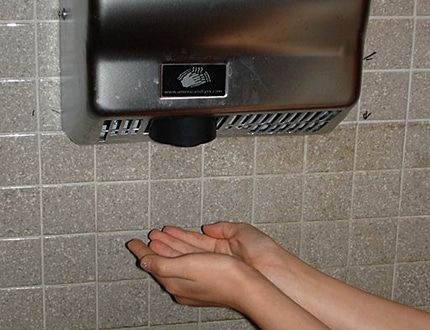
Warm air hand dryers are not so guilty of spreading contamination since they are far less powerful (thus the poor drying ability) and blow downward, so neighbouring users are not in the ‘line of fire’ so to speak.
Efficiency
When it comes to the effectiveness of drying, paper towels are definitely the better solution. One research showed that the number of bacteria on hands after drying them with paper fell by up to 85.2% on palms and by amazing 91.5% on fingers.
On the other hand, air dryers did the exact opposite – they actually helped bacteria thrive rather than eliminating them, with 414% increase in bacteria found on fingers and stunning 478% on palms.
Efficiency-wise, hand towels and jet dryers turned out to be pretty much equal. They both produce 90% dryness after the usual 10 seconds of drying. Warm air dryers weren’t nearly as efficient, though. It took them 40 seconds to achieve the same result.
Environmental Aspect
And what about the impact that the hand drying techniques make on the environment? This is one area in which the warm air hand dryer wins out, at least compared to paper.
There was a study carried out by the US-based Environmental Resources Management consultancy firm. They found that paper towels spent about 64% more electricity over a period of 5 years than warm air hand dryers.
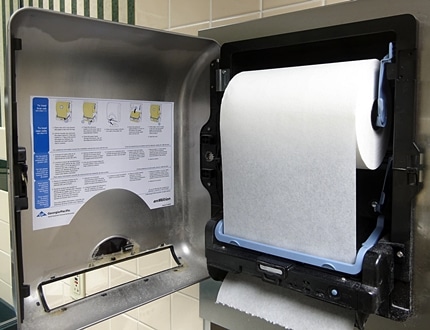
Meanwhile, a World Dryer study of 102 hand dryers installed in public schools in Kansas, US, concluded that annual savings of 34.5 tons of solid waste, 690,000 gallons of water, and 587 trees were made, compared to using paper hand towels.
Also, from a management point of view, the warm air hand dryer option is superior. They are long-term hand drying investment, with machines typically used for 5 or 6 years, while paper hand towels must be restocked continuously, and disposed of regularly.
Bins are an essential item in the workplace washroom to maintain hygiene levels. Regular waste removal is needed to prevent overflowing and ensure a cleaner working environment. It even helps to cut the instances of illness amongst staff, especially when it comes to restaurants or school washrooms.
Choosing the best hand drying technique for a public or staff washroom is important. You should make cost-efficiency a key component in the decision-making process.
In terms of hygiene effectiveness, paper hand towels remain the best choice. In environmental and maintenance terms, the warm air hand dryer wins out.
So what would be the final verdict? It’s hard to tell, but one thing is for sure – various hand hygiene solutions are good for the industry. It never hurts to have options and be able to choose the solution which best fits your current needs. If you are not sure what the best thing for you is, contact Alsco and receive a free audit for your business.
Photo Courtesy of Mega Pixel Images by Nikon D3s
Photo Courtesy of Wikimedia Commons Images by Stilfehler
Photo Courtesy of Flickr Images by Mark Turnauckas
The Most Overlooked Facts About Hand Washing
The development of transportation and technology has enabled people to move more than ever before.
Also, these two factors have increased the number of contacts an average person has with other people on a daily basis.
Since every interaction between people includes an exchange of microorganisms, the question of our hygiene is becoming more and more important.
Shaking hands with acquaintances, spending time on the means of public transportation or using your gadgets are all situations in which various germs can get into your body.
You don’t know if these people wash their hands regularly or not. What you can do is keep the hygiene of your hands at a high level. This guide will show you why hand washing is extremely important and when it is imperative to do so.
The Risk of Unhygienic Toilets
A recent study has shown that about 30% of men and about 10% of women in Australia don’t wash their hands after using the toilet.
Given that toilets (and bathrooms) are usually rife with germs, such irresponsible behaviour puts other people’s health at risk. Therefore, hand washing is obligatory every single time after you use the toilet, especially in public places.
Apart from that, it’s recommended to sanitise your hands even before you use the toilet.
Also, when talking about going to restrooms in cafes, at bus stations and in other similar settings, you should wash your hands even if you haven’t used the toilet. Touching knobs, towels or taps can also result in acquiring some unwanted germs.
Another smart tip for such places is to wipe your hands with paper towels or dry them with an electric hand dryer. That way you’ll give your hands a proper treatment after washing them, which is also an important part.
The Hygiene of Office Equipment
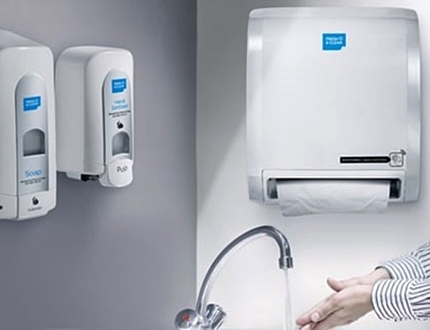
Let’s start with a disclaimer: we are not selling any cleaning wipes or liquids. So, when we say that your computer keyboard is about 20,000 times dirtier than your toilet, we do it only because we want to illustrate how important washing hands really is.
Similarly, your smartphone contains about 9,000 times more microorganisms than your toilet. These data are even more shocking in the offices in which workers don’t work at the same computer.
Knowing all this, you need to clean your keyboard and your monitor with a wet wipe. Also, apply some special liquid made specifically for cleaning computer equipment.
What you can also do is install a hand sanitiser dispenser in your office. It will help you keep your hands clean during busy work hours without having to leave the office.
However, all these actions can only be an addition to your supreme hygienic habit – washing your hands before and after you use your computer and your keyboard. The same principle should be practised by every worker who uses any technical equipment in a public environment.
Washing Hands Before Every Meal
Even if you’re the most pedantic person in the world when it comes to hand hygiene, you can still get infected by other, not so pedantic people. What’s even worse, you don’t have to be in direct physical contact with them at all. It’s enough only to touch “dirty money”. By this, we literally mean money that’s contaminated with bacteria and viruses.
These harmful microbes originate from people who don’t wash hands and places they go to, from their homes to various public venues. When Staphylococcus, Escherichia coli or any other similar microorganism gets into your body, you can have a lot of trouble recovering your own (macro)organism.
This is why your hands need to be washed before every meal. Even if you’re just going to grab a slice of pizza on the street, make sure that your hands are clean before you start your snack.
However, it’s not always possible to wash your hands, especially if you’re eating outdoors. In order to keep your hands in a hygienic condition, have handy wet wipes and sanitise your hands. This routine is even more important in hot summer months, as well as in the high flu season.
These two periods are extremely dangerous for your intestines and your respiratory system, respectively. If you stick with a strict hand-washing policy, you’ll reduce the risk of coming down with annoying diseases.
Hand Hygiene in Nature
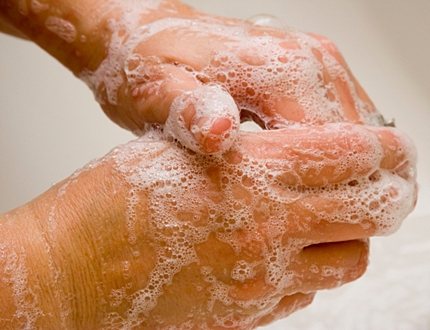
Going for a trip or a vacation in nature shouldn’t make any difference regarding your hand hygiene. On the contrary, you’ll expose your limbs to an even greater number of various bacteria, but this time in uncontrolled, natural surroundings. And if you’re planning to prepare food outdoors, it’s imperative for your health to keep your hands clean.
Also, keep your hands clean on your trip to the country. Let’s say you’ve been driving your car for a few hours and you’d like to stop by to grab a sandwich. Exhausted and hungry, most drivers will forget to wash their hands in such situations.
However, you need to know that cars are often largely populated by bacteria. There’s a two-tier solution to this problem. On the one hand, fight against car germs before you hit the road.
On the other hand, bring a hand sanitiser or a bar of soap and some water with you. That way, you’ll be able to clean and wash your hands whenever you pull over to take a break.
When you finally get to nature, it’s crucial that you wash your hands before you touch your clothes and after you get in physical touch with money. Likewise, touching plants in nature requires the same set of actions.
Beware of Wet Bathroom Towels
It’s much easier to hold on to your hand-washing rules in your domestic environment. However, even if you do everything by the book and wash your hands in every potentially contagious situation, you can still expose yourself to health-threatening germs.
One of the most common sources of such contamination is damp bathroom towels. If your bathroom doesn’t have a window or the bath fan is dead, it will contain a high concentration of damp. Bacteria thrive in wet and damp surroundings.
So, what happens is that you wash your hands and you still end up with some germ-provoked infections.
This is why you should frequently change your bathroom towels and dry them outside the bathroom. Otherwise, the entire effort of regular hand washing will be in vain.
Furthermore, in some offices, people still prefer traditional towels to paper towels for wiping hands. If you work in such an office, make sure that you always have paper tissues stored in your desk. That way, you’ll be able to wipe and dry your hands in a hygienically friendly way every time you wash them.
People who don’t wash their hands regularly behave in a socially irresponsible way. Since it’s difficult to change others, you need to start from yourself. After all, your hands and your arms are among the most active parts of your body. They deserve a great treatment.
If you try and keep them clean throughout the day, they won’t infect you with various transmitted diseases. As a result, you’ll be a healthy and socially responsible person.
Need a hand soap dispenser or hand sanitisers in your workplace? Alsco provides fully-managed hand care systems and supplies for a convenient and cost-effective hygiene solution for your workplace. Get in contact with us today to learn more!
Photo Courtesy of Flickr Images by Arlington County
5 Steps to Make Your Workplace Colds and Flu Free
The flu and colds season is every employer’s nightmare. Sometimes they might not know what is the worse option for their business.
Employees who do not come to work because of seasonal illnesses or employees who come to work ill and then spread viruses to other employees.
Both options lead to lower productivity and efficiency.
Viruses are normal phenomena, especially during the fall and winter months.
You cannot protect your employees completely from them, but there is something you can do.
By following the next steps you will make your workplace environment as healthy and as productive as possible.
1. Never Forget Hygiene
Hands need to be washed using soap and hand sanitisers right before and after eating. Talk to your staff and encourage them to wash their hands as often as possible. You can even put up some posters or get creative about reminding them about regular hand washing in some other way.
Moreover, proper hand drying is also highly important since improper hand drying can lead to spreading bacteria. You should consider having some high-quality cloth or paper towel dispensers or maybe an air towel.
Also, provide tissues and gel sanitisers for all your employees. It is more than helpful to have them around in case of sneezing or coughing, don’t you think? Make sure that there is each of these at every corner of the workplace.
2. Improve Your Workplace Conditions
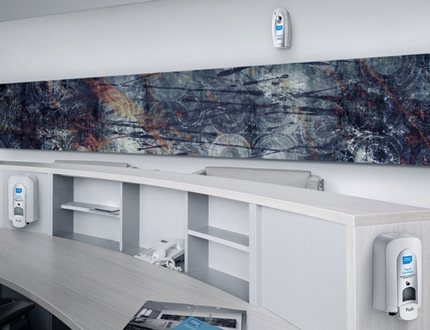
Fresh and clean air is something every workplace needs. Viruses and bacteria are not huge fans of it, but your staff should be. There are plenty of ways to improve the quality of the air.
The simplest ways to do this is getting some green plants in your office and ensuring the ventilation systems are clean. Moreover, cleaning and disinfecting the surfaces in your workplace will prevent the spread of germs enormously.
3. Encourage the Employees to Take Care of Themselves
Eating healthy, sleeping well, doing some exercises and relaxing improve and strengthen your immune system. Learn how to deal with stress and the best way to relax and calm your mind.
Encourage your employees to try with doing some office exercises. Doing any type of exercise would provide your immune system with a boost. After implementing these tips you will see that fighting off viruses has never been easier.
4. Educate Your Employees

It is extremely important that your employees know how to recognise the symptoms of a cold or the flu. Remind them how to protect themselves. The best way to do this is to have reminder posters in your workplace.
Putting up hygiene posters all over the place is not done because you don’t think that your employees are not able to take care of themselves. Busy environment often means that they have a lot on their minds and if not reminded, their attention to hygienic details may slip.
5. Keep Sick Employees Away From the Workplace
Lastly, there are numerous reasons why sick people shouldn’t come to work. Firstly, for purely human reasons – no one who does not feel good enough to work should be at work. Show your employees that it is all right if they need a day or two off in order to feel better.
Secondly, by staying at home, sick employees cannot spread the germs around the workplace and chances of other employees catching a cold or the flu are very low.Health Should Always ComHaving a healthy and clean workspace is crucial. Healthy employees and clients should be your top priority. If you are not sure what is the most efficient way to boost hygienic levels in your workplace, Alsco can help you do that without capital investments.
For instance, if a school is your business environment, this School Washroom Guide contains all you need to know about the New Zealand legal requirements and health and safety standards school washrooms must meet to keep germs at bay.
We provide plenty of useful and essential products and services, including hand sanitisers, different soaps, washroom essentials, as well as first aid supplies.
To get the best both for your workplace and your employees’ health, call Alsco and ask for their excellent services and tailored fees.
Your Workplace Hygiene Level Greatly Depends On Your Restroom Facilities
Cleanliness in the workplace is as important as the devices used to make life in the workplace easier and faster.
It’s a lot better to work in a clean environment because it makes you happier and less prone to sickness, don’t you agree?
We at Alsco have recognized that more and more companies have made major changes to their hygiene levels, most especially their washrooms.
However, toilet paper and bleach are not always enough to accomplish this.
Providing the most practical facility and the perfect design for it, specifically the workplace washroom, is the right thing to do. We have a simple guide that you can use to maximize the hygiene levels at your workplace.
Items You’ll Need in Your Workplace Washroom
- Hand Sanitizers
Hand sanitizers are important to help keep your hands clean at all times. However, they only kill germs that are on the surface of your skin. Some bacteria lie underneath the surface of your skin, making frequent hand washing with clean soap more suitable.
- Hand Dryers
There are three types of hand dryers that you can use: disposable paper towels, electric hand dryers, and cloth roller towels. However, not all of them keep your hands clean after drying them.
You’ll definitely dry your hands faster with an electric hand dryer, but the level of bacteria on your fingertips just increased by 194% and bacteria level on your palm increased by 254%.
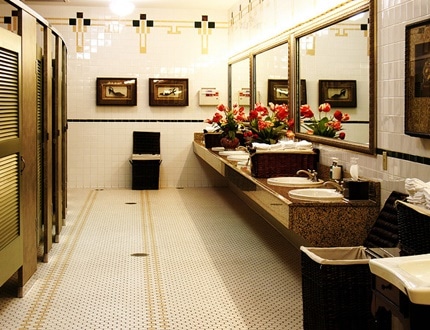
Photo courtesy: Flickr Image by Sarah Poole
Modern jet air dryers can also spread bacteria up to 2 meters away. Not only did you get bacteria all over your clothes and hands, but also on the people behind you.
Using disposable paper towels is a smart move because it reduces bacteria by 76% on finger pads and 77% on palms. Just make sure you throw them in a bin with a cover! We wouldn’t want those germs flying back in the air again, now, would we?
The cloth roller towel is also another good way to clean and dry your hands. Cloth towel dispensers are closed, therefore greatly reducing the spread of bacteria. Research in 2007 found that when cotton roller towels are being used, bacterial level on hands drops by 85%.
- Hand Soap Dispensers
Soap keeps our hands clean, but you may have to think twice about using the old-style bar of soap. These things accumulate dirt and bacteria on the surface. So, you can end up transferring bacteria from the soap to your hands. A more effective way to keep bacteria away from the soap you’re using is to use a hand soap dispenser. You can find them in liquid or foam form, this way you lessen the chances of bacteria spreading on the soap.
Facility Layout and Design
Talking about the design of the workplace washroom includes choosing the type of hand soap dispensers to be used, the actual layout of the washroom, the sinks that you’ll be using, type of toilets to be installed, etc. This means we’re talking about a wide variety of decisions to be made.
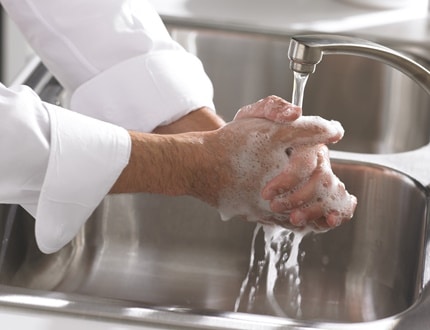
Photo courtesy: Flickr Image by U.S. Department of Agriculture
An example would be – having a hands-free soap dispenser dramatically reduces the risk of germs spreading from the dispenser button. Especially, when compared to using a regular soap dispenser with a button to release the soap.
Another example is, installing an automatic flush on a toilet. This means you won’t have to worry about bacteria getting on your fingertips after flushing.
Sanitation in the washroom is definitely the starting point of a clean working environment. Using swing doors in the washrooms is better in this regard. You would use dividers instead of doors to block the view of the restroom.
We must not forget that cubicle doors must be locked when being used, so using slide latches or push-button locks on cubicle doors is more hygienic instead of twist latches because you don’t have to grip the door lock.
If you manage a school, this is your lucky day because you can avoid the headache by finding all these details and much more in our ultimate School Washroom Guide.
The Upkeep of Facilities
Choosing the right facilities is important, but keeping the loo at the workplace clean is crucial too. After all, maintaining everything in perfect condition will make it more effective. Having a facilities manager is the best way to keep everything in an orderly manner.
Well Kept Workplace Washroom
For all your stock and maintenance management needs, look no further than Alsco. We provide high-quality maintenance services.
You can choose from any of our rental programs such as washroom equipment, supplies, and maintenance services. Your staff can now focus on their jobs instead of worrying about washroom maintenance and hygiene.
For more details, call Alsco now! Our friendly representatives will always be happy to assist you!
Photo Courtesy from: Flickr Image by Aqua Mechanical
Warning: Your Workplace Washroom Is More Important Than You Think
Did you know that 3 out of 4 customers said they would never return to a restaurant with a dirty washroom? This is the result of the survey conducted by Harris Poll in 2010.
Moreover, people, today use smartphone apps to find establishments with clean toilets.
That is just how important clean washrooms are to people.
In the era of social media, you can be sure that people will take photos of your dirty restroom and share them online which can ruin your reputation.
Still, some companies neglect their washrooms due to the lack of time, will or manpower to regularly maintain it.
There is a way for those companies to have properly maintained workplace washrooms because Alsco can manage washrooms for any company.
4 Reasons to Have a Spotless Workplace Washroom
Even if you don’t run a business that involves your clients and customers entering your venue, there are still some good reasons for you to keep the washroom flawlessly clean.
- Fighting off diseases and illnesses
- Keeping your employees satisfied
- Leaving a positive impression on your customers and clients
- Aesthetic reasons
Dirty toilets make a perfect environment for spreading harmful bacteria. The flu virus, E.coli and even hepatitis A lurk at you from an improperly cleaned toilet, especially if your workplace is in a school or any similar place where there are many people around.
Therefore, unclean toilets mean that your business will deal with a lot of sick days.

Image from: Flickr Image by tszchungwing
It is far easier to hire more staff to clean your washroom more regularly. Even better, hire a deep clean service every once in a while and let experts scrub down your washroom professionally.
Your employees will not be satisfied working in an environment that is not sanitary. This influences their morale which translates to poor motivation and even poorer productivity. This is not something that any business can afford.
If your employees do not appreciate your washroom, your potential clients and customers will appreciate it even less. Dirty washroom will make your company seem unprofessional and that will cause you to lose business.
5 Key Factors of a Proper Workplace Washroom
There are several key factors that make all the difference when it comes to a nice and sanitary washroom.
1. Regular Cleaning
You need a regular cleaning service that will make sure your washroom is always in the perfect condition. This means daily service. You need maintenance staff and you need to work out a daily cleaning schedule with them.
It can be a timetable on which each member of the staff marks the job they have done for that day and sign the sheet.
While your toilets need to be perfectly clean, this is not enough. You need to have toilet paper at all times, and you need a disposable toilet seat cover. Of course, you need a proper bin that is entirely sanitary.
2. Additions for the Ladies
Sitting on a toilet seat means that a person is more exposed to germs. The first line of defence should be a toilet seat sanitizer that will kill those germs before they make contact with your skin.
Also, it would be great to equip your washroom with special disposal units. Alsco’s Feminine Hygiene units are sanitary and discrete. They make waste disposal clean and easy.
All the mothers will be happy to find a good nappy disposal unit in your washroom. They meet very high sanitary standards and Alsco replaces the entire unit every time they do their usual maintenance rounds.
3. Fighting Off the Odour
Your washroom can look flawless, but if it smells bad, all your efforts will be in vain. The odours are the result of the uric acid crystals build-up. Even if you have regular maintenance of your toilet, this can still happen.
Your best bet against these odours is wall mounted air sanitisers. They fight off odour even before it happens. Namely, they disperse the chemicals that kill the germs and prevent the uric acid build-up.
After regular cleaning and the amazing effects of the air sanitisers, you can add an extra touch and install a couple of air fresheners. Your washroom will not only be odour free, but it can smell lovely, as well.
4. Hand Hygiene Made Convenient
A good workplace washroom helps keep your employees healthy. In order for that to happen, you need to allow your employees to maintain proper hand hygiene.
A lot of germs are transmitted by dirty hands, so you need excellent soap dispensers beside every faucet. They need to be full at all times and you can never afford for them to be empty.
Drying one’s hands is just as important for their health as washing them. Wet hands are a perfect place for the germs to get stuck and wait for their chance to infect you. You can offer your employees different hand drying options that include air drying, paper towels or even cloth towels.
In order to go that extra mile in protecting your employees, install hand sanitisers at appropriate places so that disinfecting hands can be easy and convenient.
5. Good Workplace Washroom Management
Managing your washroom is a serious task and it takes a lot of time and regular checkups. Being a business owner or a manager, you definitely have more important things to do than to check on the condition of your washroom every now and then.
A smart move is to hire staff that cleans the washroom and to contact Alsco to help you with the equipment needed for its proper functioning.
You don’t have to buy anything – simply rent it. It is cheaper and more convenient.
Make an enquiry about Alsco’s rates right now. For a price that comes down to a couple of coins a day, you can have washroom equipment installed, maintained and restocked on a regular basis.
Alsco employees do that for you – and we do it with a smile.
Photo: Movieshapers
Hand Sanitiser vs. Soap and Water – Which is Preferable?
Washing hands is an effective way to minimise the spread of germs and deadly diseases. In recent times, we are fortunate to have multiple ways to keep our hands clean thanks to the invention of hand sanitisers.
Now, here is a quick question: Is hand sanitiser more effective or superior to washing hands the old fashioned way?
Washing Hands with Soap
Over and again, washing hands with soap and water has been proven to rid bacteria that could cause debilitating disease. Washing with hand soap, however, does not necessarily mean it can kill the bacteria.
When washing with soap, dirt, and germs trapped within the natural oils of the skin are lifted and suspended in water. In order to ensure efficacy, washing hands must be done well.
To effectively wash hands:
- 1-3 ml of soap should be used, with just enough water to make a lather.
- Scrubbing between fingers, fingernails and wrists should be done in no less than 20 seconds.
- Thorough rinsing should be done, and lastly
- Hands should be dried after washing.
Recent research has shown that drying is very important to the effectiveness of hand hygiene. If you do not dry your hands properly after washing, it could turn into a breeding environment for bacteria to spread.
The Facts about Hand Sanitisers
Hand sanitiser use bottled gels as an alternative for old-fashioned handwashing with soap and water.
Do hand sanitisers virtually kill 99% of germs as they claim? Of course, they do. However, not precisely on the hands. The truth is, these products are commonly tested on inanimate surfaces and the claim of its effectiveness is based totally on that. But, if tested on hands, the outcomes will be exceptional.
Hand sanitiser is an excellent alternative when the right facilities are not available. However, it shouldn’t replace washing hands with soap and water because there are more aggressive forms of bacteria available that sanitiser cannot fight.
Additionally, hand sanitisers aren’t as efficient as soap and water in reducing dirt and grease. So if your hands are visibly dirty, it is better to wash with soap and water. If not, you can make use of hand sanitisers.
The main ingredient in hand sanitiser is alcohol. The alcohol kills the bacteria by softening the bacterial membrane, permitting the alcohol to render micro-organism useless.
But this doesn’t mean that you should use any hand sanitiser containing alcohol. Always choose the one with at least 60% alcohol — anything less is regarded as ineffective.
It is also essential to know how to use hand sanitisers properly. Firstly, do not be too conservative with the quantity. Squirt two to three pumps of the product on the surface of your hand, rubbing the entire surface of your hands. Ensure you do not exclude your fingers and underneath your nails; don’t stop until the product dries out.
Hand Hygiene In The Workplace
Having a pleasant and safe working environment is one of the most crucial requirements for any employee. After all, most of us sacrifice almost all of our weekly hours to work at a paid rate.
So long as working conditions are concerned, there are some things that generally tend to irritate some employees, including poor water quality or access to none at all, unfavourable temperatures, offensive odours, messy kitchen environment, and a lack of hygiene.
The workplace is perhaps the most common place to contact diseases. However, the only way to reduce the contamination of diseases is to ensure that the environment is kept clean, and it involves more than simply emptying bins or vacuuming the floor.
Wiping off your keyboard, telephone, and desk is the number one place to start eliminating bacteria. The kitchen region is likewise critical. Having things like liquid soap, clean towels, towel roll dispensers, and bench wiping liquid can also help this region stay clean. Finally, and most significantly, is the washroom area.
Particularly in working environments such as schools, hand sanitisers bring about reducing the spread of infection via dirty hands.
The Ultimate School Washroom Guide shows you how to take proper care of your school washroom and protect the health of all the staff and students.
Keeping hands clean is vital in reducing the spread of diseases because it’s our hands that do most of the work and come in contact with multiple people as well as items around the office. Good quality liquid soap, sanitising systems, and anti-bacterial products must be made available at all times.
So, Which is Better?
In case you are evaluating whether to spend money on hand sanitisers or on hand soap dispensers, there shouldn’t be a debate.
Both are very important in the workplace to help workers stay healthy and happy. Both are effective at protecting you from bacteria and viruses.
If there are specks of dirt or oils on your hands, the best way to clean it is to use hand soaps with water. Hand sanitisers should not replace hand washing with soap but in areas where there is no water available, or instances when you need to immediately disinfect your hands, hand sanitisers come very handy.
These should have a significant place in your office, too — have them strategically positioned in some areas of the workplace e.g doorways, elevators, floors etc. If this is implemented, it will be much easier for them to remember to keep their hands clean.
Need a hand soap dispenser or hand sanitisers in your workplace? Alsco provides fully-managed hand care systems and supplies for a convenient and cost-effective hygiene solution for your workplace.
Enquire now and get the best price quote!
Image Courtesy: Flickr Image by Chiot’s Run


