Trusted by 237K+ Business Worldwide. Find a Location
Trusted by 237,000+businesses worldwide across 250 locations delivering uniforms, linens and more. Find a Location Near You


Delivering Excellence Since 1910
Contact Us
What Every Business Owner Needs to Know About First Aid Compliance
Did you know that you are twice more likely to get hurt doing a job in New Zealand than doing the same one in Australia?
Facts and figures gathered by the WorkSafe New Zealand show that health and safety records in New Zealand are two times worse than those in Australia.
Naturally, New Zealand is doing something about it and a new Health and Safety at Work Act were made in 2015. It is a good and honest attempt to make workplaces safer. In order for it to work, everybody needs to do their part.
One of the many things a business needs to do is to become First Aid compliant. Accidents happen from time to time, whatever you do to prevent them. Still, both prevention and being prepared for them makes all the difference between a safe and unsafe workplace.
Additionally, you risk a big fine for not being First Aid compliant. Therefore, here are some key points that every business needs to know about First Aid.
Three Things to Think About: First Aid Requirement Categories
There are three main factors you need to think about when you are trying to make your business First Aid compliant. Your workplace needs to have:
- First Aid Kits and facilities
- Trained first aiders (not all businesses need this)
- Properly displayed and distributed information about first-aid arrangements for your employees
A number of necessary First Aid kits, facilities, trained first aiders and additional arrangements depend on many factors. Type of your business and number of employees are the most important ones.
The First Step: Assessing Your Workplace
In order to make your workplace safe, you need to conduct a proper assessment. To do that, you need to read and understand the Workplace First Aid Needs Assessment Checklist.
This checklist consists of questions about factors that influence safety at your workplace. This includes:
- Likelihood of getting hurt or ill at your workplace
- Workplace specific hazards
- Number of workers
- Workers with disabilities or special needs
- Shifts, overtime and work hours
- Type of building
- The proximity of emergency services
Your assessment will help you determine the number and position of your Kits, their inventory, as well as the number of trained first aiders.
Number of First Aid Kits and Their Positions
Every workplace and every company vehicle need at least one First Aid Kit. You need one Kit for every 50 employees. Also, if you have a multi-level workplace, every floor needs its own Kit.
Place your First Aid Kits near hazardous areas at your workplace. Also, if you can, place it near a washbasin with hot and cold running water.
Remember that a wall-mounted First Aid Kit needs to be light enough to be carried by a single person. First Aid Kits need to be easily visible and properly marked.
Things You Must Have in a First Aid Kit
Your workplace Kit will be different than the one that you use for your vehicles. Also, when you assemble your Kit, take into account the specifics of your workplace and the hazards that are more likely to occur than others.
First Aid for Workplaces – A Good Practice Guide from 2011 suggests the following minimum of every First Aid Kit at a workplace:
- The First Aid Manual
- Saline solution or wet wipes
- 20 adhesive dressings in different sizes
- 2 eye pads
- 2 triangular bandages
- Safety pins or clasps
- 6 wound dressings, approximately 12 cm x 12 cm
- 2 wound dressings, approximately 18 cm x 18 cm
- 2 pairs of disposable gloves
- One resuscitation mask
Keep in mind that all wipes, pads, bandages and dressings need to be sterile and individually wrapped. In addition, dressings need to be unmedicated. This is just a suggestion and you should add the items according to your Assessment.
If you operate a high-risk business and you have over 100 employees, or if there are no emergency facilities nearby, consider setting up a First Aid Room.
Your Workplace First Aiders: Training and Certificates
Only certified organisations can offer First Aid training that is recognised by the HSWA.
Once obtained, the certificate is valid for two years. After those two years, the first aider should take a refresher course.
However, if the certificate has expired and the certificate holder has not attended the refresher course within 3 months, they need to take the entire course again.
Proper Way of Informing Employees About First Aid Arrangements
Informing your employees about the First Aid arrangements is just as important as having those arrangements. You need to know what to tell them and when to do it.
What to tell:
- Number and location of all First Aid Kits
- Number and location of all First Aiders
- Procedures to follow in case of emergency
- Location of the First Aid Room, if available
When to do it:
- When they first get the job or change jobs within the company
- When something important changes about First Aid
- When they once a year, just to remind them
Shortcut to Your First Aid Compliance
All this is can be quite overwhelming for a business owner. You should read through everything that NSWA recommends, but you should also consult somebody that makes First Aid their business. Alsco is the ace up your sleeve when it comes to First Aid compliance.
You get to rent managed First Aid Kits that are absolutely compliant with current laws. Alsco maintains them, restocks them, takes care of them and checks upon them.
All that – only one fee.
Call 0800 4 ALSCO and enquire about the First Aid rental service.
How Defibrillators Save Lives
Heart disease is the leading cause of death in many countries. Roughly 6.4% of people above the age of 15 suffer from either heart disease or a stroke each year.
This may not seem as bad as you think, although considering that this statistic is above road incidents and cancer diagnosis’, it’s probably worse than you’d think.
The majority of these cases happen within a business workplace. Whether they are an employee, a visitor, or a customer.
The fact is that due to the amount of time that is spent within a workplace, the risk of going into cardiac arrest while at work is significantly higher than anywhere else.
As low as 20% of cardiac arrests happen inside of a medical facility, with the remaining 80% of cases happening at home, a workplace, or out in public.
Is your workplace ready for medical emergencies? Contact Alsco for carefully sourced, hospital-grade and regularly restocked first aid kits and defibrillators.
The “Kerry Packer” Effect
Kerry Packer had fallen victim to another cardiac arrest in 1990 and was lucky enough to have been treated effectively by one of the two ambulances which had a defibrillator available within them.
If we take a look back at that time, we can compare it to the current age and day where there are AEDs placed even in public areas so that if a citizen requires the use of one, life could potentially be saved.
With that in mind, a lot of larger businesses have taken this effect into consideration and have invested in AED units throughout their business as a safety precaution.
Why Time is of the Essence in
– In the event of a heart attack, depending on the level of severity, time is vital.
– If someone who has gone into cardiac arrest hasn’t received help within the first 10 minutes, both CPR and defibrillation will be ineffective and unhelpful.
– With the previous point in mind, response times are estimated at over 10 minutes and in some areas, even longer.
However, the fact that AEDs (otherwise known as Automated External Defibrillators) are becoming an essential part of a business’s medical set up is a huge step in the right direction.
A Serious Example of Why AEDs Should Be in Place
The story that follows shows just how critical an AED unit is to save lives, especially in the workplace.
During December of 2011, the HR Advisor (and fortunately the Head Office First Aid Office) of a large business attended a Christmas lunch at one of the company’s branches, along with their National Sales Manager and their Regional General Manager. During the lunch, the HR Advisor had spotted that one of her colleagues seemed to be in distress and therefore went on to approach the colleague to provide the assistance that was necessary.
After questioning the colleague, she discovered that she had not only shortness of breath, but had been feeling pains in her arm along with feeling pressure on her chest, on her neck, and on her face. On top of that, the HR Advisor had found out that her colleague had been prescribed heart medication in the past due to heart problems, but had stopped taking the medication over 6 months prior to that day.
The HR Advisor asked another of her colleagues to instantly call Triple-O and get the AED that was in the workplace. In the meantime, she helped the colleague in distress get herself into a more comfortable position that was closer to the ground.
Fortunately, once Triple-O was contacted they arrived within minutes and were impressed due to the first aid assistance that had been offered by the HR Advisor.
Unfortunately, after the colleague had been taken to the hospital and had undergone bypass surgery, she was unable to return to her workplace due to her ongoing health issues.
Access to AEDs
Ensure that your workplace has access to high quality and fully-managed Automated External Defibrillators (AED) at all times. You wouldn’t know when you would need one to save lives. Time is very important. Enquire about our high quality, easy-to-use, and reliable portable defibrillators now!
Keeping Your Workers’ Safe: Be First Aid Ready with Alsco
Is your workplace capable of giving immediate care during emergency cases?
First aid readiness is required to enhance the safety of your employees. After all, a quick response can mean the difference between life and death.
A workplace first aid kit also ensures that legal guidelines for health and safety in employment are met.
Not having the appropriate first aid kits available could put you at risk to WHS penalties of up to $1,000,000.
If you want a fully managed, hassle-free safety solution for your first aid needs, contact Alsco now.
Why is a Workplace first-aid Aid Kit Important?
First aid can save lives in a number of situations. For instance, immediate CPR treatment can increase the chances of survival for heart attack. It can provide immediate and effective first aid to injured workers to help speed up recovery.
Health and Safety in Employment Regulations 1995 states that employers are required to take all steps to ensure:
- First aid facilities are provided at every workplace
- Facilities are suitable for the purpose for which they are used
- Facilities are provided in sufficient numbers
- Facilities are maintained in good order and condition
- All employees have access to these facilities
There are about 100 work-related fatal injuries in New Zealand every year. First aid readiness can protect your business so that injured individuals may be able to return to work quicker, with lesser treatment costs.
Why Choose Alsco for First Aid Readiness?
Most employers find first aid kit compliance confusing and tedious. Hazards need to be identified so that adequate supplies can be maintained. Why not leave it to the experts? Choose a provider that offers a managed first aid service.
1. Managed first aid kit
Alsco’s service keeps your business safe and compliant all year round. Your kits will be stocked with carefully chosen, hospital-grade supplies every quarter. No matter your business, Alsco tailors their services to meet your unique needs.
With Alsco’s managed first aid service, you just have to pay a single annual fee. A dedicated team will be in charge of installation, restocking, budgeting, and legal compliance. We actually take care of everything!
2. Hospital-grade contents
Hospital-grade supplies can provide superior performance. That’s why Alsco includes only the highest-quality, long-lasting first aid supplies as part of our service. We also follow the quantities prescribed by the ANSI and WHS standards.
For a single annual fee, Alsco limitlessly restocks your first aid kit at no additional cost. The contents are stored in a sturdy, highly-visible cabinet that can be installed in strategic locations in your workplace.
3. Use-defined organisation
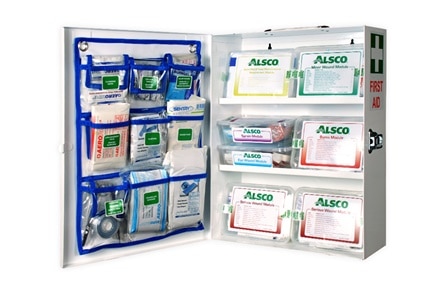
To deliver effective first aid, contents need to be organised and clearly labelled. With Alsco, supplies are grouped into injury-specific, colour coded modules. For example, a ‘burns’ module, eye module, and serious injury module.
Each module is individually shrink-wrapped, which acts as a safety seal. This way, injuries are treated with the right kit as quickly as possible. The expiry date is also written in large, easy to read font.
4. Fast and reliable service
Each Alsco first aid kit is replaced and restocked every 3 months and designed to be serviced in under 5-minutes. A service agent is tasked to check and maintain eight items, which includes seven modules and a door liner.
The goal is to keep the disruption caused at the customer site to a minimum. A brand new liner is installed and modules are replenished at each service. This will help keep your workplace safe and legally-compliant 24/7 all year round.
Alsco’s First Aid Rental Service
Alsco offers a convenient and affordable solution to first aid compliance. Clients can avoid spending too much on the required supplies, cabinets, and refills. Not to mention appointing someone to maintain it.
You no longer have to worry about penalties or legal costs with Alsco’s rental program. You’ll have peace of mind knowing that your first aid kits are auditable to WHS guidelines. A flat fee already includes all services and consumables.
No matter how big or small your workplace is, Alsco can help you find the right first aid kit to meet your needs. Alsco also offers portable defibrillators, eyewash stations, and vehicle first aid kits.
Be first aid ready! Get in touch with us for a fully managed, hassle-free, safety solution.
Photo: Stevepb
Alsco’s Quick Tips On How To Make The Workplace First Aid Ready
Summary: Is your workplace capable of giving immediate care during emergency cases?
Workplace first aid readiness can mean the difference between life and death. A quick response can reduce the severity of the injury.
It is a legal requirement for employers to provide first aid facilities in the workplace, as stated in the Health and Safety in Employment Regulations 1995. However, the process to first aid readiness may be a bit complex.
If you want a fully managed, hassle-free, safety solution, contact Alsco now.
Why is Workplace First Aid Important?
According to the Workplace Health and Safety Strategy for New Zealand to 2015, there are about 100 work-related fatal injuries in New Zealand every year. More so, approximately 17,000 to 20,000 new cases of work-related diseases are reported annually. Over 200,000 occupational injuries result in ACC claims.
First aid in the workplace covers the arrangements for employers to ensure that employees receive immediate attention in times of illness or injury. It also includes calling an ambulance in serious cases.
First aid can save lives in a number of situations. For instance, immediate CPR treatment can increase the chances of survival for heart attack.
First aid readiness can also protect your business. Providing immediate and effective first aid to injured workers may help speed up recovery. They may be able to return to work quicker, with lesser treatment costs.
What Does the Law Say About Workplace First?
Health and Safety in Employment Regulations 1995 was created to secure the health and safety of workers and workplaces by eliminating or minimising risks, promoting the provision of information and training, and providing the right facilities.
Employers are required to take all steps to ensure:
- First aid facilities are provided at every workplace
- Facilities are suitable for the purpose for which they are used
- Facilities are provided in sufficient numbers
- Facilities are maintained in good order and condition
- All employees have access to these facilities
How to Do a First Aid Needs Assessment?
To identify your first aid needs, a workplace assessment should be completed. Some circumstances can affect your first aid necessities.
Low-risk workplaces only need minimum arrangements, such as a stocked first-aid box. For workplaces with greater health and safety risks, they are more likely to need a first-aider.
Ask yourself the following questions:
What are the hazards present?
It can be physical, environmental, chemical, or biological. For example, working at heights provide greater risks for fall. Or, working under an open heat of the sun can result in sunburns. Work processes like cleaning machinery also create hazards.
How many employees are in the workplace?
The number of workers will affect the facilities you need, including the volume of supplies. It will also determine the number of first aiders you need. Make sure that the first aid provisions cover all hours when employees are working.
What is the layout of my workplace?
The size and layout of the workplace matter. First aid should be readily accessible to all employees upon minutes of emergency situations. You need to consider how long it will take for a first aider to reach the injured or ill person.
How can location affect my first aid needs?
Employers should also take into account the proximity of the workplace to medical centres, hospitals or ambulance service. For those situated in remote areas, find out how long it takes for emergency services to reach the workplace.
How many first aiders do I need?
The hazards in your workplace, the nature of work, the number of your employees, and location will determine the number of first aiders you’ll need. For instance, an IT company close to a medical centre, with three employees, may no longer need one.
The Core Elements of First Aid Readiness
First aid readiness offers obvious benefits for both your employees and your business. It can also help you with reduced claims costs associated with workplace injuries. Here are its three core elements:
1. Resources and equipment
A fully-stocked first aid kit, with clear first aid signage, should be found in each place where people are working, including work vehicles. Supplies should be enclosed in a sturdy material to protect contents from contamination.
For high-risk workplaces, such as those located in remote areas, first aid rooms may be necessary. First aid kits must be checked regularly. Items should be replenished after use, and replaced before the expiry date shown on the packaging. Nothing other than first aid equipment or related equipment should be in the kits.
2. Accredited first aiders
A first aider should be available during work hours and provided on all shifts. Low-risk workplaces are required one first aider for every 50 workers. High-risk workplaces need one first aider for every 25 workers.
First aiders are required to undertake annual refresher courses in CPR and renew their qualifications every two years. Training should be carried out by people who work for an organisation accredited by the New Zealand Qualifications Authority.
3. Procedures and drills training
All employees must be given clear information about first aid available in the workplace. They should know the location of first aid kits and first aid rooms. Communication channels should be clear in case of an emergency.
Employees need to be introduced to first aiders so that they know their names and where to find them. For high-risk workplaces, employees need to be trained in basic first aid procedures, and what to follow when needed.
Alsco Managed First Aid Kit Solutions
Give your workers an extra dose of confidence by letting them know that their safety and wellbeing is taken care of. Alsco offers best-practice solutions for your business to get you first aid ready and compliant.
Alsco’s serviced first aid kits have the following advantages:
- Their dedicated team does all the checking
- They make first aid kits sturdy, well mounted, and portable.
- Supplies are hospital-grade and auditable to WHS guidelines.
- They offer a scheduled maintenance program.
- Fees are inclusive of consumables with value for money.
Choose Alsco for a fully managed, hassle-free, safety solution. They also offer portable defibrillators, eyewash stations, and vehicle first aid kits.
Be first aid ready! Visit www.alsco.co.nz to discover the services Alsco can provide. Fill out our enquiry form and we will contact you shortly.
Photo Courtesy: Reytan
Does Your Business Meet New Zealand OH&S Guidelines?
To meet the requirements of the Health and Safety in Employment Act (1992):
1.3 – “All practicable steps” should be taken by employers (and others) to provide properly maintained first aid equipment
9.0 – First aid equipment is suitably marked and easily accessible
9.1 – Marking used should be a white cross on a green background
9.2 – There is at least one kit on each floor of a multi-level workplace
9.2 – An additional kit should be provided where there are more than 50 employees and every 50 employees thereafter
9.3 – It is essential that first aid equipment be checked regularly
9.3 – Items are to be replaced before the expiry date on the packets
9.2 – Each work vehicle should be provided with a first aid kit
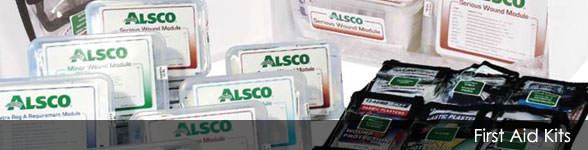
Why Buy When You Can Rent Your First Aid Kit?
Alsco’s Managed Rental Program for First Aid Kits gives you and your employees instant peace of mind. We follow through and check your kits on a regular basis for out of date items, and replenish when necessary. There are no additional charges. You can have total peace of mind.
8 reasons to use Alsco’s Managed Rental Program
| Rent | Buy | |
|---|---|---|
| Re-stocked regularly | Always | Sometimes |
| OH&S Compliant | Always | Sometimes |
| Full range of kits | Available | Available |
| Hospital-grade supplies | Always | Sometimes |
| Up-to-date Service Logs | Always | Sometimes |
| Value for money | Always | Sometimes |
| One fee for everything | Yes | Never |
| Injury Specific supplies | Yes | Sometimes |
Sometimes’ isn’t good enough. In 2014, there were 226,100 claims of work-related injuries* in New Zealand. This is an injury occurring every 9.4 hours worked. With Alsco’s Managed Rental Program for First Aid Kits, you can be sure that you’ll have the first aid supplies you need, specific to injuries, on hand every time.
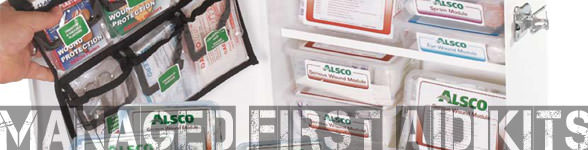
An Alsco Managed Service has many advantages:
- Agreed maintenance schedule by our friendly, professional team with a proven service record
- High quality “hospital grade” first aid supplies that are never out of date
- Peace of mind knowing that all your first aid kits are auditable to OH&S guidelines
- Sturdy, highly visible, wall-mounted cabinets for immediate identification and ease of access
- Proven method of documenting usage and “outages”
- Service record on the kit that is easily visible for auditing purposes
- Value for money and easy budgeting with a set fee inclusive of consumables
What makes Alsco’s First Aid kits better than the rest?
- Each item in Alsco’s first aid kits are colour coded for specific injuries, ensuring you select the correct first aid kit for your required situation.
- A removable door liner is exchanged each service.
- Well labelled, transparent packaging allows you to find the right supplies when you’re in a hurry.
- A service card in each cabinet is used to log service dates.
- Each kit has a logical, standard layout that makes it simple and easy to use.
Managed First Aid Systems
Workplace injuries happen to 600 people and kill one New Zealander each week. Apart from the human toll, the effect on a small or medium-sized enterprise can be terminal.
According to Gavin Smith, the designer of a tailor-made managed first aid system, although the New Zealand workplace is getting safer, what is required for businesses to comply with Occupational Safety and Health (OSH) is getting tighter and more robust.
Managed first aid systems
 Gavin, New Zealand manager at Fresh and Clean, part of ALSCO, specialists in managed first aid systems, says an increasing number of Australasian businesses are now opting for this type of system, where they contract their first aid kit management to an all in one rental service because the DIY approach doesn’t meet the stringent OSH or Australian state requirements.
He explains: ‘Most businesses will have a first aid box somewhere and usually they are completely disorganised and dysfunctional. I visited a South Island engineering firm a month ago. They were prepared for a paper cut at best. If a major cut or injury occurred they wouldn’t have been able to deal with it.’
OSH Guidelines for businesses
Gavin has summarised the five pages of OSH Guidelines for businesses to meet the requirements of the Health and Safety in Employment Act (1992) into eight points:
- ‘All practicable steps’ should be taken by employers (and others) to provide properly maintained first aid equipment.
- First aid equipment is suitably marked and easily available.
- Marking used should be a green cross on a white background.
- There is at least one kit on each floor of a multi-level workplace.
- An additional kit should be provided where there are more than 50 employees and every 50 employees thereafter.
- It is essential for first aid equipment to be checked regularly.
- Items are to be replaced before the expiry date on the packets.
- Each work vehicle should be provided with a first aid kit.
He explains: ‘Most people fall over at the first step. Many businesses will have bought a kit five years ago and forgotten all about it. Secondly, they will most likely have put it somewhere and in an emergency, no one can find it. Thirdly, you’d be amazed at how many still have a red cross on them. When we do a first aid kit audit we find that most kits have not been checked recently. The rules have changed too; everything has now to be single-use. You can’t just have a bottle of eyewash for example. They have to be single, sealed, sterile packs.’
Managed first aid system – An American example
Gavin developed a managed first aid system after being told about an American version by ALSCO chief, Tony Colenso. ‘Our CEO had seen the concept of a managed first aid system in the US. Broadly spoken we are a health, safety and image company and it seemed to us that this would be a natural evolution for our overall service. I looked at how we could develop a scheme for our existing customer base and we started with a pilot service in Wellington in 2002.’
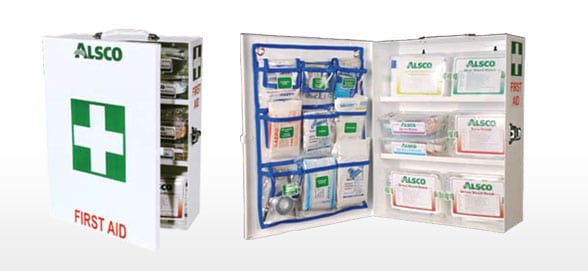
Several other suppliers will sell businesses a first aid kit but checking the contents and replacing used items is either too expensive or left to the client to manage by ordering supplies online.
Gavin explains: ‘A lot of businesses don’t realise how much they spend managing their kits and the people to manage them. It’s a false economy. They don’t know if their kit is being serviced to the correct standards if it has been allocated to a staff member or what their auditing ability internally is. But many businesses now prefer to have it done for them and know that they are meeting all the OSH requirements. A rental programme for around a dollar a day per kit removes the need to check the kit yourself and the servicing of our kits takes less than two minutes for one of our trained operatives.’
Checked and restocked
Gavin designed the ALSCO kit with an exchangeable liner with clear plastic pockets for day to day use. The contents are checked routinely and restocked. The entire liner is replaced every three months whether used or not. The contents are reprocessed offsite and ALSCO has established a network of organisations such as the SPCA, zoos, animal shelters and Rotary, for offshore disaster relief, to take the expired products.
There are also six modules in each kit for accidents and specific injuries, covering all the items for a reasonably sized incident allowing someone to grab and run to the accident site with everything they may need.
Gavin points out: ‘We developed the kits in New Zealand with our own liner and modules. There is no prescriptive use in NZ but Australia has adapted the kit to suit the separate state compliance requirements. If the modules are opened or missing or the expiry date is exceeded we replace them and if a specific module is used we will enquire and check that it has been logged in the accident book, which is part of the OSH requirement. Very often we are the first to point out to the client that the accident book needs updating. Inside the door of each kit is a sheet which is signed at each service as well as an online record.’
There are now more than 4,000 kits in use in New Zealand and the service has been operating in Australia for three years with around the same number signed up there. New Zealand clients include a wide range of organisations such as the Ministry of Health, Hollywood Bakeries, Department of Corrections, Ministry of Fisheries, Auckland City Council, a number of other district councils and libraries, the Olympic pool at Newmarket and Parliament House.
Four versions of kit available
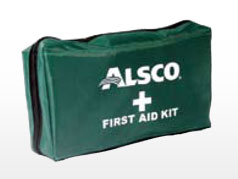
In New Zealand, there are four versions of kit available; large for up to 50 employees; small for up to 15 employees, plus a food version of each (with blue plasters which are visible and metal detectable). There are supplementary kits for smaller offsite, vehicles, executive workplaces. The company also offers additional equipment such as defibrillators and eyewash stations
Gavin explains that even a small business never knows quite what it might need in the event of an accident. Last August an Mt Eden physio who had just taken delivery of an ALSCO defibrillator used the unit to save the life a man who had been electrocuted while erecting flagpoles on Normanby Ave outside the gym where the physio worked.
Gavin says: ‘He was at the man’s side within three minutes and without the defibrillator, the man could have died. He had only just rented the defibrillator from us and had just been trained in its use the month before.’
Free no-obligation compliance audits
In early 2012 ALSCO is to start offering free no-obligation compliance audits to small and medium-sized enterprises to see if they are compliant with OSH first aid requirements.
Gavin adds: ‘We have grown this Kiwi developed service so that we are the only true national provider. We have started to pick up national organisations as well as smaller owner-managed businesses because of the need to standardise systems. We do offer peace of mind but at the end of the day it’s about doing what’s right.’


