Trusted by 238K+ Business Worldwide. Find a Location
Trusted by 238,000+ businesses worldwide across 250 locations delivering uniforms, linens and more. Find a Location Near You


Delivering Excellence Since 1910
Contact Us
When Should You NOT Use an AED?
In most cases, you should use an AED in case of a cardiac arrest. However, there are instances when the AED should not be used
- If the victim is in water or is wet for any reason.
- If the victim is surrounded by the combustible material.
- If the victim is less than 12 months old.
These are the situations when you should not use the defibrillator. In addition to these, there are situations when you should use your AED with caution:
- If the person has a pacemaker
- If the victim has a medication patch
- It the victim is a child under 8 years of age or weighs less than 25 kg
In all other situations in which you are dealing with a person who is unconscious and unresponsive, you should perform CPR and use the AED. Whether the AED will or will not administer the shock is not up to you. The device itself will analyse the pulse and make that call for you.
For this to happen, you need to have a functional AED ready and easily accessible in your workplace. Get it today from Alsco New Zealand for a monthly fee.
When Should AED Be Used?
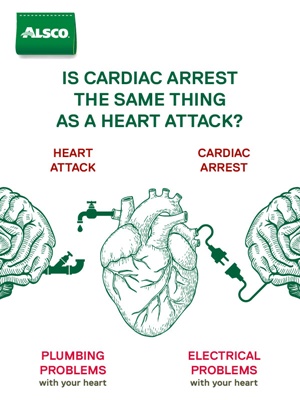 AED should be used in case of a cardiac arrest. The symptoms of a cardiac arrest usually include an sudden collapse with irregular or no pulse or heartbeat. The victim is unresponsive, so they don’t react to your calls, shakes and touches.
However, cardiac arrest and heart attack are very similar in their symptoms. While AED can help with the cardiac arrest, it is not effective in the case of a heart attack.
If the person is suffering a heart attack, the only thing that can help them survive until the ambulance arrives is CPR. The AED shock will do no harm, but it will do no good either.
So, how do you know if the person is having a heart attack or a cardiac arrest? You don’t. There is no time for you to make these conclusions and diagnose the condition. If you determine that there is no pulse or the heartbeat is irregular, don’t hesitate and start with the CPR and AED immediately.
While AED won’t help with the heat attack, it will not do any harm either, so it is best to cover your bases, just in case. AED simply won’t administer a shock if the heart rate is not “shockable”.
Should AED Be Used Before or After CPR?
You need to start CPR the moment you see that a person has collapsed and doesn’t have a pulse. CPR is used to continue the blood flow that has stopped due to the heart failure. If the blood stops, brain doesn’t get its oxygen and can die. CPR should be done immediately while the AED is set up.
Shout for help if there is anybody nearby who can hear you. Tell them to call 111 and ask for the ambulance. Grab the nearest AED and start performing the CPR while the other person sets up the AED so you can use it, preferably within a minute.
How Long Should You Perform CPR after a Successful Shock from the Defibrillator?
Generally, the AED should be performed as soon as possible, but some researches showed even a minute-long CPR before the AED shock helped the outcome of these first aid efforts. Setting up your AED will last at least a minute and there is no reason why that time should not be used for CPR.
In that way, you have prevented the complete halt of the blood flow, which is essential for the preservation of all important organs and tissues and you have administered the shock within the first two minutes from the moment of the accident, trying to restore the electrical function of the heart.
When Should You Stop CPR?
If you are in a safe situation when performing a CPR there are only a handful of reasons why you should stop CPR:
- There is an obvious sign that the person is better. They are breathing and/or are responsive.
- A trained medical professional has arrived to the scene and is taking over.
- You have done 40 pushes and you are quickly checking for the pulse.
In other words, unless the person is well, don’t stop with the CPR until ambulance has arrived and somebody is taking over the CPR from you.
What Are the Chances of Survival When Using AED?
This depends on the time that has passed from the moment you the cardiac arrest happened and the moment you have started the defibrillation.
According to the USA researches and findings, if you shock somebody’s heart with an AED within a minute of their cardiac arrest, their chances of survival are 90%. With every minute passing, those chances drop from 7% to 10%. The Australian resources claim that the success rate within the first minute is 70%.
There have been initiatives around the world for the portable defibrillators to be placed in the public places. This also happens in New Zealand. Due to the importance of the quick response and the timely use of the AED, it is logical that people want to have it nearby at all times.
The majority of cardiac arrests that turn out fatal happen in home. This is because there are no AEDs in most households and while the ambulance arrives, it is usually too late to help.
Some of the cardiac arrests will happen in the workplace. Those who already have heart issues are in greater risk of suffering a cardiac arrest than those who don’t. You can never be 100% sure that all your employees are aware of the state of their heart.
Therefore, you need to do whatever is in your power to make your workplace as safe as possible for everybody. This includes acquiring portable AEDs and installing them, so that they are always within a reach.
There is no need to buy so many AEDs. You can rent them from Alsco New Zealand for a reasonable monthly fee. Call Alsco NZ today and get your workplace AEDs.
What Does AED Do to a Heart?
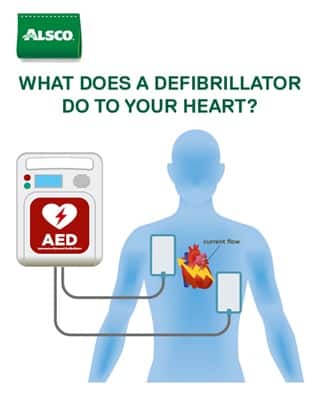
AED releases electrical shock to the heart. In that way, it restarts the heart. It is important to know that an AED will not revive a heart that doesn’t have any electrical activity left in it.
It will simply try to establish regular heart activity in cases when it is disrupted and dangerous.
The TV series that show a patient that is flat-lining being rushed into a hospital and doctors reviving them with electrical shock are wrong.
It doesn’t happen that way. Once stopped, a heart should be supported by the CPR compressions until medical professionals can take over.
They do everything in their power to restart the heart, usually by medications and quick attempt to remove the underlying cause of heart failure.
However, it is essential that the First Aid is administered ASAP in case that a person is unconscious and unresponsive. CPR should be started immediately, with the AED to follow. Also, the ambulance should be phoned instantly.
 For this to happen, your workplace needs to have AEDs at hand. Their location should be known and they should be positioned so that they can be reached within a minute from every place in your company. Every minute counts in the case of emergency.
Rent portable AEDs for a monthly fee from Alsco New Zealand and never worry about them again. They will be regularly maintained and checked, and we will even install them ourselves.
Do You Use AED on Heart Attack?
AED will not help in the case of a heart attack, but you should still use it if you see an unconscious person who is not responsive. AED is used in a case of a cardiac arrest, but you cannot be sure if you are facing a cardiac arrest or a heart attack just by looking at a person.
It would take you several minutes to establish what really happened, and by then it can be too late to do anything about it. While AED will probably not help with the heart attack, it will not do any more harm either. That is why you should perform CPR and use AED just in case.
What Is a Heart Attack?
A heart attack or a myocardial infarction is when one or more of the arteries that supply the blood to the heart are blocked for some reason. So, the heart would function properly, but the blood supply is cut off. Since it is rare for the arterial blockage to happen instantly, a heart attack can happen anywhere from a matter of minutes to a matter of hours.
The symptoms of a heart attack are:
- Chest pain
- Dizziness and/or fainting
- Cold sweating
- Grasping for breath
However, the heart of the patient will most probably still be beating and they will have a pulse, although the pulse and the heartbeat may be irregular and abnormal.
During the heart attack, the electrical function of the heart is not in jeopardy. It is most probably still preserved and that is why the heart is pumping. However, in the later stages of the heart attack, this may stop being the case.
What Are the Symptoms of a Cardiac Arrest?
Cardiac arrest happens when there is a disturbance in the electrical impulses through the heart. They are what makes the heart contract and, therefore, pump the blood, supplying it to the rest of the body. When these impulses are irregular, a patient is experiencing irregular heartbeats or arrhythmia.
When the arrhythmia is so severe that it prevents the heart from pumping the blood entirely, the person suffers the cardiac arrest. The symptoms of a cardiac arrest are:
- Shortness of breath
- Palpitations
- Lightheadedness
- Fainting and collapsing
The cardiac arrest itself happens suddenly. It strikes in a matter of minutes. However, there can be some warning signs that it is about to happen. These include:
- Weakness
- Vomiting
- Shortness of breath
- Blackouts
- Dizziness and fatigue
Cardiac arrest is fatal within 5 minutes if the person doesn’t get the CPR and the AED shock. Therefore, treat every suspicious state that involved unconsciousness and non-responsiveness as a cardiac arrest.
How to Use an AED?
AED should be used as an addition to the CPR. This means that you have already started the CPR and called for help. The CPR and the AED should be continued until the ambulance arrives to take over. When performing the CPR, your pushes are the only thing that keeps the blood flowing and the person alive.
Here are the steps you need to take when using the AED:
- If necessary, connect the pads to the AED device if they are not plugged in.
- Remove the shirt of the patient.
- Remove all wetness, water or sweat from the person’s chest. They need to be dry.
- Place the pads on the person’s chest, making sure they are not over a pacemaker or a medical patch.
- Make sure nobody is touching the patient.
- Start the AED device.
- When the shock is administered and the device reports it is safe to touch the patient, continue the CPR
- Don’t stop the CPR even if the AED reports that it is not needed to shock the patient.
If you truly want what is best for your staff, you will have at least somebody who knows how to do CPR and perform First Aid. However, as you can see, there are instances when CPR is not enough. That is why you need to have one or more AEDs so that they are easily accessible from every corner of your workplace.
Purchasing them would be a significant setback, but renting your AEDs for a monthly fee can be the perfect answer for your company.
It means you can have them in a matter of days and you don’t have to invest too much in them. If you decide to close the company, move it or resize it, you can simply return the AED or rent more or less of them.
Rent your AEDs from Alsco New Zealand and make your workplace safe.
Can an AED Start a Stopped Heart?
The short answer is no – an AED cannot start a stopped heart. What a defibrillator does is actually restart of the heart. For that to happen the heart needs to have any sort of electric activity, meaning – it needs to have some contractions.
AED is used when the heart doesn’t work regularly. It can be pumping too hard or too slow and it will most likely be pumping without the rhythm. The rhythm is essential for survival and that is why it is so important that the heart rate is restored.
However, an AED is still essential as the means of First Aid when a person is experiencing a heart attack. In combination with CPR it is what keeps the person alive until the Ambulance arrives. They are then transferred to a hospital where they will get the help they need.
That is the reason why an AED should be in every workplace in New Zealand. The time window in which the reaction can help the patient is very limited, so an AED needs to be close at hand. Contact Alsco NZ to rent enough defibrillators to keep your workplace safe.
What Does a Defibrillator Do to Your Heart?
The defibrillator releases a shock that will disrupt the electrical activity of the heart that causes it to contract for a split of a second. Hopefully, the heart will continue working properly after that, because AED shock works like a restart button.
The state of irregular heartbeat is called arrhythmia. The types of arrhythmias that can be fixed with the AED shocks are ventricular fibrillation and the ventricular tachycardia.
Ventricular fibrillation is the state in which the ventricles (lower chambers of the heart) don’t contract like they should in order to pump blood, but rather quiver too quickly. These mild and irregular movements are not enough to push the blood out, so the blood flow stops. VF can be caused by a damage of the heart muscle, some severe infections, issues with aorta and many more.
Ventricular tachycardia is when the ventricles of your heart have more than 100 beats in a minute and are in discordance with the upper chambers of the heart. Even though this means that the heart beats faster, the irregularity doesn’t allow for the chambers to fill with blood enough before the pumping out. In other words, there is not enough blood being pumped from the heart to sustain a person.
The rhythm of the heart is caused by electrical impulses. So, when these impulses are not sent properly, AED restarts them by disrupting them in hope that the heart will assume the normal impulse rate.
Why Is Asystole Not Shockable?
Asystole means that a person doesn’t have a heart rhythm at all. The heart has stopped. There are several systems in the heart that produce the electric charge that keeps the heart contracting and pumping. When that system is disrupted, you can restart it, but when the system is entirely broken that is another story.
Asystole means no electric activity, so there is no activity to disrupt or jumpstart. That is why the asystole is a very dangerous condition that cannot be helped by an AED.

What helps with the asystole is the CPR. At least, this is what helps to keep the blood pumping and preserve the body from shutting down completely before the real help is administered. The real help that has the chance of restoring the systolic activity of the heart are the medications.
Epinephrine is the most commonly used medication in this situation. In case of severe emergency, it is given to the patient every 3-5 minutes, while performing the CPR.
Can CPR Restart a Stopped Heart?
CPR alone is unlikely to restart a stopped heart but it can help delay the dying off of the tissue until the medical professionals arrive and try to revive the person.
Brain damage and brain death happen when the air supply is cut off for more than 3-4 minutes. When the heart stops, there is no way for the oxygen to be distributed throughout the body. However, there is still some of the air left in the body when the heart stops, and CPR helps it keep moving through the body.
In combination with mouth-to-mouth, this First Aid method can even help more oxygen reach the blood and delay the fatal outcome even longer.
What Are the Steps of CPR?
CPR is conducted in several steps:
- Place the heel of one hand on the lower half of the person’s breastbone. Locate the lower part of a person’s breastbone. Press it with the base of one hand and put your other hand over, grasping your wrist or interlocking your fingers.
- Press down the chest, trying to reach one third of the total chest depth.
- Keep pressing in the rate of 30 compressions to two breaths of mouth-to-mouth or 100 compressions without mouth-to-mouth.

Click the image to download the poster
CPR stands for Cardiopulmonary Resuscitation. It should be started as soon you see that a person is unconscious and unresponsive.
First, check if the person’s airways are blocked and if they are – remove the obstacles. Check if the person is breathing at all. If the breathing is normal, roll them on their side, if it isn’t or the breathing is irregular, start the CPR compressions.
If there is anybody else there to help you, rotate when doing the CPR, because it is tiring and it is easy to lose the rhythm.
CPR is your best chance for the asystole. However, AED is the best option for the VF and V-Tach. Since the symptoms of both of these things are similar, you have no time or the means to determine whether a person suffers from one or the other.
That is why your best bet is to start CPR immediately and then add AED to your efforts. AED will not release shocks if they are not needed, so you don’t have to worry about doing more harm than good with it.
Contact Alsco New Zealand today and rent portable AEDs for your workplace. Inform your workforce about their location and how they are used and boost the safety levels in your company.
Photo courtesy of stryker
Who Can Use an AED?
Anybody who can follow simple instructions can use an AED. A person does NOT have to be qualified or trained in order to conduct defibrillation in case of sudden cardiac arrest. Of course, it is best if the person has at least minimal training in CPR or AED.
The best results are achieved with the combination of CPR and AED. CPR helps with the heart failure issues that cause the electric activities of the heart to stop entirely. In simple words, when the heart stops pumping.
It is important to start CPR immediately so that the pressure on the heart helps pump put the blood and mimic the normal heart function.
AED usually helps with the situations in which the heart has an abnormal function. This means irregular heartbeat or arrhythmia. When this occurs, especially when there are irregularities with the function of the lower chambers of the heart, such as ventricular fibrillation or ventricular tachycardia.
In this case, the heart starts beating in an irregular rhythm, too fast or too slow and it leads to the loss of blood pressure and unconsciousness. It can be fatal.
That is why each workplace needs to have at least one AED so that the first aid in the case of a cardiac arrest can be administered in the first 3 minutes. After that, the chances for survival are reduced drastically. Get your AED from Alsco New Zealand and avoid big upfront investments.
What Are the AED Laws?
So far, New Zealand laws do not require mandatory AED in the workplace. However, the law should not be your main reason for acquiring AEDs for your staff. The chances of survival when there is a defibrillator used increase up to 80% than when only CPR is involved.
That should be a reason enough to have one or more defibrillators in your workplace ready and clearly marked, so that anybody can see them.
From the moment a cardiac arrest occurs, to the moment when it is too late to offer assistance before brain damage occurs, there is only a 3-minute window. During that time window, somebody needs to react, start the CPR immediately and use the AED right away.
This is less likely to happen if people in a workplace don’t know where the AED is located or it is too far away, or if they are reluctant to use it because they think they don’t know how to use it.
The truth is, modern defibrillators, especially the ones that Alsco offers, can be used by anyone. They do all of the work themselves, including the analysis if the electric shock should or should not be administered and when.
The proper workplace signs that show where the AED is should be put everywhere because, in the state of shock and fear when something like a cardiac arrest happens, people get flustered and they don’t think clearly. That is why the signs need to be put on prominent places to remind them in the moment of crisis what needs to be done.
How Do You Use a Defibrillator?
The defibrillator is used when you see that a person is unconscious, has irregular heartbeat and isn’t breathing normally. In that case, you should call for help or, ideally, ask somebody else to call the ambulance. Quickly grab the AED or send somebody to grab it while you perform the CPR.

Click the image to download the poster
Once you have the AED by your side, go through the following steps:
- Connect the AED pads to the device if necessary.
- Remove or open the patient’s shirt, exposing the chest.
- Determine if the patient has a pacemaker or a medicine patch.
- Remove the medicine patches if any.
- Wipe the patient’s chest clean if they are wet.
- Place the AED pats on the patient’s chest avoiding direct contact with a pacemaker.
- Let everybody know that they need to “STAY CLEAR”
- Push the analyse button.
- Listen to the instructions from the AED.
- Resume CPR until the next electrical shock and repeat the steps 8 and 9 until the ambulance arrives.
Can AED Be Used on Anyone?
You can use an AED on almost anyone. You should not use it when the person is wet for any reason before wiping them dry. There are also different types of patients that can get people doubting if they should use AED on them, fearing that they can do more harm than good.
Can I Use an AED on Someone with a Pacemaker?
Yes. You should use an AED on somebody with pacemaker. Make sure that you don’t position the pads directly over the pacemaker, though. It is usually located right below the left collarbone. The older models can be felt like a hard disc-shaped surface, while the smaller ones are less likely to be detected.
Can I Use an AED on a Pregnant Woman?
Yes. Don’t be afraid that you will hurt the unborn baby. Neither AED nor CPR will hurt the baby. There will be more damage to the unborn child if their mother doesn’t survive due to the lack of first aid.
Can You Use an AED on a Child?
If available, use a pediatric AED. There are special pediatric pads for children and special settings on the AEDs that administer milder electrical shock. If this is not available, use the adult AED on children above 12 months of age only and that is only if you are their only option available. Children under 12 months of age should be treated with CPR and without the AED.
The cardiac arrest related deaths in New Zealand are not unusual. They are frequent enough for the government to start introducing the public defibrillators. Therefore, it is advisable that company owners do their part in this effort and introduce the AEDs as a part of their First Aid.
The easiest way to do this is to contact Alsco New Zealand right now. Call us and tell us that you want AEDs in your company. That’s all you need to do. Alsco does the rest.
We will asses how many you really need, where is the best place to put them and what needs to be done with them. We will control them, replace batteries and check up on them. We will install them. Your obligation is only to let people know they exist and to pay affordable annual rental fee.
Get your workplace AED from Alsco today.
Photo courtesy of Medisave
What Is the Role of the First Aid Officer in the Workplace?
The first aid officer or a first aider is the person who holds the certificate in first aid, achieved after taking a course that complies with the standards and requirements provided by the NZQA, including the New Zealand Resuscitation Council and First Aid Guidelines of the Department of Labour.
The role of the first aider in a New Zealand workplace is to administer reasonable amount of treatment in the case of emergency.
They also need to cooperate with the employer (PCBU), be aware of the first aid equipment on sight and the contents of the first aid kits.
First aid kits need to be maintained. Since the first aiders already have a lot on their plate, this is best left to somebody else. Rent your first aid kits from Alsco New Zealand, and you will get regular and careful maintenance and restocking included in your annual flat rate.
What Are the Qualities of a First Aider?
According to the NZQA and their Training Requirements for Quality Provision of Unit Standard-based
First Aid Training, the first aiders need to be able to:
- Assess the situation in a timely manner, identifying dangers to the patient, themselves and everybody present in the workplace. When assessing the situation, they need to come up with ways to deal with the hazard.
Rationale: Placing themselves into risk, the first aiders are actually, indirectly, placing into risk the bystanders and the patient themselves. That is why it is essential that the first aider is capable of quickly assessing the situation and make sure nobody is in imminent danger, including themselves.
- Assess the severity of the illness or injury in order to quickly call 111, briefly and precisely explaining the situation to them. For this to happen the first aiders need to be able to recognise symptoms of potentially lethal states, such as heart failure, stroke and similar. They also need to be able to decide whether the person should be taken to the ER or to the GP.
Rationale: The most important decision that a first aider faces is whether the patient needs urgent medical care, routine care or no medical care at all. That decision determines all the actions that come after this. In case of life-threatening situations like strokes and heart conditions, minutes make the difference between life and death. That is why it is essential that the first aiders know how to make this call.
- Establish the uninterrupted air flow through the airway of an unconscious patient. First aiders should know how to free the airway so that the patient gets good air supply. They should know how to do the head tilt and chin lift. After that, the patient needs to be put into a recovery position which is also something a first aider should be able to do.
Rationale: There are different ways other than head tilt plus the chin lift to open the airways for an unconscious patient. More effective ways are cervical spine immobilisation and jaw thrust, but these skills are considered to be above the level of workplace first aid level. The important thing is for the patient to get the air and this simple procedure is enough in most cases.
- Correctly perform CPR – Cardiopulmonary resuscitation is essential for any first aider. The first aider will already know what is the correct rate of compressions, the depth of those pushes and the place on the chest that needs to be pressured. They should also know how to efficiently and correctly perform the mouth-to-mouth.
Rationale: Timely use of CPR and AED has been shown to increase the chances of survival from the cardiac arrest significantly. For this to happen, the CPR needs to be done correctly. First aiders need to be confident in their CPR skills, because lives very well depend on it.
- Manage bleeding. Bleeding needs to be stopped instantly, in order for the patient to survive. This is done by applying pressure to the appropriate places to stop the blood flow. First aiders need to know how it is done properly.
Rationale: Sudden and extreme blood loss can lead to fatal outcomes in patients, as well as to serious injuries. That is why the first aider needs to be the one who will stop the blood loss until the emergency unit arrives.
- Recognise and deal with common medical emergencies. First aiders need to be able to recognise the symptoms of coronary syndromes, stroke, seizures, breathing difficulties, choking and diabetes emergencies. They also need to know how to help the patient and buy them time until the ambulance arrives.
Rationale: It is essential that the first aiders are capable to identify the life-threatening issues, but to be more focused on the symptoms than the solutions. They need to realise that their emphasis should be on allowing the patient to receive the attention of trained professionals.
- Manage common injuries. Burns, fractures, cuts, eye and head injuries should all be manageable by the first aiders.
Rationale: The workplace injuries are usually light fractures, burns, cuts and the like. Therefore, the treatment of these injuries should be something that a first aider can do anytime.
How Long Does a First Aid Certificate Last?
To be first aiders, your employees need to obtain a certificate first. Once obtained, the certificate is valid for 2 years. After two years, a refresher course needs to be taken.
If two years and three months pass from the moment a first aider took their course, they need to retake the original first aid course.
The courses need to be conducted by an institution which has been approved by the NZQA. The courses should be conducted under the following standards: 6402, 6401 and 6400.
However, there have been some changes, and these standards have been replaced with 26551 and 26552. Since then, there has been one more shift back to the previous set of standards.
How Long Does a First Aid Course Last?
NZQA requires from the institutions that provide the first aid courses to allot the following time:
| Course standard | Teaching and assessment time |
| 6402, 6401 and 6400 | 12 hours |
| 6401 and 6402 or 26551 and 26552 | 8 hours |
| Refresher course | 6 hours |
However, this doesn’t include the breaks in the courses. These are the times that is used for teaching and assessment.
Courses are essential for equipping the first aiders with enough knowledge and skills to save lives and help injured employees. However, if they don’t have the tools and supplies to do so, they will be much less efficient.
Get fully stocked first aid kits from Alsco NZ. Rent them and avoid upfront costs while also ensuring regular and thorough restocking included in the price.
Photo courtesy of Flickr Images by Freepik
Aeromedical Rescue Services
Mission Number 21465/Primary Response
Pilot- Rob Anderson, Paramedic- Chris Deacon, E.D. Doctor – Cameron Rosie, Crewman- Ati Wynyard
BK117–ZK HLN responded to Whangapiro to a 16yr old male patient. Multi-System Trauma. Status 1.
As 16-year-old Nathan lay motionless in the middle of an endurance Motocross track 10 minutes after a highspeed collision with a tree, he was informed by the first responder & instantly relieved to know that the Westpac Rescue Helicopter had been dispatched to his aid!
After stabilization on-site by the E.D. Doctor and Advanced Paramedic, the crew performed a winch extraction from the forest and a quick 20-minute flight to Auckland Hospital ensured another successful mission.
ARHT’s ‘Anyone, Anywhere, Anytime,” philosophy, which has become a hallmark of the ARHT management, support staff, dedicated rescue pilots, paramedics and flight crew, is what appeals so much to NZTS ALSCO New Zealand.
This year will mark 22 years of consecutive support for the service. Over the 2+ decades, the company’s sponsorship has funded numerous rescues for ARHT, including the mission detailed above. It was a direct result of NZTS ALSCO New Zealand’s support that a positive outcome for Nathan was achieved.
It was typical of the Auckland Rescue Helicopter Trust, which has been providing timely assistance to those in need and often in challenging circumstances. For the past forty-seven years, Auckland’s Westpac Rescue Helicopters have served the people of the greater Auckland area, with an aeromedical rescue service that is second to none.
From its pioneering days as a beach-based rescue unit at Piha beach, on Auckland’s notorious, Wild West coast in 1970, to a fully-fledged service in 2017.
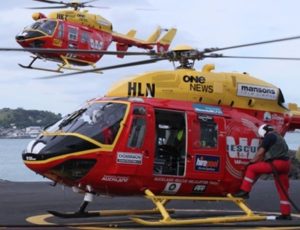
The past five years have seen a major overhaul of the operation with a second Helicopter added to the fleet, a second hanger in Coromandel that opened in 2012, the blood carried on all aeromedical rescue missions and most significantly, ED specialist trauma doctors from Auckland Hospital flying with us on all weekday missions!
This service covers an area stretching from Waihi in the south to as far north as Wellsford and has a catchment area of some 2 million people.
Over this period, the service has completed some 19,500 accident-free missions and it has evolved into New Zealand’s only full time, 24 hour a day, air rescue service.
The type of work that the helicopter carries out is as diverse as the geography and the people, with which it serves.
In short, this service is available to Anyone, Anywhere, Anytime.
ARHT relies very heavily on the Corporate & Community sectors to help fund these missions past, present and into the future. Our average operation cost is currently $7,500.00 per rescue, and for the 2017 season YTD 500+ rescues have been undertaken & successfully performed!
ARHT’s aim is to continue to maintain/improve the service so that we can continue to provide the lifesaving work that we have been performing for the last 47 years!
With the continued support and understanding of the Corporate and Community sectors within the region, we will be able to achieve the goal of providing an aeromedical rescue service that is second to none; available to Anyone, Anywhere, Anytime.
Shaan Hulena
Corporate Fundraising Manager
Auckland Rescue Helicopter Trust
P: +64 9 950 7278 F: +64 9 950 7251
http://www.rescuehelicopter.org.nz
Photo courtesy from rescuehelicopter.org.nz
Why Being a First Aider Makes You a Superhero in the Workplace
Without the first aiders, all those first aid kits and Work Health and Safety regulations are useless things that cannot help anybody. Only in the hands of a skilled and trained first aider, they get to serve their purpose and even save lives.
Being a designated first aider does not mean that you will have more to do on a daily basis. Your job description remains the same.
Your role is active only when an emergency happens. In that case, all heads turn to you and everybody follows your directions.
You get to be the first one that treats a burn, dresses a wound, performs CPR or even uses a defibrillator on a colleague in grave danger. It feels good to know that you can help the people you meet every day when they are in trouble – using your skills and training.
Still, to do a proper job, you need a fully stocked first aid kit and other supplies that are compliant with the WHS Act.
Does Your Workplace Even Need a First Aider?
This depends on several factors. These factors include:
The size of your company
Larger companies will need more certified first aiders. Providing proper first aid can make all the difference between life and death. So, you need to have enough first aiders so that every employee can be helped in the case of an emergency in a matter of minutes or even seconds.
Number and location of your employees
More people present at your building means more first aiders needed. The same goes if your building is designed so that employees are scattered in remote parts.
Type of work your company does
Light office work with a small number of employees means that first aiders are not essential for your workplace. On the other hand, a high-risk workplace requires more trained people.
The proximity of medical services
If you have an emergency medical facility nearby, your need for the trained staff is very much reduced.
Shift work and sick days
When organising first aiders, think about your shifts. There should always be one first aider available. Also, consider the fact that some of the first aiders will be absent from work at times and that somebody else has to replace them during that period.
Things You Need to Know About First Aid Training
Being a first aider is a serious job, so not just anybody can be assigned this duty. You need to be properly trained by organisations accredited by New Zealand Qualifications Authority. There are several things you need to know about your training:
- It can last 8 or 12 hours plus an assessment
- The certificate is valid for 2 years
- A refresher course is obligatory after 2 years
- A first aider must repeat the full course again if 3 months elapsed since the certificate expiry
Duties of a First Aider
According to the WorkSafe website statistics, one in four workers reports that they had a serious work-related injury in the past 12 months.
This means that the first aiders are quite busy and very much needed. In order to do their job properly, first aiders need their training in first aid. Among other things, they need to know:
- the location and the contents of all first aid kits
- the location of AEDs and how to use them
- how to use protective equipment in order to protect themselves while helping others
- cooperate with the PCBU
- provide reasonable care to those in danger
It is hard to be a trained first aider in a company that does not take care of its first aid kits. All the first aid kits need to comply with the WHS Act and they need to be regularly and properly maintained.
Is that a job for a first aider? No. That is a job for Alsco.
Call 0800 4 ALSCO right now or contact us online. Our representatives will tell you everything about our first aid rental service. For a great price, we will bring you all the kits and AEDs you need and maintain them regularly.
Photo Courtesy: Flickr Image by ** RB **
5 Proven Factors That Make a Workplace AED Necessary
 Every hour and a half, a person in New Zealand dies from heart disease. This figure is a result of a research conducted by Ministry of Health in 2015, published by the Heart Foundation.
The same study shows that cardiovascular diseases cause 30% of all deaths in New Zealand, making them the leading cause of death. Cardiovascular diseases include angina, diseases affecting blood vessels and heart attacks.
However, despite the efforts to reduce these worrying numbers, a heart attack is still a serious issue that needs to be addressed by individuals and society in general.
When an episode occurs, time for reaction is limited and it can happen to anybody, anywhere, anytime – including workplaces. Therefore renting an workplace AED from Alsco Uniforms can save lives of your employees.
The question is – why is the risk of a sudden cardiac arrest so high? Here are the five most important factors that cause it. These are the factors that, consequently, make workplace AED an important part of your workplace inventory and your First Aid efforts.
1. Work-Related Stress
Every person has different triggers for stress, so it is hard to make a uniform list. Stress is a natural reaction of our body to dangerous situations.
Needless to say, your body is pulling out all of its resources so you can defend yourself or survive that situation. If you force your body to act that way during prolonged periods of time, you will soon feel the negative effects on your health.
Work-related stress happens when you have serious issues with your work. The most common causes of this type of stress are:
- Inadequate management and leadership – improper management style that frustrates employees increases the stress levels. The same goes for management is not family-friendly.
- The nature of the job – if an employee is required to perform tasks that are well above their abilities or more tasks at the same time, it will make them feel frustrated and inadequate.
- Lack of workplace safety – jobs that involve high risks from injuries also involve higher stress levels.
Stress causes chest pains and increased heart rate. It also causes increased blood pressure, different heart diseases and significantly raises the risks of a sudden heart attack.
2. Dietary Limitations of Workplace Lunches
Working long hours usually means that people do not have a lot of choices when it comes to their lunch. In most cases, they want to grab something quick and easy in order to get back to work and go through the day. This leads to some worrying eating habits that increase the possibility of heart disease.
- Deep-fried or oil-fried meals
- Increased sugar, fat and sodium consumption
- Sugar packed drinks and snacks
- Binge eating instead of smaller portions throughout the day
3. Side Effects of Sleep Deprivation
People who work too much often report that they get too tired to sleep. Moreover, a lot of employees take their work home or long hours cause them to lose sleep in order to catch up on time with their family and friends.
However, sleeping less than 7-8 hours a night greatly influences heart health. Glucose metabolism, hormonal balance and blood pressure are influenced by the lack of sleep.
According to some studies, people who had 6 or fewer hours of sleep every night are 66% more likely to have increased blood pressure which, consequently, increases risks of a cardiac arrest.
4. Downsides of Shift Work
Having enough sleep is not all that counts. The equally important factor is – when that sleep occurs. People have a circadian rhythm pattern that influences when we sleep, eat and work. It is tied with hormonal balance throughout a day.
Therefore, shift work can interrupt this cycle and that has many consequences on a person’s life. While it causes fatigue, it can also cause depression, anxiety, and stress. All these things have tremendous negative effects on your heart.
5. Specific Workplace Factors: Tobacco and Toxins
There are many studies about the horrifying effects of smoking, active and passive, on one’s health. Especially notorious are the effects both kinds of smoking have on one’s heart.
Carbon monoxide is another gas that significantly increases risks from a sudden cardiac arrest. It is present in exhaustion gases from vehicles of all kinds. People most usually exposed are those that work in tunnels and other closed spaces where engines are running.
Carbon disulphide is another gas that should be eliminated from the employee surroundings. It is mostly present in the plants that produce viscose.
Ways to Reduce Risk of a Heart Attack
Changes in lifestyle can help fight off increased chances of a cardiac arrest. Businesses should definitely encourage their employees to make those lifestyle changes and improve their health. Also, this means that their safety in the workplace will be improved, as well.
- Offer healthy lunches at the cafeteria
- Replace sugary and fatty snacks with fruits and vegetables
- Encourage employees to take the stairs
- Introduce an exercise area or a gym in your building
- Make regular health checks obligatory
- Have trained first aiders in your office
- Have an operational workplace AED ready for use
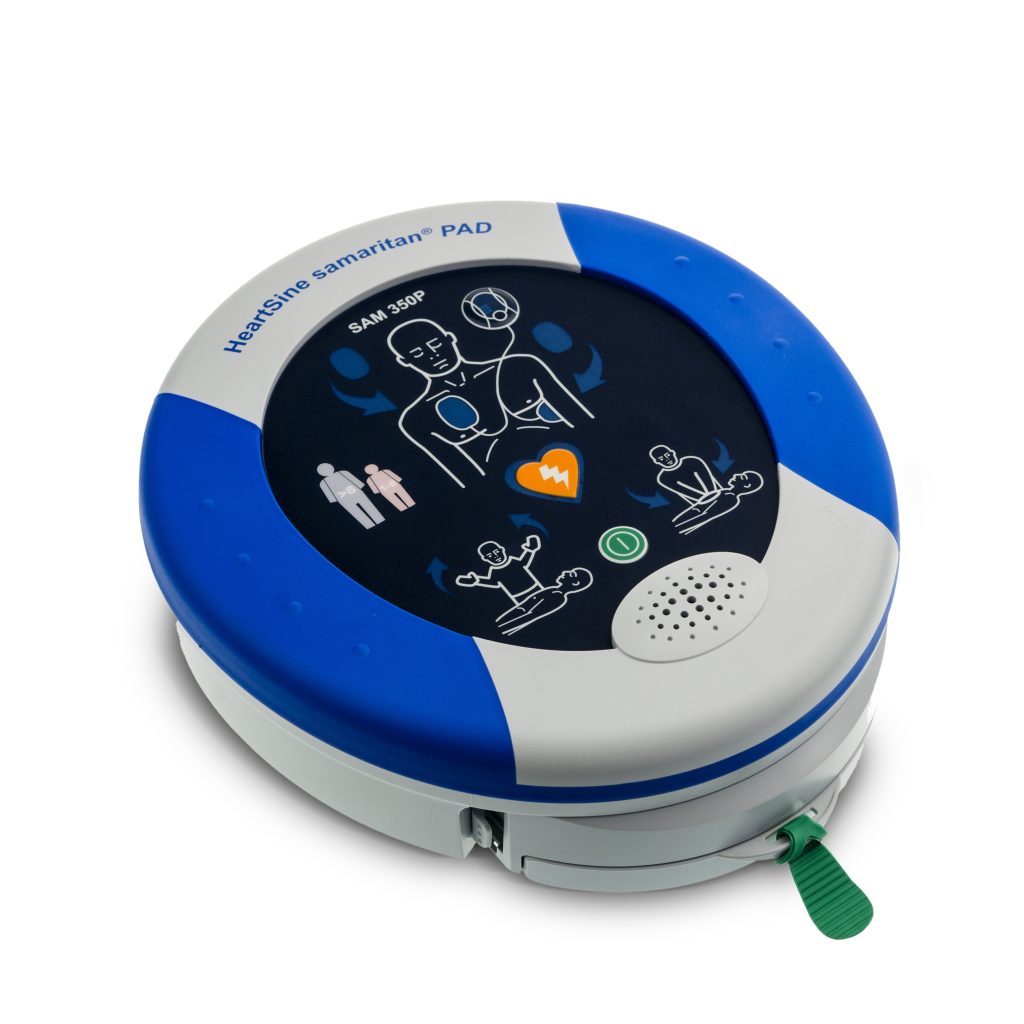
While you can ensure that most of these things are available in your workplace, Alsco can definitely help you with that defibrillator. Ask Alsco Uniforms for a portable HeartSine Samaritan 500P for the following reasons:
- It’s light – anybody can pick it up, carry it and use it
- It’s easy to use – there are only two buttons and it is very much intuitive
- It’s durable – there is an 8-year warranty on these AEDs
- It’s automated – it sets the needed charge automatically
Usually, with this sort of service comes a hefty price tag. Not in this case. You cannot put a price on somebody’s life, and with Alsco, you don’t have to. Call your local Alsco branch and ask us about our rental fee.
Alsco representatives come, place workplace AEDs strategically and come back to check it every three months.
You pay a small rental fee that includes all these and you can stop worrying about your workplace AED once and for all. Try us now!
Eye Injuries in the Workplace: Causes and Treatments
Mere seconds of delay in treating an eye injury can make a difference between temporary and permanent damage to one’s eyes. The immediate and efficient first response to eye injuries is necessary to save someone’s vision.
To do that, you need skills, knowledge, and a fully stocked First Aid Kit.
Skills and knowledge can be acquired through training, but a First Aid Kit should be rented from Alsco. That is the most reliable way to be 100% sure that it is stocked, up to date and up to legal standards.
In some workplaces, it is more likely to obtain an eye injury than others. Still, the types of eye injuries that occur are more or less the same at all of these places.
It is more likely to get a chemical burn in a lab and a black eye in a warehouse, but a foreign object in your eye can happen anywhere.
Here are the most common types of eye injuries and what to do if something like that happens:.
Foreign Objects in the Eye
There are all sorts of things that can find their way into the unprotected eyes. Splinters, larger dust particles, and even bugs occasionally end up there. If this occurs, there are some dos and don’ts about treating this injury.
You SHOULD:
- Wash your hands before touching the injured eye
- Try to rinse the eye, preferably using the eye washing station
- Remove the contact lenses from the victim’s eyes
- Use clean and wet cotton swab if the object is in the white area of the eye, but only so that the objects stick to the swab. Never to dig the object out.
You SHOULD NEVER
- Rub the injured eye
- Try to use tweezers or similar tools to remove the object
- Try to remove metal objects from the eye. Only a doctor should do that
Scratched Cornea
This injury is usually the consequence of a foreign object being stuck in the eye. In most cases, the cornea gets scratched because a person attempts to rub the eye. The recommended actions are similar to those when the foreign object gets stuck in the eye:
- Don’t rub.
- Rinse or remove the object if possible.
- Close your eye or wear an eye patch until it heals.
Black Eye
This is a bruise that occurs when the area around the eye has been injured. A black eye does not occur instantaneously, so there are steps that can be taken to prevent it.
- Step 1 – Keep the person’s head elevated. This will prevent the blood from building up and causing swelling.
- Step 2 – Check the eye itself for possible injuries. Black eye affects the surrounding area.
- Step 3 – Apply an ice pack to the eye to reduce the swelling and bruising. These should be applied every 10 minutes. Do not use packs that contain chemicals. These can rupture and cause further damage to the eye.
- Step 4 – After several days, when the swelling calms down, use warm packs to speed up the bruise fading.
Chemical Burns
Chemical burns can be very serious and they should be prevented at all times. If you are working in an area where these types of injuries are possible, make sure that you wear eye protection at all times.
There are two major classes of chemicals that can hurt your eyes: acids and alkali. These chemicals are found in different cleaning products. They don’t have to reach your eyes directly in order to hurt you, but they can produce fumes that are harmful.
Either way, if any other liquid besides clean water reaches your eyes and causes a reaction of any kind, you should rinse the eye and seek immediate medical help.
Small Cuts to the Eye
If there is a cut in the eye area it is important to react quickly. The first thing to do is to grab the First Aid Kit and get a sterile cloth to apply pressure to the bleeding area.
Pressure should be applied gently but firmly in order to stop the bleeding. However, do not apply it directly to the eyeball.
As soon as possible, go to the doctor’s for an exam because some cuts can cause further damage to tear ducts or your vision.
Heat Burns
There is no reason to expose your unprotected eyes to the sources of great heat. It that happens, it is absolutely necessary to seek help immediately. Three things should be done one after another.
- Flushing with cool water. This should be done immediately. The eye should be under the cool,running water and the injured person should attempt to close and open the eye and move it while underwater. This should be done for half an hour.
- Applying sterile bandage. The bandage should be taken from the First Aid Kit to make sure it is sterile. Also, it should be applied carefully and without any unnecessary pressure.
- Seeking professional help. Burns can cause serious damage that is hard to repair. They can get infected and cause much bigger problems. Therefore, a doctor should check any eye injury that was caused by heat.
You can be prepared to provide proper First aid in cases of all eye injuries if you have a proper First Aid Kit. Moreover, if it contains the eyewash station, you can provide even better and safer care.
These are only a phone call away. Call 0800 4 ALSCO and ask about our rental services. Once you agree to let Alsco help you, you will get:
- First Aid Kit and eyewash station that meets legal requirements
- Regular and thorough check-up of these items
- Regular and full restocking and repairing in case this is needed
- Regular replacement after the expiry date
- Priceless advice on where to place these items and how to use them
All this is included in only ONE annual fee. There will be no additional costs and no hidden charges. Make an enquiry today and make the first step toward a safer workplace.
Defibrillator Success Saves Alsco BGM
On a cold winters evening on July 18th 2016, at the gym inside the Avantidrome Cycling Velodrome in Cambridge, Ron Kemp (me) suffered a Sudden Cardiac Arrest (SCA).
This in layman’s terms essentially means I was “dead” on the floor.
I had been exercising at the gym for around 20 minutes when the SCA occurred. Another gym occupant hit one of the fitted “panic buttons” and laid me in the recovery position. When the panic alarm sounded, the emergency procedures kicked into gear and people came running.
The Fastest Way To Save A Man’s Life
One of the people to get to me immediately was Talya Thomas, who works in the café attached to the Avantidrome Cycling complex.
Talya, who has been accepted to begin training in 2017 as a paramedic, recognised from the symptoms that this was a cardiac issue and that my heart had gone into fibrillation (not beating but electrical pulses going crazy) and was immediately able to organise CPR and get me hooked up to a defibrillator that had been brought to the scene as part of the “panic alarm” procedures.
Within a short time, Talya had administered three shocks in addition to performing CPR and my heart started back in rhythm prior to the ambulance arriving. An ambulance arrived within 12 minutes and I was transported to Waikato Hospital still in an unconscious state.
The Recovery Period
I spent the next 3 days on life support in the ICU (Intensive Care Unit) at Waikato Hospital where I was diagnosed, after an angiogram, to have major restrictions in several of my heart arteries. While in ICU I was on a ventilator, as well as all the other whiz-bang gadgets they could find to plug into me and my body temperature was kept very low to aid in recovery.
On Thursday I had recovered sufficiently to be transferred to CCU (Cardiac Care Unit) to await the procedure recommended by the Cardiologist. On Monday, 7 days after my SCA, I had 3 stents inserted into my heart arteries under a procedure called an angioplasty.
Fortunately, this is a fairly non-invasive way of fixing the immediate heart issue. 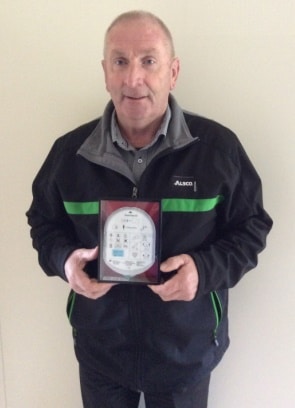
Due to other injuries sustained when I collapsed while having a sudden cardiac arrest, I remained in the hospital for 3 additional days.
Recovery has been a slow affair as I needed to take the time to understand what happened and what changes needed to be made immediately.
Slowly Going Back To Normal Life
It was around 10 days before I could speak with any confidence, probably a result of having a ventilator down my throat.
The part of the body to take the longest to recover has been the chest cavity as the CPR done correctly often cracks or breaks ribs.
It has taken around 6 weeks for my chest to heal sufficiently to be able to contemplate a return to work.
Some history regarding the Avantidrome – In 2012 when the Avantidrome was being constructed, Alsco submitted a proposal for a level of sponsorship in addition to the supply of washroom dispensers, consumables, First Aid, Civil Defence and a Defibrillator.
This sponsorship package, worth a considerable sum per annum to the Avantidrome, was agreed, and all dispensers were fitted by myself and Peter Martin (now Business Manager, Napier).
The defibrillator was installed and Alsco ran several training sessions for staff in the operation of the defibrillator, in addition to organising multiple First Aid Training for staff since 2013.
To be the first person to have needed the defibrillator at this site is kind of crazy.
The Real Deal About Sudden Cardiac Arrest
There are many stories of people surviving an SCA but the survival rate is approximately 6% of people who have a cardiac arrest outside of a hospital and approximately 24% of people who are in hospital at the time of their SCA.
It needs the right people at the right time, with a defibrillator, for this to happen. There are on average 10 SCA’s in NZ daily. In most incidents, there is no warning an SCA is about to happen. I am now on a graduated return to work plan, still aware that I have been incredibly lucky to have survived.
My story has been great for our Sales Executives as a sales tool and as you can imagine I have become an ambassador for the placement of as many defibrillators in the market as possible.
Ron Kemp, BGM, Alsco Hamilton NZ


