Trusted by 237K+ Business Worldwide. Find a Location
Trusted by 237,000+businesses worldwide across 250 locations delivering uniforms, linens and more. Find a Location Near You


Delivering Excellence Since 1910
Contact Us
What Are the 5 Main Aims of First Aid?
It is impossible to predict when an accident will happen in the workplace. However, it is the employer’s duty to do everything in their power to prevent accidents and provide access to first aid to their employees and everybody who frequents their workplace.
The 5 main aims of first aid are:
- preserve life
- prevent the escalation of the illness or injury
- promote recovery
- pain relief
- protect the unconscious.
Preserve life – while the first aider is the person who has the certificate for the first aid, they are not medical professionals. They can do their best to make sure the patient is given the basic care and they can help treat minor injuries like cuts and scrapes that don’t need routine or emergency attention.
However, in severe situations that are a threat to the patient’s life, they do not focus on providing care but on preserving life long enough until the ambulance arrives.
Prevent the escalation – again, the efforts of the first aiders are directed toward prolonging the time the patient has until the ambulance arrives. If the patient is bleeding profusely, the first aider will not stitch the wound, but they will do their best to stop the bleeding until the ambulance arrives. In that way, they will prevent further complications and health deterioration.
Pain relief – this is done only if it is in any way possible and it doesn’t present a risk to the patient. Some pain relief medications can be dangerous if a person is bleeding. Therefore, if you are not sure if the pain medication is appropriate, it is better to ask the medical experts first.
Protect the unconscious – one of the important factors in administering first aid is protection and safety for both the patient and the first aider. Moreover, this extends to the people who are nearby as well. Protecting the unconscious can mean removing them from a dangerous situation, like fire, a flooded space or a road with traffic.
Promote recovery – every action that a first aider takes should be in the direction of helping the person who has suffered an injury or sudden illness get better.
Promoting recovery usually means using the first aid kit. It is packed with supplies that are necessary for the first aider to be able to help the person in need. You can understand that the time of providing the first aid is crucial. If your first aid is not well-stocked or it is not there at all – that is a big problem.
Let Alsco NZ provide you with all the necessary first aid kits for your workplace and always be ready for an emergency.
As you know, children are most prone to accidents. So, if you work in a school, your duty is to ensure a safe and healthy environment for them.
You could start with the washrooms. The Ultimate School Washroom Guide will help you learn how to address major washroom health and safety concerns according to the New Zealand standards.
What Are the Types of First Aid?
The two types of workplace first aid in New Zealand are:
- Basic first aid
- Workplace-specific first aid
The basic first aid contains all those types of assistance that you would expect from a first aider to know about. These include:
- Dealing with cuts, scrapes, grazes, burns and other minor injuries
- Managing eye injuries of different kinds
- Immobilising fractures, sprains and strains of joints
- Preventing choking
- Stopping the excessive bleeding
- Helping unconscious patients
More or less, those are the areas that the most basic first aid course covers. These courses are not places where first aiders learn to treat people, but simply to offer the first aid that will buy some time and prevent the situation from getting much worse.
Workplace-specific first aid courses in New Zealand are easily organised with the institutions that offer the basic first aid courses. These are the training sessions that focus on the specific dangers that can occur in the workplace.
For example, if you have a touring business and most of your tours are by boat, your first aiders need to be ready to administer first aid to people who have had a near-drowning experience, hypothermia, or sunstroke.
What Are the 10 Items in a First Aid Kit?
There is no legal requirement about what you need to put in a first aid kit. However, you can expect to find the following 10 items in almost any workplace kit.
- Bandages of different kinds
- Adhesive tape and bandages
- Sterile gauzes and eye pads
- Wet wipes
- Antibiotic ointment
- Saline solution
- Clasps and safety pins
- Scissors and tweezers
- CPR mask
- First Aid Guide that includes first aider phone number
However, the nature of your workplace will determine the contents of your first aid kits. Workplaces that involve ovens, open fire and similar hazards will need more antibiotic ointments and gauzes than anything else. Keep that in mind when choosing the first aid supplies.
What Are the Types of First Aid Kits?
Not all first aid supplies are the same. These, again, should be positioned and packed in a way that ensures the most convenient use. Types of first aid kits include:
- First aid cabinets – This type of first aid supply is not movable in its entirety. You can open the cabinet and take the supplies you need from it, but you cannot carry them all at once. The good side of this type of first aid kit is that you always know where it is. The bad side is the impossibility of moving it.
- First aid kits – This is usually the most common way to pack supplies. You can grab the entire kit and take it with you directly to the place of the accident. That saves time and prevents making several trips for this item or that during the treatment. On the other hand, there is a possibility for this first aid kit to be misplaced.
- Vehicle first aid kits – These first aid kits are specially designed so they can be placed inside the vehicles at all times. New Zealand companies that have vehicles are required to have a first aid kit in each of the vehicles.
Alsco New Zealand has decades of experience in dealing with workplace first aid. You can trust us to offer you the most effective and cost-efficient solution for your company. Don’t worry about what happens when you use your first aid kit or whether you will have to think about the expiry dates. For a fixed annual rate, we do that for you. Contact us to learn more about how we can meet your first-aid needs.
What Are the 3 C’s When Dealing with an Emergency?
The three C’s represent the mnemonic technique that should help people who administer first aid. They are meant to help these first aiders remember the course of action and their sequence so they can provide the best possible first aid. The first C’s are:
- Check
- Call
- Care
Check: For the first aid to be administered successfully, the patient, first aider and the present people should be out of the influence of the hazard that has caused the injuries.
Moreover, you should check for the safety of you, patient and the others. This can include removing the victim from the traffic or putting out the fire, providing the airflow and eliminating toxic fumes, etc.
Call: One of the primary functions of the first aid is to actually give the victim enough time and prolonging their life until the ambulance arrives. For that to happen, the ambulance needs to be called. As soon as you assess the surrounding, you need to call the 111 and talk to the operator explaining the specifics of the situation and answering their questions accurately and directly.
Care: The first two C’s are actually the preparation for the main course of action – providing medical assistance. This is where you actually start administering care to the patient. In some cases, it will simply mean dressing a wound, but it can also mean monitoring a person’s breathing and pulse, giving them CPR and even shocking them with AED.
For the most steps of the third C: Care, you will need special supplies. The first aid supplies are packed in the first aid kits. Every workplace should have at least one. Rent your workplace kits from Alsco NZ and make the Care step much easier for your first aiders.
For instance, did you know that floor-to-ceiling cubicle doors can seriously compromise safety and make the checking and caring for the injured person impossible?
You should be aware of hazards such as this especially if you work in a school or other crowded environment.
Learn how to make your school washroom safe and healthy with our ultimate guide.
What Are the Steps in Assessing an Emergency Situation?
Once you find yourself in an emergency situation, you need to assess it quickly, especially if you notice that there are one or more people injured. Don’t rely on the other people to be responding, because this does not always happen. Look around and do the following three steps of assessing the situation:
- Assess the situation
- Assess the environment
- Assess the patient
Assessing the situation – this means establishing what is going on, if there are injured people and what are other people doing. You will notice that many people react to emergencies by freezing. In many cases, the bystanders will do nothing to help the person in trouble. That is why you should react instantly if you see that somebody is hurt. If you need help from the others, give them precise directions about what to do and they will most likely follow them.
Assessing the environment – this is the moment when you need to see what caused the injury to the patient and if they are still in the same danger. Moreover, you need to take care of yourself and the others, also. You, as the first aid provider are useful to the patient only if not injured yourself, so do everything in your power to stay safe.
Assess the patient – check the patient’s pulse, breathing and airways. Those are the three things that you need to do if the person is unconscious. If you are not sure if the person is conscious, shake them and call them like you would if you were waking them up from a deep sleep. If they are not responsive, go for the pulse and breathing.
- Check for the breathing by laying the person on the back and observing if their chest is moving. Place your hand on their chest to closely feel the possible motion. Move your cheek next to their nose and mouth and try to feel their breath.
- Check the airways by raising the patient’s jaw and tilting their head back so you can see the inside of their mouth. If you see something, turn the patient to their side and unblock the airways.
- Checking the pulse is best done by placing the index and middle finger on the carotid artery which is next to the windpipe.
What Is the First Thing You Should Do If a Person Is Unconscious and Not Breathing?
When you see a person without consciousness and not breathing, you still need to check their breathing and try to wake them up. This should not last long. Establish the lack of consciousness and breathing by taking the following steps:
- Call or ask somebody to call 111
- Check the airways and unblock them if necessary
- Start CPR
While administering the CPR, ask somebody to give you AED and use it on the person. Don’t worry, the AED will not administer the shock if there is no heart rate or the heart rate is regular.
What Do You Do If Someone Has a Pulse but Is Not Breathing?
If the person has a pulse, but they are not breathing, it is possible that their airways are blocked and need to be unblocked. If that is not the case, start the “rescue breathing” until the ambulance arrives.
Positioned them on their back and start with the “rescue breathing”. This is different to the CPR because, during the CPR, you are pressing the patient’s chest, while when performing the “rescue breathing” you are only blowing the air into the patient’s mouth, but without the compressions.
You should tilt the patient’s head, pinch their nose, and open their mouth. By positioning your mouth on theirs, slowly breathe in the air. This should be done once every 5 or 6 seconds.
How Do You Give a Defibrillator Shock?
While you are going for the first aid kit, or calling the 111, grab the nearest AED in your workplace and have it handy. AED in combination with the CPR gives the best chances for survival to the person who is unconscious and has an irregular heartbeat. Defibrillator shock is given in a couple of steps:
- Position the person on their back
- Open their shirt
- Wipe them dry if necessary
- Place the AED pads, one above the right nipple and other slightly to the left side of the chest.
- Make sure nobody is touching the victim
- Press the start button
- Continue CPR when the AED informs you it is safe to do so
Both AED and the first aid kit are the first aid equipment that can mean the difference between life and death in the emergency situation.
Alsco NZ can rent you the first aid kits and the AEDs for a flat annual price. For the same price, we will regularly make sure that they are working properly. We will fill the cabinets when the supplies are used and we will make sure they are all up to date.
Get your first aid kits and AEDs from Alsco NZ today.
Photo courtesy of Max Pixel
What Is Automatic External Defibrillator (AED)?
AED stands for Automatic External Defibrillator. This is a small and light electronic device that is used to diagnose and treat certain life-threatening heart conditions in the case of an emergency.
It is done by the method of defibrillation. Automatic External Defibrillator is portable and runs on batteries.
An Automatic External Defibrillator should be in all workplaces in New Zealand since it is of essential importance in the case of emergencies.
Heart disease and different heart conditions can lead to an irregular heart rate, called dysrhythmia which can be life-threatening.
The causes of such conditions can be varied but include previously suffered heart attacks, certain substances or congenital heart conditions – heart conditions that you have been born with.
What Is an Automatic External Defibrillator Used For?
An Automatic External Defibrillator is used for the first aid response in case of a sudden cardiac arrest (SCA). More precisely, when a person is suffering from an abnormal heart rate which usually happens as a cause of a cardiac arrest. The two most common reasons for the AED are Ventricular Tachycardia (V-Tach) and Ventricular Fibrillation (VF).
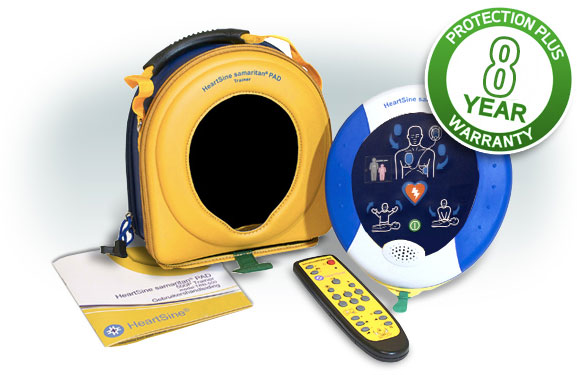
An AED is used to administer an electric shock that should trigger normal heart function. When a sudden cardiac arrest happens, the heart loses its rhythm, which is essential for sustaining a human life. Usually, the lower parts of the heart start with the rapid and erratic beating that doesn’t pump enough blood and doesn’t do it properly.
That is the ventricular fibrillation. When it occurs, it means that the heart is not performing its function properly, and the person suffering from VF will probably experience a rapid and severe drop in blood pressure and lose consciousness. If not treated with an AED and CPR instantly, this can be fatal.
How Does an AED Work?
An AED releases electrical current into the heard of those suffering from the VF or some other abnormal, life-threatening heart rhythm. The idea is to stop the heart for a split second and reset it. In that way, the heart should automatically resume its natural rhythm.
The AED will not release the electric current unless required. It has an analyser in it that checks how the heart is beating and it releases the current only when it picks up the signs of abnormal heart rate. If it ‘sees’ that there are signs of VF or V-Tach, it will release the current of 150 to 360 Joules. That’s enough to restart the heart without causing permanent or irreparable damage.
That is why it is important that the AED is used properly.
The electrodes of the AED should be placed on the patient’s chest. Through them, the heart rate is measured and analysed by the AED. If they show that the person is suffering from VF or another life-threatening arrhythmia, the electrical shock is administered through the pads.
Does an AED Work on a Beating Heart?
Yes. An AED works on a beating heart. Moreover, it only works on a beating heart. An AED will not try and shock the heart that is not beating. Once you place the electrodes on a patient’s chest, the analyser looks for the signs of the beating heart and establishes whether the current needs to be administered or not.
The reason for administering the current are the signs of erratic and irregular heart rate. Therefore, if the heart is not beating, the AED will not detect the VF or V-Tech and won’t administer the shock.
What Are the Steps for Using AED?
There are several steps for using AED that you should be aware of before the situation occurs. Also, keep in mind that a lot of instructions are already on the AED display as you perform the first aid.
Turn on the AED.
Some AEDs are battery operated, so you won’t need to plug them in. Check your AED right now and learn if it is battery operated or needs a socket. This will save you time one day when you need it instantly.
Remove the patient’s shirt.
The chest of your patient needs to be bare, dry and with no patches on them. There should be nothing that could get in the way of direct contact of your AED and your patient’s skin.
Position the pads.
Sometimes the pads are already connected to the AED. Sometimes, these pads need to be plugged into the AED. Make sure they are plugged in before proceeding.
Warn everybody to stand clear from the patient.
Nobody should be in direct contact with the patient. The electric shock may transfer to them, as well and that is very dangerous. This includes the person who is using the AED. Make sure that you are not touching the person accidentally with your legs, body or in some other way – not just with your hands.
Press the analyse button.
Watch the instructions from the AED. It will analyse the heart rate and administer the shock if necessary.
Perform CPR.
AED will check if the electric shock needs to be repeated. In the meanwhile, perform the CPR and make sure you analyse the patient using AED again
It is important that you use your AED during the first 3-5 minutes after the cardiac arrest has happened and the person has lost consciousness. The quick and swift reaction is essential and it is the only way to save somebody’s life.
Therefore, what you can do right now is check if your workplace has an AED, where they are and how they work. That will save you precious minutes if the situation arises. Inspire others to do so as well, since they will be the ones to use the AED on you if you are unfortunate enough for an SCA to happen to you.
Work in a school? Create a safe school environment for all the children you’re responsible for at your workplace.
Apart from an AED to save lives, you must meet the basic school washroom legal requirements and provide all the students and stuff with a safe and healthy environment.
Fresh & Clean School Washroom Guide teaches you all you need to know about it.
Your workplace doesn’t have an AED? Contact Alsco New Zealand immediately and get your AED.
You don’t have to invest thousands into an AED. You can rent it for a flat affordable annual fee and get it checked regularly without additional cost.
What Is In An Earthquake Kit?
There are two items that should be clearly discerned when it comes to workplace earthquake preparedness: the grab bag and the earthquake kit.
The workplace earthquake kit checklist should include:
- First aid kit and life-sustaining medicine (e.g. insulin)
- Battery powered or self-charging torch
- Radio
- Spare batteries
- Dust masks and protective items
- Toilet paper, moist towels and rubbish bags
- Food and water supplies
It is easy to conclude that the workplace emergency kit should equip you with all the necessary tools to sanitise any wounds, keep you fed and hydrated for a while, allow you to contact your family and the rescue teams and ensure basic sanitary needs.
What Do You Put in a Grab and Go Bag?
We already mentioned that the earthquake kit and a Grab and Go bag are not the same. The workplace earthquake kit is a necessary item that every New Zealand workplace should have. It should be used after the earthquake to make sure the consequences are dealt with.
The Grab and Go Bag is also recommended for most workplaces and these are individual bags that each of the employees should assemble for themselves and keep close in case they need to evacuate immediately.
Here is what you should find in an average Grab and Go bag.
- Water, energy bars and dry food
- Essential toiletries
- First aid kit and necessary medicine if needed
- Covers or blankets
- Foldable raincoats, fleece clothes and walking shoes
- Torch and radio
These bags need to be designed in a way that allows them to be carried easily. You can make a shoulder bag, but many people opt for a backpack since it is easier to carry and leaves both of your hands free.
Where Is the Safest Place to Be During an Earthquake?
The answer to this question greatly depends on where you are at the moment of an earthquake. Therefore, here is a table that can help you make your choice:
What Is the Safest Place to Be during an Earthquake? | |
Where are you during earthquake? | Where to go? |
| Inside your home/workplace | Stay inside |
| Outside | Keep away from the buildings, street lights, electric posts. Seek open areas. |
| In a moving car | Slow down, pull over and stay in the car |
| In a moving train | Stay inside the train and keep calm |
| In an elevator | Wait until the shaking stops before exiting the elevator |
| On a beach | Wait until the shaking stops and seek elevated ground due to tsunami possibility |
Regardless of where you are, you should follow the instructions given by Get Thru New Zealand.
The most important thing you should instruct your employees to do is to Drop, Cover and Hold.
This means that all your employees should drop down so that they are not knocked down by the earthquake. In that way, they will avoid injuries from the fall.
Together with your employees, you should identify the sturdiest pieces of furniture, usually the desks, that can be used as a cover from the masonry that can fall down from the ceiling and walls.
Holding onto the shelter is also important because it will prevent people from sliding away from the shelter or, on the contrary, preventing the shelter from sliding away itself.
Holding on also provides people with a feeling of security, much needed in a case of such emergency.
Also, it is important to keep in mind that there can be persons in your workplace that cannot drop down that easily, even in the case of emergency. That is why it is important that your employees know their options in case of an earthquake:
IMO @NZGetThru should do more to inform pple who are not able to just ‘drop’, ‘cover’ & ‘hold’. Like this pic on FB: pic.twitter.com/8UtiyiibaN
— C_NZ_ (@C_NZ_) October 14, 2015
This, together with the location of the workplace earthquake kits, is the essential piece of information in case the grounds start shaking – a fairly common occurrence in New Zealand.
How Much Does an Earthquake Survival Kit Cost?
The New Zealand price of earthquake survival kit for one person can be up to $260. This usually contains items that people would have in their homes, but rarely carry to their workplaces.
Do you need to create, from scratch, these kits for each of your employees? Luckily for you, no. There are special workplace earthquake kits that you should use.
Their price greatly depends on the size of your workplace and the number of people that are present in your workplace on a daily basis.
The earthquake kits for 50 people should be a bit different than those for 5 people. That is something to consider once you plan your workplace emergency procedure and the equipment of your office.
Putting together your own earthquake survival kits can be challenging.
You need to make sure you buy all the necessary items, pack them in the appropriate way, so that they are usable in a case of emergency and to regularly check them and replace items if they have expiry dates.
Therefore, managing your own earthquake kits can cost you time and money. The good news about the cost of your earthquake survival kit doesn’t have to be paid in full, all at once.
Moreover, you don’t have to worry about replenishing the items in a timely manner. There is a much better option than buying the earthquake kits. You can rent them.
Renting earthquake kits means that you just need to contact Alsco New Zealand. We already have emergency kits in our offer that are available to you for a flat, annual fee.
Call us and we will discuss the size and the needs of your workplace. We will recommend the number of our emergency kits and we will deliver it to your doorstep.
This is not all. Since even the first aid kits have perishable items, we will regularly come back and replenish the earthquake kits and replace the items close to their expiry date. That is all included in your annual fee.
Call Alsco New Zealand now and get your best quote for a earthquake kit rental.
How Do You Maintain a First Aid Kit?
Once you purchase a first aid kit, you just find a place for it and don’t give it a second thought. You hope for the best and hope that you will never need it.
But, there is an expiry date on many first aid supplies. If the first aid kit is not maintained, it can be useless in the case of an emergency.
Here are the things you should do to keep your first aid kit maintained:
- Choose two dates a year when you check your first aid kits.
- Replace all the supplies that are close to the expiry date.
- Check that the first aid kit easily opens
- Check that the first aid kit is not damaged
- Check that all the contents and supplies are in stock.
- Check that the sterile products are still uncompromised and sealed.
Only by regularly checking your first aid kits can you be certain that they are always ready to use. It is just a matter of habit. Also, your employees all need to know where the first aid kit is and what it contains.
Not all of them need to know how to administer the first aid, but it is advisable that you have at least one of them who is a certified first aider.
First Aid kits help save lives. They are the first step toward getting real medical assistance in case of emergency. Therefore, their maintenance cannot be emphasised enough. However, it is easy to forget about it and business owners usually don’t have the time to deal with it.
Alsco NZ has the answer. Our rental program helps you in two ways: first, you don’t have to pay a lot of money upfront to buy first aids and secondly, once you rent first aid kits from Alsco NZ, regular maintenance by our professionals is included in your annual rate. Get maintained first aid kits for your workplace.
What Should You Keep in a First Aid Kit?
To maintain a first aid kit, you first need to have one. New Zealand workplaces are not legally required to have precise contents of their first aid kits. However, there are recommendations made by the Ministry of Business, Innovation and Employment of New Zealand (MBIE) about what should be found in a basic first aid kit:
- First aid instructions
- Phone numbers of first aiders
- Saline solution and wet wipes
- Adhesive dressings
- Bandages and eye pads
- Wound dressings
- Resuscitation mask
- Clasps or safety pins
- Gloves, scissors, tweezers
These are just general items that can be found in a basic first aid kit that is appropriate for an average workplace with no special risks. This is a first aid kit that will work well in a school office, retail shops even a restaurant.
Better prevent than cure, right?
In addition to keeping your first aid kits properly stocked and regularly maintained, especially if you work in a school, learn how to create a safe and healthy environment to minimise the risk of accidents.
This School Washroom Guide can be your starting point.
However, the first aid kit contents can and should be adjusted to specific workplace requirements. Here are some more details about the contents of the first aid kit.
- Instructions – Not everybody works well under the pressure of an emergency situation. Even if they know a thing or two about first aid, the adrenaline can render them flustered and unable to remember what to do. That is why you need first aid instructions, written in brief and concise directions.
- First aider phone numbers – The phone numbers of first aiders can be useful to get in touch with them for advice or to call them if they are within the facilities.
- Saline solution and wet wipes – Wet, sterile and packed one by one. That is how you want your wipes to be. They are needed for wiping your hands and similar activities in case that there is no running water nearby. The saline solution has a similar purpose, but it is usually used to disinfect the wound so it can be properly dressed.
- Adhesive dressings – these supplies make sure that your dressing of the wound stays in place. They are excellent for cuts and slits. You need them in different shapes and sizes and the minimum is 20 pieces of individually packed dressings.
- Bandages and eye pads – two stretch bandages come in handy in cases of bleeding that needs to be contained and compressed. Regular ones have their use, as well. It is best to have two of each kind. Also, eye pads are specially formed types of bandages that serve to protect the hurt eye from possible infections. All these supplies need to be sterile.
- Wound dressings – you use bandages to keep the wound dressings in place. That is why they need to be sterile and unmedicated. They are what comes in contact with the wound, so if they are not sterile, there is a good chance that the wound will be infected. You cannot predict the wounds, so you need to be prepared. The most commonly picked sizes are 12 cm x 12 cm and 18 cm x 18 cm. Keep the stock of 6 smaller dressings and 2 big ones.
- Clasps and safety pins – the wound dressings provide protection for the wound and the bandages keep them fixed, but what makes the bandage stick? That is where the clasps and the safety pins come. They are needed to attach the bandages and other first aid supplies.
- Resuscitation mask – it is not always sanitary and/or safe to give mouth-to-mouth to an unconscious person. That is why you should use a resuscitation mask. It contains filters that prevent viruses and bacteria to get transferred from one person to another during CPR.
- Different small tools – the use of scissors is obvious. You need to open the packages and tailor the bandages in some situations. Tweezers are irreplaceable when you need to remove foreign objects from eyes or ears.
It is challenging to worry about every little thing in your first aid kit. But, Alsco NZ doesn’t mind. We will put this and anything else you may need into your workplace first aid kits.
Moreover, we will visit you regularly to check if anything needs replacing or restocking. It is all the safety and none the worry with Alsco New Zealand. Get your customised first aid kits to keep your employees safe.
Are Workplace First Aid Kits Required?
According to the Ministry of Business, Innovation and Employment of New Zealand (MBIE), it is required that you have at least one workplace first aid kit in every location.
The recommendations for the workplace first aid have been given in their Guide.
The number of needed first aid kits rises with the number of employees and the size of the workplace. For every 50 employees, an additional workplace first aid kit should be added. If the workplace has more than one floor, a first aid kit should be on each of the floors.
The first aid kits should be positioned in a way that makes them clearly visible. There should be signs in place that point to them and there should never be anything that blocks the first aid kit. Ideally, right next to the first aid kit should be a wash basin with both hot and cold running water and a supply of clean towels and soap.
Based on this, a perfect place for positioning first aid kits are washrooms or anywhere near them, especially in crowded multi-storey places such as schools or restaurants.
If a school is your workplace, don’t miss out on learning all the positive effects washrooms that meet the legal requirements have on the staff and students’ safety.
However, it is not enough to just install the first aid kits and to hope that there will be no emergencies. As an employer, you need to make sure that the first aid kits are regularly checked, so that the items are replaced before their expiration dates and that used items are regularly replenished.
What Should Be in a Basic First Aid Kit?
WorkSafe recommends that first-aid kits contain the basic equipment for attending to injuries, along with equipment based on the risks of your workplace. This is best estimated after conducting a thorough first-aid workplace assessment.
First aid requirements are different for low-risk workplaces, such as offices, single person companies, retail stores without major warehouses and similar.
On the other hand, there is an entirely different situation in the mining industry, automotive workshops, businesses that require heavy machinery, and the like. The hospitality business is not without its challenges, either, although it cannot be compared to mining.
These are the basic items that should find their place in your workplace first aid kits:
- First aid guide
- Contact information of workplace first aiders
- Moist wipes
- Adhesive dressings
- Triangle and stretch bandages
- Eye pads
- Saline solutions
- Safety pins and clasps
- Tools such as gloves, scissors and tweezers
- Resuscitation mask
Wipes, dressings and bandages should be unmedicated and entirely sterile. They need to be packed individually so that when you take out one piece, the others stay uncompromised. Stock them in different sizes, so they can match different requirements.
The adhesives should be in different sizes and you should have at least 20 of them. As for the stretch and triangle bondages, make sure that you have at least 2 of each. The same goes for the eye pads.
It is not legally regulated whether the pain medication should be stocked in the first aid kits. There is an ongoing discussion about whether this is justified or not.
One side claims that they are over-the-counter medications that people can freely use at any moment. The other side says that any kind of medication should be administered by a medical professional, especially in the case of an emergency.
This is a judgement call for the employer. However, if you choose to stock the pain relief medication, its use must be closely monitored.
How Many Aiders Are Needed in the Workplace?
First aiders are employees who hold the First Aid Certification and are qualified to offer first aid in the case of emergency. However, there is no law that says if you have to have a first aider in your company or how many of them should be present.
The need for the first aiders is regulated by the Health and Safety in Employment Act 1992, but it doesn’t go into details. It only says that you need to come up with procedures for dealing with the emergencies. This leaves a lot of room for interpretation from the employer. In other words – it is up to you.
MBIE also advises that the employers are the to make the call about the number of first aiders, based on the workplace assessment. First Aid workplace assessment involves examining the characteristics and the specifics of the workplace in the aim to tailor the best possible solution for the first aid distribution.
The factors that need to be considered when making such an assessment include:
- The number of employees
- Specifics and hazards of the industry
- The size, the location and the work organisation (e.g. shift work)
- The proximity of the medical assistance centre
If you opt for first aiders in your workplace, you need to keep in mind that some of those people need to be present at all times. For example, if you don’t have a lot of employees, but they work in three shifts, you need to make sure that there is one first aider in each of these shifts.
The holidays, sick days and other absences of the first aiders should also be covered. That is why you will need a couple of people trained to administer first aid in the most efficient way.
First aid certification is valid for two years. After those two years, a refresher course is needed for a person to keep their certificate. If there are more than three months from the moment the certificate expired, the first aider needs to take the course all over again to get a new certificate.
Besides the first aiders and the first aid kits, your workplace can also have a first aid room. However, even in that case, you will need the appropriately stocked first aid kits. Purchasing them is not the end of your worries. They need to be checked and rechecked regularly.
Some of the supplies will expire while others will be used. The first aid box itself can be compromised in some way, or the doors can simply get stuck. Running a good business and thinking about these issues at the same time is challenging.
Delegate all your first aid efforts to Alsco New Zealand. We offer rental first aid kits that we can stock in any way you like. For a flat rate, you can forget about the stocking and restocking, as well as about the regular checkups. That’s all included in your annual price. To get started with workplace first aid, get in contact with Alsco today!
What Items Are Found in the First Aid Kit?
Different workplaces will have different requirements for their first aid kits.
If you are working in an office with low levels of risks for a workplace injury, a simple, basic first aid kit will be enough.
However, if you are working in the mining industry, you will need a much better stocked first aid kits.
While restaurant businesses will have more need for bandages and adhesive dressings, you can expect for the miners to have more need for resuscitation masks and more sterilisation supplies.
Either way, every first aid kit should contain at least the following:
[b3_row]
[b3_column lg=”6″ md=”12″ sm=”12″ xs=”12″ ]
- Phone numbers and contact information of first aiders
- Wipes
- Adhesive dressings
- Eye pads
- Bandages (regular and stretch)
- Saline solution
- Clasps
[/b3_column]
[b3_column lg=”6″ md=”12″ sm=”12″ xs=”12″ ]
- Safety pins
- Scissors
- Tweezers
- Gloves
- Resuscitation mask
- First Aid Guide
[/b3_column]
[/b3_row]
You need to assess your workplace first. Alsco NZ already has decades in supplying workplaces with first aid kits and similar items. Contact Alsco today and let us help you rent appropriate first aid kits.
What Supplies Should Be in the First Aid Kit?
Let’s get back to the basic first aid supplies and try to go into a bit more detail about them. This will help you determine which of these supplies you really need and which can be reduced to a minimum to make room for the more useful items.
First aid guide and contact information – this should definitely stay in your first aid kit. Your workplace needs first aiders and people are sometimes flustered in the emergencies, so they cannot remember details like phone numbers or even whom they should call. The first aid guide should be there to help people start administering the first aid as soon as possible.
[b3_row]
[b3_column lg=”4″ md=”12″ sm=”12″ xs=”12″ ]

MINOR BURNS
[/b3_column]
[b3_column lg=”4″ md=”12″ sm=”12″ xs=”12″ ]

CUTS AND SCRAPES
[/b3_column]
[b3_column lg=”4″ md=”12″ sm=”12″ xs=”12″ ]

HEAT EXHAUSTION
[/b3_column]
[/b3_row]
Wipes – these should be individually wrapped, moist and easily opened. They are necessary if there is no easy access to hot and cold running water, as sometimes, wounds need to be cleaned.
Adhesive dressings – for all the cuts and minor bleedings, adhesive dressings make the best first aid. These should also be individually wrapped and there should be at least 20 of them in different sizes.
Eye pads – it is best to have 2 sterile eye pads for all the emergencies in which the eyes are hurt and need to be protected from the outside influence.
Bandages – there should be both stretch and regular, triangular bandages in your first aid kit. All of them should be sterile. You need at least two triangular ones and two stretch bandages.
Wound dressings – it goes without saying that the wound dressings should be sterile. They also need to be unmedicated. The best is to two sizes of wound dressings. The smaller one is 12 cm x 12 cm and the larger one is 18 cm x 18 cm. You need 6 small and 2 bigger dressings.
Saline solution and hand sanitisers – these two items are in your first aid kit so that you can make sure the open wounds are not infected. The saline solution can be used to wash the wound and prevent contamination. The hand sanitiser should be used to quickly sanitise the hands of the person administering the first aid. Again, all in the aim of preventing the infections.
Resuscitation mask – this mask is used to help your CPR efforts. It is placed on the patient’s mouth and nose and the air is breathed through the opening. In that way, the contamination is prevented.
Other helpful items – these include gloves, scissors, tweezers and similar items. Their use is to facilitate opening of the packages, removing foreign objects from the wounds, help maintain sterile conditions and the like.
Are Workplace First Aid Kits Required?
Everybody will agree that the first aid kits are needed, but the question remains – are they legally required. The Health and Safety at Work Regulations cover the legal requirements of the workplace first aid. This is where you get the most precise information about the laws covering the first aid kits (facilities) and the first aiders.
The law says that the first aid kits need to be:
In good working order – In other words, you should be able to open, use and close your first aid kit without issues. It should not be compromised in any way, including the environmental conditions like moisture and extreme temperatures.
Clean, safe and accessible – there should be nothing blocking the access to the first aid kit. The worst thing you can do is hide it behind a plant, a piece of furniture and other objects. It needs to be visible and obvious to everyone. Maybe your employees already know where it is, but what if the person who needs to access the first aid kit is simply visiting your premises and doesn’t know them that well. Don’t forget to enable the access for the person’s in wheelchairs, as well.
Suitable for work carried out – again, this is about the contents of your first aid kit, but also about its size and location. The work that is conducted mainly from the cars, should have the vehicle first aid kits. The workplace that has increased levels of risk for the eye injury should have more eye patches in the kits.
Appropriate for the size, location and the number of people in the workplace – each workplace should have at least one first aid kit. If there are more buildings or the building is multi-storey, each storey should have at least one first aid kit. The same goes for the company vehicles. However, the number of kits should be increased if there are more than 50 people in the workplace. Generally, you need one additional first aid kit on every 50 people.
Meeting these legal requirements is absolutely critical in work environments such as schools, for instance. See how you can promote health and safety in schools by providing proper school washroom facilities according to the New Zealand standards.
First aid signs, kits, AEDs, eyewash stations and other first aid tools are items that you don’t really think about until you really need them. However, it may be too late then.
Contact Alsco NZ and, when it comes to first aid, we will do the thinking for you. Our rental system allows you to get first aid kits installed in the best possible places in your workplace. We also restock them and check them regularly for no additional fee. Get your best first aid kits today.
Does an AED Require Maintenance?
Yes. Your AED requires some maintenance because it needs to be operational at all times. Check it every 6 weeks, at least. You should do the following every 4-6 weeks:
- Test primary battery by pressing the button and checking if the AED starts to work.
- Test the secondary battery, if there is one, by inserting it into the AED.
- Check the AED pads for expiry date.
- Check the data card if your AED uses one.
You can never tell when an emergency can happen. When it does, there is no time to fix an AED that is not working for some reason.
A broken AED means reduced chances for survival until the ambulance arrives.
That is why you should maintain your AED. If you are not sure if you can maintain regular servicing, leave that to Alsco New Zealand. We rent AEDs that are perfect for the workplace. Moreover, you don’t have to worry about their maintenance.
We include the servicing, maintenance and all regular checkups in your monthly fee. You call us and we set it all up. Get Alsco NZ to provide you with fully functional AEDs at all times.
What Is an AED?
AED is a portable electronic device that is used for emergency treatment of dangerous heart conditions which can cause grave consequences. AED stands for Automatic External Defibrillator. Defibrillation is the emergency treatment of cardiac dysrhythmias by the means of administering electrical shocks to the heart.
You should use an AED as your first response tool when a person suffers from a sudden cardiac arrest (SCA). Actually, what you treat with an AED is the abnormal heart rate that happens because of a cardiac arrest. There are different abnormalities in heart rate and an AED helps with Ventricular Tachycardia (V-Tach) and Ventricular Fibrillation (VF).
What Is the Average Cost of an AED?
Your average AED costs anywhere from $2,500 to $3,000. That is only the price of the new device. Here are some comparative prices.
| Device model | Lowest price | Highest price |
| Heart Saver AED7000 | $1,895.00 | $2,425.00 |
| Heart Saver AED7000 Plus | $2,195.00 | $2,695.00 |
| ZOLL AED Plus | $2,750.00 | $2,800.00 |
| Defibtech Lifeline AED Semi Package | $2,450.00 | $3,050,00 |
Remember that you need to replace the pads regularly and they don’t cost less than $80. The waterproof wall box for your AED costs around $1,000. These costs add up to a significant amount within a year.
Not to mention the time it takes to replace these when necessary as well as making sure to remember! That’s why it’s a much better option to rent the AEDs for a flat monthly fee. This means that all that fuss about batteries, pads and installation won’t have anything to do with you.
Alsco New Zealand offers HeartSine Samaritan 500P AED. It is portable, durable and easy to use. Anybody can use it, even without specialist training.
In the case of an emergency, using the AED like HeartSine Samaritan 500P, you will drastically increase the chances of survival for the person who’s suffered a cardiac arrest.
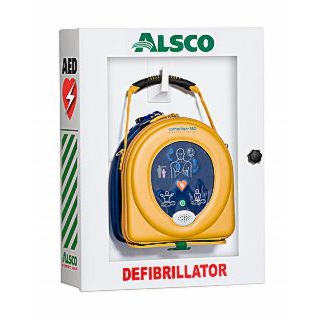
This AED model is:
- Practical and portable – weighing 1.13kg and measuring 20×18.4×4.8cm. Our defibrillators can be used by anyone, anywhere
- Durable and long-lasting – dust, water and shock-resistant and come with an 8-year warranty. These defibrillators are suited for even the most hazardous workplaces
- Advanced technology – cardiac detection selects and delivers the charge automatically for maximum safety and effectiveness
- Foolproof – voice instructions, automated shock delivery and 2-button operation means anyone operating the HeartSine Samaritan 500P will be able to save lives
Does an AED Expire?
The device itself does not expire. Just like any other electrical device, it can go on for decades, or it can stop functioning suddenly. However, since the fully operational AED is of vital importance, it is regularly checked. There is no time for such nasty surprises in the time of emergency.
From the moment a person had a cardiac arrest, to the moment the AED shocks them into normal function, there should be no more than 3 minutes. The sooner the better. Therefore, if your AED is not functional for any reason, there will be no time to find another one. That is the time that you don’t have a luxury of losing.
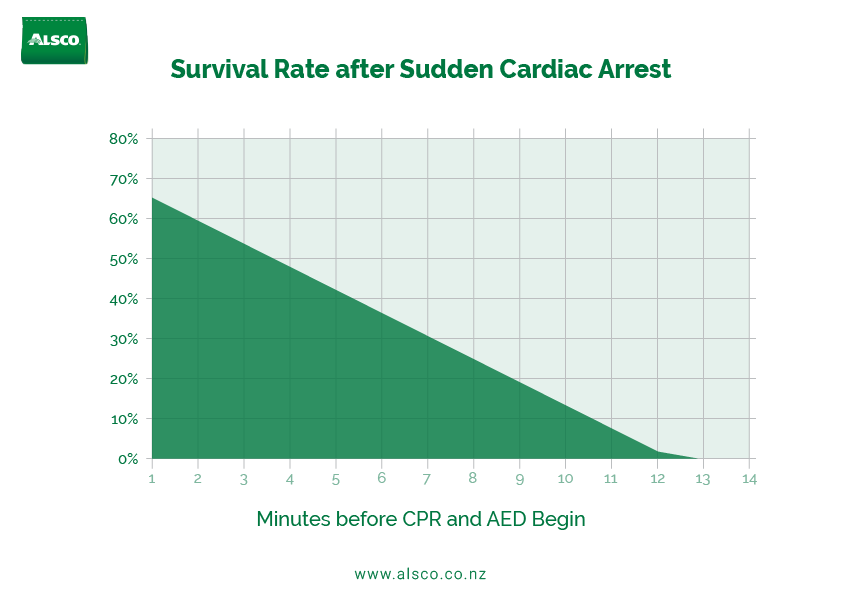
As you can see, this table is showing the sudden and steep drop of the survival rate as the minutes pass by. That is why you need to act fast and to have a fully operational AED handy.
Why Do You Need an AED in Your Workplace?
Take a look at these statistics that concern cardiac arrest in New Zealand and it will all be make sense. These numbers were published by Parliament NZ.
- Every year, there are 1500 primary cardiac arrests outside hospitals in New Zealand. This includes workplaces.
- Using an AED on a person suffering from cardiac arrest increases the chances of survival until the ambulance arrives from 7% to 30%
- On average, in New Zealand, it will take approximately twelve minutes for ambulance officers to get to a patient in cardiac arrest and attach and use a defibrillator. By that time, the chances of survival are very slim.
Do AEDs Need to Be Inspected?
Yes. For all the reasons listed above, the AEDs need to be inspected. The fact that you inspect it yourself regularly is great, but you should let an Alsco NZ representative do this, also.
This is done so that you are sure that the AED device is operational and all the wearable parts are functional and at their best. Inspections should be done every month.
If you rent your AED from Alsco, this is included in your monthly price. A professional will come at an agreed time and inspect all AEDs in your workplace. That is the best way to ensure they will not fail when they are the most needed.
How Often Do AED Pads Need to Be Replaced?
It is expected that your AED pads will need to be replaced every 18 to 30 months. Usually, there is an expiry date on your pads, so you need to make sure that they are replaced before that date.
The main reason why the pads need to be replaced is that they use gel as an adhesive. During CPR and the AED use, the gel is used for the AED pads to stick to the patient’s body. During CPR especially, the pads can peel off if the adhesive is not sticky enough.
This can be catastrophic as the pads need to be positioned during CPR so that the AED can determine whether a new shock is needed or not.
If the pads stay are out-of-date, the adhesive gel dries off. When they dry off, they cannot perform their function and therefore need to be replaced.
How Long Do Defibrillator Batteries Last?
The batteries in your defibrillator usually last anywhere from 2 to 5 years. However, this can depend on the manufacturer. To be absolutely sure if they are still operational, you should check the batteries and their expiration date.
In some devices, there is a spare battery. You should check both of these at least once a month. For the primary battery, you just need to click the ON button (some devices have the TEST button, as well). As for the secondary battery, simply take out the primary one, replace it with the secondary one and do the same test.
Research in the USA claim that one in four deaths, in which an AED was used, was caused by flat batteries. That’s a horrible statistic and one which could be prevented.
How High Should an AED Be Mounted?
Your AED should be mounted on the wall, so that the handle that’s used to grab it, is not lower than 40 cm and is not higher than 120 cm. This may sound very specific, but the idea behind it is that this is the range within which a person in a wheelchair can reach the AED.
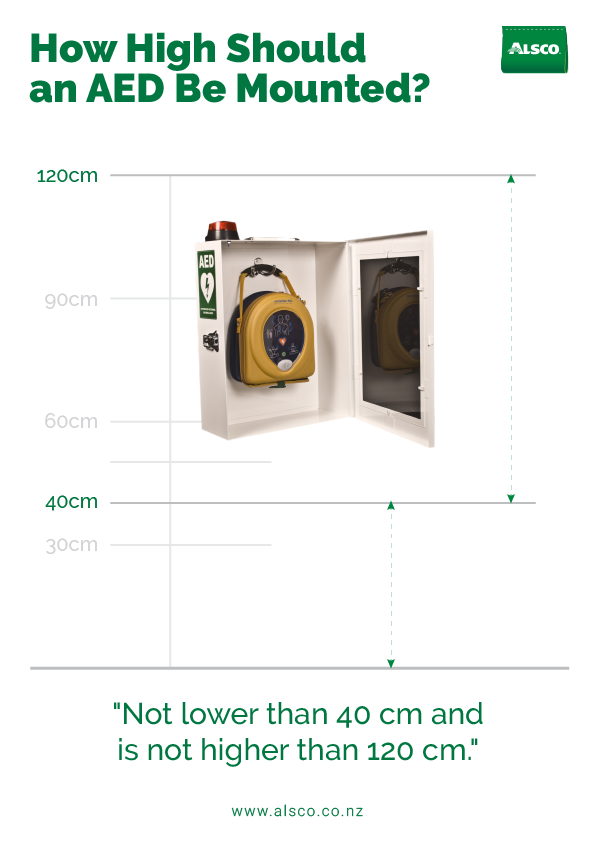
It is essential that the AED is put to use as soon as possible, so it needs to be positioned in a way that facilitates easy retrieval. This means nothing should be blocking it and it should not be behind plants and similar decorations. It also needs to have a bit sign pointing to it.
When an emergency occurs, people typically get flustered and they cannot remember simple things – like where the AED is! A clearly visible sign helps.
Do You Need Training to Use a Defibrillator?
No. There is some training available that can teach you about first aid and CPR, as well as how to operate an AED. This is highly useful and, if there is any chance, offer such courses to all your employees.
But even if there is nobody in your workplace who has first aid training, AEDs are very self-explanatory.
Simply open it, press the button, and it will talk you through all the steps you need to do. You will get short and to-the-point audio instructions about what to do. It’s all about placing the pads on the person and allowing the AED to administer the shock if necessary. If it isn’t, the AED will signal that, and prompt you to continue doing CPR.
Alsco NZ includes all that maintenance in the price you agree on. Call us today and rent your workplace AED.
Where Do You Place a Defibrillator?
One of the best decisions you can make when it comes to workplace safety is to get workplace AEDs installed. They should be easily reachable and there should be at least one AED on a building storey. While there is no direction and official legal requirement about its placement, here are the recommendations about where to place a defibrillator:
- One on each storey if you have a multi-storey workplace
- In the central, easy-to-access access area
- In secluded hard to reach areas where it is difficult to arrive with an AED quickly
- In areas that are frequent and/or the cardiac arrest is more likely to happen
- In the lobby or reception
- Near the phone
When you contact Alsco New Zealand and tell us you want portable AEDs to be installed in your workplace, our experienced representatives will help you decide where and how to position them. They will also install them, check on them and regularly re-check them. Rent your workplace AED today.
What Height Should a Defibrillator Be Placed?
All of your workplace AEDs need to be accessible and visible. Everybody should be able to reach the handle of the defibrillators without the danger of it to drop down.
This means that it should be positioned at no more than 120 cm of height. Also, it should not be at less than 40 cm. In this way, people who are using wheelchairs can also reach it without problems. For the same reason, the unobstructed side reach should be no more than 25 cm.
The height is not the only requirement when it comes to positioning the defibrillator. There are others, as well:
- It should not be in a locked compartment.
- It should never be blocked with furniture, plants or other items.
- It should always be marked with proper signs.
Feel free to download Alsco New Zealand AED sign in as many copies as you need. They will help you in the time of crisis when people are not quick to think, but they need to act fast.
Is It a Legal Requirement to Have a Defibrillator at Work?
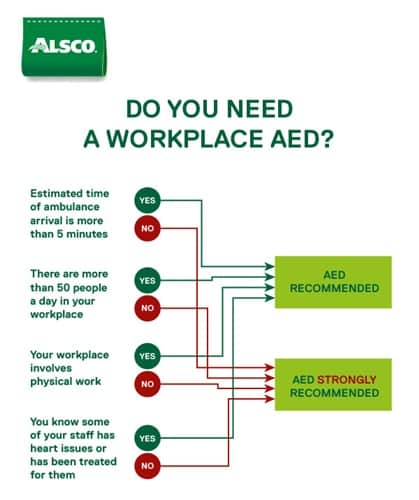
There is not a legal requirement for you to have an AED at work, but there is a recommendation that all workplaces have at least one. Moreover, New Zealand government is trying to spread awareness about the publicly placed AEDs. So, does your workplace need an AED or more?
Find out by following this flowchart:
How Does a Defibrillator Work?
The defibrillator shocks the heart into working properly. When the heart’s ‘electrical work’ doesn’t work properly. Regular electrical impulses are essential for the heart’s function, because they make the heart contract.
The contractions make the heart pump the blood and feed all the organs with nutrients and oxygen. No electrical impulses – no contractions – no blood flow. It is not that the heart needs to contract. It needs to contract in the precise way. Irregular contractions are heart palpitations or fibrillations.
It is all in the name. De-fibrillation means interrupting the fibrillation of the heart. The electrical shock that is administered to the heart stops it for a split second so that the heart can restart at a regular rate.
First, when you attach the pads on a person and push the button, the AED will check their pulse. If the pulse is OK, the AED will not release the current. The same will happen if the AED detects no pulse. The shock will be administered only and only if there is irregular heartbeat that poses danger to the patient.
What Rhythms Are Shockable?
Shockable rhythms are those rhythms of the heart that are caused by the electrical activity. This mainly includes ventricular fibrillation and the ventricular tachycardia, but also supraventricular tachycardia.
Since they are caused by the irregular electrical activity, they can benefit from the restarting. On the other hand, asystole and the Pulseless Electrical Activity are not shockable since they are not the result of bad ‘electricity’ but rather the blood supply to the heart, clogged or disrupted arteries.
Who Is Allowed to Use AED?
Anyone who is around a person that is suffering a cardiac arrest should use AED. You don’t need medical training to use it and you don’t have to worry that you will hurt or kill anybody. Modern day AEDs come with easy instructions and they are designed so that even untrained people can use them.
They analyse the heartbeat on their own and administer the shocks only if they are necessary. They choose the power of the electrical impulse. All you need to do is make sure it is attached properly.
Can a Defibrillator Kill You?
No. AED doesn’t kill people. You should not worry that you will hurt the person that is in cardiac arrest by using AED. AED can hurt a person that has a normal heart rate. However, if and when an AED analyser checks the heart rate and sees that there are no irregularities, it will not administer the shock.
Even if the AED fired, which is extremely unlikely, it is almost impossible that it would kill a person. The electrical shock should have to be released in such a tiny time-window within the heart cycle that it is almost impossible that it would be lethal.
With all this in mind, it is obvious that having an AED in the workplace is a matter of wishing the best for your workplace and your employees. Adding this essentially important level of workplace safety doesn’t even have to be expensive, or a capital investment.
You can rent your defibrillators. Alsco New Zealand offers AEDs that are perfect for the workplace. We install them, show you how they work and regularly check them from time to time, to make sure they are fully operational.
In this way, you just pay an affordable annual fee. You can always decide that you don’t want them anymore or that you need more or less of them. We are flexible!
Call Alsco New Zealand today and get your AEDs as soon as possible.
Photo courtesy of Flickr Images by Cliff Johnson
What Are the Steps for Using AED?
If a person has collapsed and is not breathing or not breathing regularly and you cannot find their pulse and they have changed colour, it is likely that a cardiac arrest has occurred. Take the following steps to use an AED:
- Turn on the AED and listen to the instructions.
- Remove the patient’s shirt
- Dry the patient’s chest
- Locate the pacemaker and medicinal patches
- Attach the pads
- Ensure nobody is touching the patient
- Press the analyse button
- Begin CPR after the shock
- Listen to the further instructions from the AED device
AED is used in the case of cardiac arrest. That can happen to anybody and anywhere. To make sure people in your workplace have the greatest chances of survival, place one or more portable AEDs in your workplace, so they are easily reachable and used.
What Are the Steps in the Chain of Survival?
 Click the image to view the whole Infographic.
AED is an extremely important part of the chain of survival, but it is not the only one. When an accident like a cardiac rest occurs, time is of essential value.
The chances of survival drop with every minute. On the other hand, there are several things to do. You need to call the ambulance, begin CPR, get the AED and use it, all while waiting for the ambulance to arrive.
When to Use AED?
As you can see from the first step in the chain of survival, the early detection of the issue is important. You should use the AED when you notice that the person has collapsed without consciousness, you cannot find their pulse and they are not responsive.
| Symptom | How to check for it? |
| Person is not responsive | Call their name and gently shake them. Kids should not be shaken, only gently pinched. |
| Breathing issues | Look if the chest is moving; check their breath on your cheek for 10 seconds |
| No pulse | Place the index and middle finger on the person’s carotid artery, next to the windpipe |
| Change of skin colour | Visual estimate |
| Spasms | Visual estimate |
AED helps with cardiac arrest. The heart attack victims will benefit more from the constant and well-performed CPR. However, don’t waste time on trying to make a 100% accurate diagnosis and administer both CPR and
Do You Need Training to Use Defibrillator?
No. You don’t need training to use modern AEDs. When you attach them to the patient, they mostly do their work all by themselves. You just need to get it attached to the patient in time.
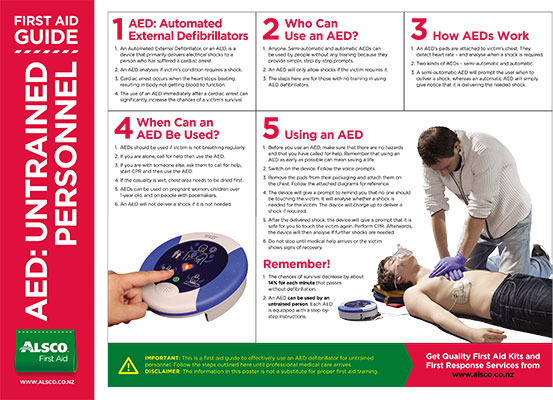
When you remove the patient’s shirt, it is best if you place one pad over the right nipple and the other on the left side of the patient’s chest, below the left breast area. If you need to use the AED on a child, then one pad should be placed on the front and one on the back of the chest.
Keep the AED pads on the patient even when the shock is administered and you are resuming CPR. The AED will continue to analyse the heart rate and warn you if it is about to administer another shock.
When Not to Use Defibrillator?
There are several instances when you should not use the AED and when you should use AED with caution. However, always keep in mind that the reasons FOR the defibrillation usually always outweigh the reasons not to use it. After all, that is the matter of life and death.
| When NOT to Use AED? | How to proceed? | When to Use AED with Caution? | How to proceed? |
| Patient is in water | Remove the person from water, take off their wet clothes and dry their skin | People with pacemakers | Avoid direct contact with the pacemaker |
| Patient is surrounded with combustible material | Move the person to a safe area | People with excessive chest hair | If possible remove the hair or find hair-free patches of skin |
| Children | Use pediatric pads if necessary. Do not use it on infants under 12 months of age. | ||
| People with medical patches | Remove the patch |
Can You Use AED in the Rain?
No. You should not use AED in the rain. You should move the person to the dry area, remove their clothes and wipe their chest dry. Otherwise, the AED will not be able to get accurate readings of the heartbeat and it will not be able to administer the appropriate shock. Also, this can present a danger for the people around the patient.
Can You Use AED on a Pregnant Person?
Yes. There is no fear that the AED will hurt the baby of a pregnant person. The same goes for the CPR. On the contrary, stopping of the mother’s heart means that the baby’s oxygen is cut off, as well.
That can cause more damage than any mechanical injury that is not impossible during the CPR or the AED shock. Don’t worry and if a pregnant person goes into a cardiac arrest, administer the CPR and AED immediately. AED can have a pregnant person’s life.
Can you use an AED on Someone with an Implanted Defibrillator?
Yes. The implanted defibrillator is actually another name for the pacemaker. It is usually located right beneath the collar bone. Earlier models were in the shape of disc that could, sometimes, be seen or felt underneath the fingers. However, today, more and more pacemakers are becoming smaller.
However, the presence of the pacemaker should not worry you. You should just do your best not to place the AED pads on it and everything should be just fine.
AEDs save lives. That should be a good enough reason for you to get them for your workplace. There is no need to make a capital investment just yet.
Rent your workplace AEDs from Alsco NZ and make it easy for yourself. We install them, service them and check them. You just let us know you need them. The rest is our concern.
Photo courtesy of EMS Safety


