Trusted by 237K+ Business Worldwide. Find a Location
Trusted by 237,000+businesses worldwide across 250 locations delivering uniforms, linens and more. Find a Location Near You


Delivering Excellence Since 1910
Contact Us
5 Reasons To Invest In Hand Sanitisers For The Workplace
The workplace makes you susceptible to many forms of diseases. Good hygiene plays a big factor in keeping the work environment tidy and productive.
Hand washing alone is not enough to kill bacteria. The use of hand sanitisers is also essential in preventing the spread of illness.
Providing a clean, hygienic workplace is important to keep your staff safe against germs. From wall-mounted soap dispenser units, and hand drying solutions, to hand sanitisers, hygiene amenities should be complete.
If you want the best hygiene products that are affordable and easy to install, contact Alsco now.
Why Do You Need Hand Sanitisers?
Did you know that the average desk contains about 400 times more germs than a toilet seat? Frequently touched surfaces are also a breeding ground for germs including lift buttons, telephone handsets, and door handles.
Once the disease spreads, absenteeism begins. This can become a burden on the company and the rest of the staff.
Providing hand sanitisers is one way to help your company’s bottom line. Because it’s convenient, it can easily promote good hygiene and encourage your staff to participate.
How Do Hand Sanitisers Work?
Proper handwashing with soap and water is still the best method to reduce microbes in most situations. However, if soap and water are not available, alcohol-based hand sanitisers that contain at least 60% alcohol are the best substitutes.
Hand sanitisers are typically gels that contain alcohol. It works immediately and effectively in order to kill bacteria and most viruses. Most brands of sanitisers contain moisturisers to minimize skin dryness and irritation.
Hand sanitisers may work well in settings where hands come into contact with germs but are not heavily soiled or greasy. They are more effective in reducing the spread of rotavirus, adenovirus, and rhinovirus.
Why Should You Invest In Hand Sanitisers?
1. Prevents the spread of diseases
The flu and common cold are contagious and can be transmitted via airborne droplets and direct contact. The things you touch throughout the day can become a breeding ground for countless bacteria. Hand washing or the use of sanitisers are effective ways to prevent the spread of germs.
2. Keeps environment safe
If you’re working in the food, education industry or healthcare setting, good hygiene and cleanliness of the workplace are paramount. Regular handwashing or the use of hand sanitisers can reduce the risk of cross-contamination.
If education is your field, to help you learn all you need to know about the effects of washrooms on making a school a safe, healthy and pleasant environment for students and staff, we’ve created the ultimate School Washroom Guide. It will teach you how your school washroom can meet all the legal requirements, health and safety standards and much more.
3. Reinforce the habit among employees
Hand hygiene is essential for good health, yet many people do not give it much thought. Establish the habit of handwashing among your staff by making hand sanitiser dispensers visible and easily accessible. The sight of the container will remind everyone of what they are supposed to do.
4. Boost work productivity
Preventing the spread of illness is preventing absenteeism. Healthy people make more and that’s a fact. Habitual practice of good hygiene amongst employees will lower the risk of spreading diseases. Keep your team or staff in tip-top shape.
5. Show workers you care
A fresh and hygienic washroom only shows that you care about the comfort and well-being of your staff. More so, a washroom that includes complete amenities such as hand soaps, hand sanitisers, paper towels, and hand dryers can create a lasting impression on guests and clients.
What ALSCO Can Offer?
Germs lurk in your work environment every day. Simple steps like putting up hand sanitiser dispensers can go a long way towards keeping employees healthy and productive. Alsco offers a wide range of hygiene products suited to specific needs.
Stop the spread of illness in the workplace and invest in good hygiene practices now!
Want a well-maintained, well-managed washroom and hygiene system, contact Alsco now.
Alsco’s Quick Tips On How To Make The Workplace First Aid Ready
Summary: Is your workplace capable of giving immediate care during emergency cases?
Workplace first aid readiness can mean the difference between life and death. A quick response can reduce the severity of the injury.
It is a legal requirement for employers to provide first aid facilities in the workplace, as stated in the Health and Safety in Employment Regulations 1995. However, the process to first aid readiness may be a bit complex.
If you want a fully managed, hassle-free, safety solution, contact Alsco now.
Why is Workplace First Aid Important?
According to the Workplace Health and Safety Strategy for New Zealand to 2015, there are about 100 work-related fatal injuries in New Zealand every year. More so, approximately 17,000 to 20,000 new cases of work-related diseases are reported annually. Over 200,000 occupational injuries result in ACC claims.
First aid in the workplace covers the arrangements for employers to ensure that employees receive immediate attention in times of illness or injury. It also includes calling an ambulance in serious cases.
First aid can save lives in a number of situations. For instance, immediate CPR treatment can increase the chances of survival for heart attack.
First aid readiness can also protect your business. Providing immediate and effective first aid to injured workers may help speed up recovery. They may be able to return to work quicker, with lesser treatment costs.
What Does the Law Say About Workplace First?
Health and Safety in Employment Regulations 1995 was created to secure the health and safety of workers and workplaces by eliminating or minimising risks, promoting the provision of information and training, and providing the right facilities.
Employers are required to take all steps to ensure:
- First aid facilities are provided at every workplace
- Facilities are suitable for the purpose for which they are used
- Facilities are provided in sufficient numbers
- Facilities are maintained in good order and condition
- All employees have access to these facilities
How to Do a First Aid Needs Assessment?
To identify your first aid needs, a workplace assessment should be completed. Some circumstances can affect your first aid necessities.
Low-risk workplaces only need minimum arrangements, such as a stocked first-aid box. For workplaces with greater health and safety risks, they are more likely to need a first-aider.
Ask yourself the following questions:
What are the hazards present?
It can be physical, environmental, chemical, or biological. For example, working at heights provide greater risks for fall. Or, working under an open heat of the sun can result in sunburns. Work processes like cleaning machinery also create hazards.
How many employees are in the workplace?
The number of workers will affect the facilities you need, including the volume of supplies. It will also determine the number of first aiders you need. Make sure that the first aid provisions cover all hours when employees are working.
What is the layout of my workplace?
The size and layout of the workplace matter. First aid should be readily accessible to all employees upon minutes of emergency situations. You need to consider how long it will take for a first aider to reach the injured or ill person.
How can location affect my first aid needs?
Employers should also take into account the proximity of the workplace to medical centres, hospitals or ambulance service. For those situated in remote areas, find out how long it takes for emergency services to reach the workplace.
How many first aiders do I need?
The hazards in your workplace, the nature of work, the number of your employees, and location will determine the number of first aiders you’ll need. For instance, an IT company close to a medical centre, with three employees, may no longer need one.
The Core Elements of First Aid Readiness
First aid readiness offers obvious benefits for both your employees and your business. It can also help you with reduced claims costs associated with workplace injuries. Here are its three core elements:
1. Resources and equipment
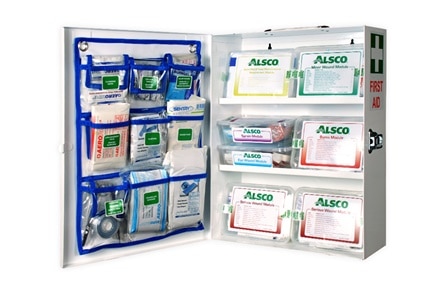
A fully-stocked first aid kit, with clear first aid signage, should be found in each place where people are working, including work vehicles. Supplies should be enclosed in a sturdy material to protect contents from contamination.
For high-risk workplaces, such as those located in remote areas, first aid rooms may be necessary. First aid kits must be checked regularly. Items should be replenished after use, and replaced before the expiry date shown on the packaging. Nothing other than first aid equipment or related equipment should be in the kits.
2. Accredited first aiders
A first aider should be available during work hours and provided on all shifts. Low-risk workplaces are required one first aider for every 50 workers. High-risk workplaces need one first aider for every 25 workers.
First aiders are required to undertake annual refresher courses in CPR and renew their qualifications every two years. Training should be carried out by people who work for an organisation accredited by the New Zealand Qualifications Authority.
3. Procedures and drills training
All employees must be given clear information about first aid available in the workplace. They should know the location of first aid kits and first aid rooms. Communication channels should be clear in case of an emergency.
Employees need to be introduced to first aiders so that they know their names and where to find them. For high-risk workplaces, employees need to be trained in basic first aid procedures, and what to follow when needed.
Alsco Managed First Aid Kit Solutions
Give your workers an extra dose of confidence by letting them know that their safety and wellbeing is taken care of. Alsco offers best-practice solutions for your business to get you first aid ready and compliant.
Alsco’s serviced first aid kits have the following advantages:
- Their dedicated team does all the checking
- They make first aid kits sturdy, well mounted, and portable.
- Supplies are hospital-grade and auditable to WHS guidelines.
- They offer a scheduled maintenance program.
- Fees are inclusive of consumables with value for money.
Choose Alsco for a fully managed, hassle-free, safety solution. They also offer portable defibrillators, eyewash stations, and vehicle first aid kits.
Be first aid ready! Visit www.alsco.co.nz to discover the services Alsco can provide. Fill out our enquiry form and we will contact you shortly.
Photo Courtesy: Reytan
Your Hassle-Free Solution To Installing Eyewash Stations In The Workplace
Summary: Workers in the manufacturing industry are still at high risk of eye injury.
Eyewash stations are the ultimate convenient answer. They provide on-the-spot decontamination to flush away hazardous substances that can cause injuries to the eyes.
Even a strict compliance with safety procedures can’t guarantee total protection from accidental chemical exposures. Look beyond the use of goggles, face shields, and procedures for using personal protective equipment.
If you want the most reliable eyewash stations that are affordable and easy to install, contact Alsco now.
Why Do You Need Eyewash Stations?
Every year, more than 4000 eye injuries occur at work in New Zealand. A sizeable percentage of these statistics consisted of employees from the manufacturing industry. Many results in pain, impaired vision, time off work and some are blinded.
The eye contains delicate and sensitive parts. If it comes in contact with corrosive chemicals and irritant liquids, it may cause corneal scarring. This leads to visual loss and disfigurement. Radiation from welding flash and industrial laser beams can lead to visual impairment by causing burns to the retinal layer.
Common eye injuries include:
- Penetration of foreign objects like metal scraping into the eyes
- Scratches and abrasions on the eye’s surface (cornea) from foreign objects
- Burns caused by exposure to caustic chemicals
- Swelling caused by being struck in the eye by a fast moving object
The good news is, most of these eye injuries can be alleviated, if not totally prevented. The best first aid treatment is to immediately flush the eyes with flushing fluid within 10 to 15 seconds of exposure. Then, followed by the appropriate medical attention.
Safety goggles and personal protective equipment can’t always guarantee total protection from accidents. Eyewash stations are the ideal solution for your eye emergency needs in the workplace. They are an absolute necessity, even for schools, laboratories, and kitchens.
What Does the Law Say About Eyewash Stations?
Safety standards define eyewash stations as devices designed and intended to deliver flushing fluid insufficient volume, to irrigate and flush the eyes. Australia and New Zealand Standards require a facility of the appropriate type in each room where chemicals are used.
Eyewash safety units should be located on the same level within ten seconds of the hazard or work areas. In the presence of strong acids or bases, the eyewash station should be adjacent to the hazard.
Eyewash units should function in accordance with safety standards. For plumbed units, a continual source of potable water is required. Stand-alone eyewash stations should immediately be refilled or replaced after use. Employers should make sure that these devices are highly visible and well-marked.
Make sure to purchase an eyewash unit that has been approved by a third-party authority. Maintain it regularly to ensure that it will do its job during an emergency. Employees who are exposed to hazardous substances must be trained in the use of the equipment.
How to Choose the Right Equipment?
The need for emergency eyewash stations is based on the chemicals that workers use and the tasks that they do in the workplace. A job hazard analysis is important to identify potential risks and dangers of the job and the work areas.
General requirements for eyewash stations include:
- Ability to flush both eyes simultaneously.
- Freeze protection when the possibility of freezing temperatures exists.
- Nozzles protected from airborne contaminants.
- The unit shall deliver no less than 0.4 GPM tepid flushing for 15 minutes.
- Valves should have a ‘stay open’ feature.
The standard also recommends self-contained units to be constructed of materials that will not corrode in the presence of flushing fluid. As for maintenance, both plumbed and self-contained eyewash stations must undergo weekly inspection to verify proper operation.
Plumbed eyewash stations are not always possible or accessible due to location issues within the workplace. If space is an issue, you’ll need a portable model to support or substitute a plumbed equipment. Portable eyewash stations are great for first aid.
The key requirement, for portable models, is that instructions and the expiration date must be permanently marked on the containers. Inspection and maintenance should be performed according to the manufacturer’s instructions. Regular check-ups, replacements, and resupplies are essential.
How To Do Proper Flushing?
Approved flushing fluids include potable water, preserved buffered saline solution, or other medically acceptable solutions. Eyewash stations should expel only tepid water with temperatures ranging from 60°F to 100°F.
Flushing periods will depend on the kind of foreign object or chemical the eyes are subjected to. If the nature of the contaminant is not known, a flushing period of at least 20 minutes is required.
For other chemicals, flushing and rinsing time are as follows:
- Mildly irritating chemicals require 5-minute flushing
- Moderate to severe irritants require 20 minutes
- Non-penetrating corrosives need 20 minutes
- Penetrating corrosives require longer flushing time of 60 minutes
Non-penetrating corrosives include most acids. Their properties limit the extent of damage since they react with human tissue to form a protective layer. Penetrating corrosives threaten the vision because they enter the eyes deeply. Hydrofluoric acid, phenol, and most alkalis are penetrating corrosives.
If irritation continues, repeat the flushing procedure as first aid until proper medical attention is available. The eye injury and chemical contamination should be consulted with a physician.
Alsco Portable Eyewash Stations
Time is of the essence when it comes to saving someone’s eyesight. Choosing the best eyewash station for your workplace doesn’t have to be complicated. Alsco’s objective is to provide an eyewash model that is accessible easily and instantaneously.
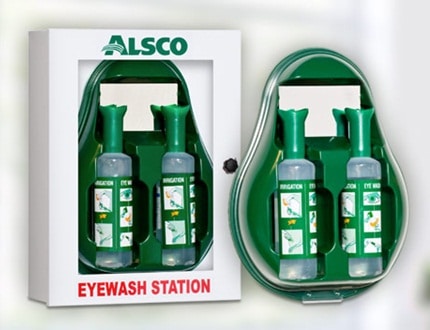
Alsco’s eyewash stations are a practical alternative to fully-plumbed flushing equipment. These do not require plumbing, thus affordable and easy to install. Employers can set up more units throughout the work area. They are highly portable and allow their users to be mobile.
Each of our portable units provides simple, step-by-step visual instructions. The equipment is kept in a highly-durable, visible wall-mounted cabinets. Each station comes with two bottles of 500ml saline flushing solutions and features a no-mess flush system.
What Is Managed Rental Services?
The Alsco team is dedicated to assisting their clients in their WHS compliance requirements. That is why they offer a hassle-free Managed Rental Service when it comes to first aid. Rather than buying multiple eyewash stations, employers can simply pay a single annual fee.
With Alsco, there is an agreed maintenance schedule for your eyewash stations. Rest assured that supplies that are never out of date. Your first aid kits are appropriately stocked with the specific supplies you need for emergencies.
Portable eyewash stations are:
- Re-stocked regularly
- WHS Compliant
- Hospital-grade supplies
- Up-to-date Service Logs
- One small, simple, flat fee
It is best to be prepared with the proper safety equipment. Before purchasing and installing your eyewash stations, check what standards your state has set. Regulations may vary in local areas, but our friendly sales representative from Alsco can assist you.
Be first aid ready today! Get in touch with us now for a free quote.
Prepare Your Workplace For any Civil Defence Emergency
[intro]For the very first time, New Zealand businesses can access emergency equipment in the form of customised modules.[/intro]
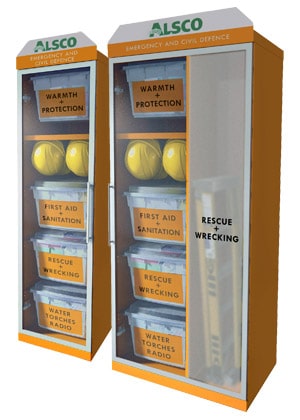 Introducing unique fully managed modular civil defence systems.
The modules are contained within safe, sturdy floor cabinets with clear glass doors, enabling staff to ‘grab and go’, depending on the nature of the emergency (and in case of evacuation).
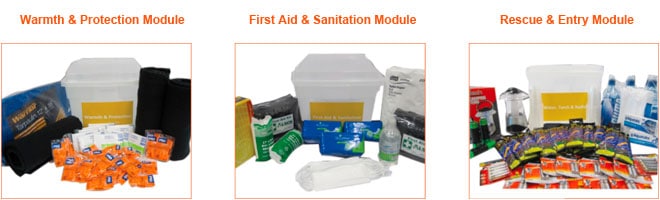
Alsco’s Emergency Response Systems provide Warmth and Protection Modules, Safety Helmets, First Aid and Sanitation Modules, Rescue and Entry Modules, Water Torch and Radio Modules, Fire and Spill Kit Modules and Food Modules.
Cabinets and Modules can be expanded according to staff numbers, floor space and existing emergency equipment.
Prepare your workplace for any civil defence emergency.
- Sturdy floor cabinets
- Transparent glass doors
- Customised ‘Grab and go’ modules
Managed First Aid Systems
Workplace injuries happen to 600 people and kill one New Zealander each week. Apart from the human toll, the effect on a small or medium-sized enterprise can be terminal.
According to Gavin Smith, the designer of a tailor-made managed first aid system, although the New Zealand workplace is getting safer, what is required for businesses to comply with Occupational Safety and Health (OSH) is getting tighter and more robust.
Managed first aid systems
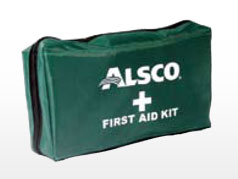 Gavin, New Zealand manager at Fresh and Clean, part of ALSCO, specialists in managed first aid systems, says an increasing number of Australasian businesses are now opting for this type of system, where they contract their first aid kit management to an all in one rental service because the DIY approach doesn’t meet the stringent OSH or Australian state requirements.
He explains: ‘Most businesses will have a first aid box somewhere and usually they are completely disorganised and dysfunctional. I visited a South Island engineering firm a month ago. They were prepared for a paper cut at best. If a major cut or injury occurred they wouldn’t have been able to deal with it.’
OSH Guidelines for businesses
Gavin has summarised the five pages of OSH Guidelines for businesses to meet the requirements of the Health and Safety in Employment Act (1992) into eight points:
- ‘All practicable steps’ should be taken by employers (and others) to provide properly maintained first aid equipment.
- First aid equipment is suitably marked and easily available.
- Marking used should be a green cross on a white background.
- There is at least one kit on each floor of a multi-level workplace.
- An additional kit should be provided where there are more than 50 employees and every 50 employees thereafter.
- It is essential for first aid equipment to be checked regularly.
- Items are to be replaced before the expiry date on the packets.
- Each work vehicle should be provided with a first aid kit.
He explains: ‘Most people fall over at the first step. Many businesses will have bought a kit five years ago and forgotten all about it. Secondly, they will most likely have put it somewhere and in an emergency, no one can find it. Thirdly, you’d be amazed at how many still have a red cross on them. When we do a first aid kit audit we find that most kits have not been checked recently. The rules have changed too; everything has now to be single-use. You can’t just have a bottle of eyewash for example. They have to be single, sealed, sterile packs.’
Managed first aid system – An American example
Gavin developed a managed first aid system after being told about an American version by ALSCO chief, Tony Colenso. ‘Our CEO had seen the concept of a managed first aid system in the US. Broadly spoken we are a health, safety and image company and it seemed to us that this would be a natural evolution for our overall service. I looked at how we could develop a scheme for our existing customer base and we started with a pilot service in Wellington in 2002.’
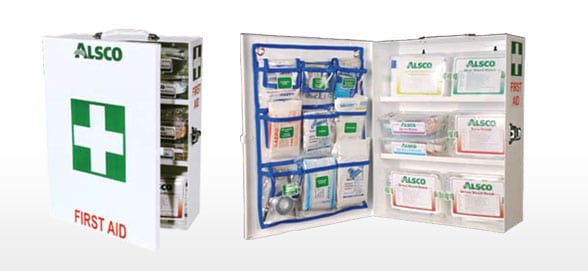
Several other suppliers will sell businesses a first aid kit but checking the contents and replacing used items is either too expensive or left to the client to manage by ordering supplies online.
Gavin explains: ‘A lot of businesses don’t realise how much they spend managing their kits and the people to manage them. It’s a false economy. They don’t know if their kit is being serviced to the correct standards if it has been allocated to a staff member or what their auditing ability internally is. But many businesses now prefer to have it done for them and know that they are meeting all the OSH requirements. A rental programme for around a dollar a day per kit removes the need to check the kit yourself and the servicing of our kits takes less than two minutes for one of our trained operatives.’
Checked and restocked
Gavin designed the ALSCO kit with an exchangeable liner with clear plastic pockets for day to day use. The contents are checked routinely and restocked. The entire liner is replaced every three months whether used or not. The contents are reprocessed offsite and ALSCO has established a network of organisations such as the SPCA, zoos, animal shelters and Rotary, for offshore disaster relief, to take the expired products.
There are also six modules in each kit for accidents and specific injuries, covering all the items for a reasonably sized incident allowing someone to grab and run to the accident site with everything they may need.
Gavin points out: ‘We developed the kits in New Zealand with our own liner and modules. There is no prescriptive use in NZ but Australia has adapted the kit to suit the separate state compliance requirements. If the modules are opened or missing or the expiry date is exceeded we replace them and if a specific module is used we will enquire and check that it has been logged in the accident book, which is part of the OSH requirement. Very often we are the first to point out to the client that the accident book needs updating. Inside the door of each kit is a sheet which is signed at each service as well as an online record.’
There are now more than 4,000 kits in use in New Zealand and the service has been operating in Australia for three years with around the same number signed up there. New Zealand clients include a wide range of organisations such as the Ministry of Health, Hollywood Bakeries, Department of Corrections, Ministry of Fisheries, Auckland City Council, a number of other district councils and libraries, the Olympic pool at Newmarket and Parliament House.
Four versions of kit available
In New Zealand, there are four versions of kit available; large for up to 50 employees; small for up to 15 employees, plus a food version of each (with blue plasters which are visible and metal detectable). There are supplementary kits for smaller offsite, vehicles, executive workplaces. The company also offers additional equipment such as defibrillators and eyewash stations
Gavin explains that even a small business never knows quite what it might need in the event of an accident. Last August an Mt Eden physio who had just taken delivery of an ALSCO defibrillator used the unit to save the life a man who had been electrocuted while erecting flagpoles on Normanby Ave outside the gym where the physio worked.
Gavin says: ‘He was at the man’s side within three minutes and without the defibrillator, the man could have died. He had only just rented the defibrillator from us and had just been trained in its use the month before.’
Free no-obligation compliance audits
In early 2012 ALSCO is to start offering free no-obligation compliance audits to small and medium-sized enterprises to see if they are compliant with OSH first aid requirements.
Gavin adds: ‘We have grown this Kiwi developed service so that we are the only true national provider. We have started to pick up national organisations as well as smaller owner-managed businesses because of the need to standardise systems. We do offer peace of mind but at the end of the day it’s about doing what’s right.’


