Trusted by 237K+ Business Worldwide. Find a Location
Trusted by 237,000+businesses worldwide across 250 locations delivering uniforms, linens and more. Find a Location Near You


Delivering Excellence Since 1910
Contact Us
4 Reasons Why You Should Clean Your Work Desk Frequently
Everybody wants to have an organised workplace, but just wanting work desk cleanliness not the same as having it.
This has nothing to do with being organised and clean in general. Sometimes, it’s just about being way too busy to pay attention to the details. Who can think about the appearance of their work desk when there is so much work to do and so little time to do it all?
As it turns out, there are four reasons why you should pay more attention to your work desk cleanliness. Some of them are so crucial, you will definitely start thinking about them the moment you enter your office.
1. It Helps You Relieve Stress
We all know how frustrating it can be trying to work on a cluttered desk. After all, all that clutter can influence your state of mind as well. Plus, if you ever need to find something quickly, it’s definitely easier to do so if your desk is well organised. Otherwise, you’d have to struggle to look for it under all the mess every single time.
On the other hand, having everything well-organised means it will take you much less effort and time to find it, which is especially helpful when it comes to finding those really important things. Needless to say, this can also greatly reduce your stress levels.
Moreover, a good organisation can be connected to visual synergy – your eyes won’t be distracted by the disorder on your desk. This means that you’ll be able to stay calm no matter how much work you actually have.
2. It Leaves A Great First Impression
Everybody knows how important first impressions are. True, they are mostly used in the context of dating and relationships, but they are just as important when it comes to your office.
You have to admit that it doesn’t look good when somebody enters your office just to see a messy desk. Regardless of how much work you have, a disorganised desk sends a bad message about you to your clients and coworkers.
On the other hand, if you’re organised, you’re telling people that you are reliable, trustworthy, and in control of your work. Of course, it’s good to actually have these qualities, but you should also be able to show them. Therefore, spend some time cleaning up your office desk, at least for others if not for yourself.
3. It Is Healthier
Anything that’s cluttered creates nooks and crannies where dust and dirt can collect unnoticed. And if there’s one thing you need to know about dust and dirt is – it can have really bad effects on one’s health.
While this is especially true for those with asthma or allergies, those effects can be just as bad for those who don’t. Some particularly nasty effects include sore throats, itchy eyes, and runny noses.
When those things hit a person, it makes it very hard to focus on work. Productivity can suffer badly from something as “innocent” as a dirty desk. When things are neatly organised and set in their proper places, cleaning becomes an easy task. That’s because of this way, you eliminate any hidden places and spaces where dust and debris can be found. Additionally, keeping things organised lets you easily see what’s clean and what’s not.
4. It Inspires Others To Follow Your Example
If your desk is always messy and disorganised, others might think that it’s okay for their desks to be the same. They might not even notice the clutter on their desk, and this can really become a problem if it starts happening to somebody like a manager. It can set a very bad example that can have terrible consequences if people choose to follow it.
On the other hand, when you keep your desk clean, you also inspire others to do the same. Even though this is mostly psychological, it can still brighten up your workplace. When everyone’s desks are clean, the work environment becomes rather pleasant, which can have a positive effect on the morale of the employees.
At Alsco, we know perfectly well how important workplace hygiene is. We’ve been helping Australian businesses maintain high levels of workplace cleanliness for years.
We provide cost-friendly solutions your company could use to improve the lives of your employees. Everything from safety to hygiene is covered by our extensive product line.
Give us a call today and we can help find the purchase or rental package perfect for you specifically.
What Do I Need for a Workplace Earthquake Kit?
In New Zealand, the Health and Safety in Employment Act states that every workplace should have a plan in case of emergency.
The safety of employees is one of the primary obligations of a business owner.
Given that the people of New Zealand can feel around 100 – 150 earthquakes a year, it is obvious that every workplace should be prepared for this emergency situation.
One of the most important things a workplace should have to be prepared for is an emergency earthquake survival kit.
[b3_row]
[b3_column lg=”8″ md=”12″ sm=”12″ xs=”12″ ]
Some of the items it should contain are:
- Items for warmth and protection
- Items for first aid and sanitation
- Items for rescue and entry
- Items for communication
- Items needed to contain fire and spills
- Food and water
Alsco provides emergency kits that are classified into modules that contain such items. All those modules are clearly marked and they are packed in a logical order in a cabinet, so you can find your way around them even in dark.
[/b3_column]
[b3_column lg=”3″ md=”12″ sm=”12″ xs=”12″ ]
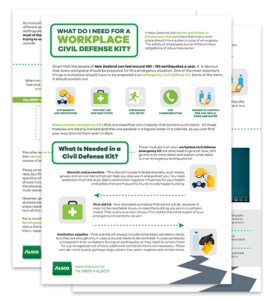
FREE “Workplace Civil Defense Kit in PDF” – DOWNLOAD HERE
[/b3_column]
[/b3_row]
What Is Needed in an Earthquake Kit?
These modules from your workplace earthquake emergency kit are described in general. Now, let’s go into a bit more detail and explain what really is in an emergency earthquake kit.
Warmth and protection – This should include foldable blankets, dust masks, gloves, and similar items that can help you stay warm and protect you. You need protection from the dust, debris and similar negative influences for your health and safety that are frequently found in a damaged building.
First aid kit– Your standard workplace first aid kit will do. However, it may not be reachable to you in case the building you are in is compromised. That is why a version of your first aid kit should be a part of your emergency kit contents, as well.
Sanitation supplies – First aid kits will always include some basic sanitation items, but they are enough only in case a wound needs to be sanitised. In case somebody is trapped in their workplace during an earthquake, or they need to remain there for a prolonged period of time, additional sanitation items are necessary. These include moist towels, garbage bags, plastic ties, water supplies and similar items.
Communication, rescue and entry items – It is possible that an earthquake will compromise the electric grid in your workplace. It is necessary to turn off utilities and prevent further disaster. That is why you need wrench or pliers, but also protective gloves and even helmet. You will need a flashlight, battery-powered radio, phone and extra batteries to be able to communicate. It is also useful to have a whistle available.
Food and drink – In the worst case scenario, you will have to remain in the workplace for longer than a day. That is why a lot of workplace emergency kits are created to help you survive a period of 3 days. In this case, you need some non-perishable food and at least 3l of water per day, to help you with sanitation and of course, to keep you hydrated.
These are all items that need to be available in your workplace emergency kit. If an earthquake hits, it is best to stay inside. Given that you spend a lot of your time at your workplace, there is a good chance that you will be forced to stay there for a while.
What Should You Do During Earthquake at Work?
In case you are inside your workplace when an earthquake happens you need to stay inside. Moreover, you should follow the Drop, Cover and Hold protocol. There are many people who rush outside in case of an earthquake, but that is a bit mistake. That is something you should be doing in case of fire.
When an earthquake strikes, the authorities in New Zealand recommend you take the following three steps:
- Drop – get on the ground as soon as you realise that the earthquake is happening. If you are unable to drop to the ground, head to the walls, away from the glass windows and try holding onto a piece of sturdy furniture.
- Cover – Seek cover under the sturdiest piece of furniture in your vicinity. In case that mortar, light fixtures and other items start falling off the ceiling, you need to be covered.
- Hold – Grab the sturdiest and the nearest piece of furniture and hold on to it. Don’t let go until the shaking stops and even for a while after that.
By analysing the injuries and outcomes of different actions taken during New Zealand earthquakes, it has been concluded that the most of the injuries were sustained by people trying to exit and those who managed to get outside.
Severe earthquakes cause parts of buildings, trees and even street lights to fall off and such objects can cause injuries. The same goes for the glass windows and even electric cords that can get torn. Inside your workplace is safer, even if the building has been compromised to a lesser degree.
How to Prepare a Workplace Earthquake Emergency Plan?
When an earthquake happens, it is a bit too late for planning. Everything will be happening too fast and you need to plan ahead. As a business owner, you need to make sure that you have a workplace emergency plan already set and that all your employees are aware of it.
You need to make sure that:
- Your employees know about the drop, cover and hold procedure
- Your employees know where the earthquake kits are
- Your employees have their go bags ready in case evacuation is necessary
- Your employees know about your established after earthquake procedure
All of New Zealand is at risk of earthquakes, and lots of us travel to parts of the country where earthquakes are more common. pic.twitter.com/at2NYI4d9P
— Get Ready Get Thru (@NZGetThru) December 5, 2016
The after earthquake procedure should be clearly understood and your employees should have their personal workplace emergency plans. Also, there should be an agreement about the correct course of actions and the leadership chain in case of earthquake.
These emergency plans will include the same idea, but they should also take into account the specifics of your workplace. For example, it should include the fact that nobody should use the elevators in case you run your business in a multi-storey building.
However, getting a well-supplied and regularly stocked earthquake kit is something every workplace needs. Contact Alsco New Zealand and rent all the earthquake kits you need.
For an affordable annual price, you will always be prepared for an emergency and you’ll never have to worry about the state of your kits, as we will check them, repair them, and replenish them regularly.
8 Signs Your Employees May Be Fatigued
Fatigued employees are never capable of offering one hundred per cent at work. No matter what you try to do and how you try to help them and motivate them, you won’t succeed unless you help them rest.
Some disorders like the work-related musculoskeletal disorder (MSD) can cause people to become exhausted, to miss out on work and to even injure themselves in the workplace.
MSD should be taken very seriously – it’s been identified as a very serious disorder. Ergonomics, proper rest time, all of these things can help out in preventing (or alleviating) issues like these.
Integrating and presenting ergonomic solutions in the workplace can do wonders. You should even invest in some quality ergonomic products that aim to reduce employee fatigue.
In case you are wondering how ergonomic products may help you and your employees:
- They improve employee work quality. Workers that perform manual labour duties that really tire them out will really enjoy ergonomic products. It will not only make their jobs less painful but will even help them rest more effectively.
- They improve productivity. Employees will become much more efficient. They will be in less pain, have less joint aches and issues, and this will, in turn, get them to accomplish much more at work.
- They lessen and reduce expenses. MSD can be prevented, and quite easily. All the costs associated with this disorder can be nullified by just getting proper ergonomic gear.
- They help to create a culture of safety. By having ergonomic items and products, you send out a message not only to your competitors but to your employees and customers as well. A message that centers around safety and employee care.
- They improve employee morale. By having this stuff, you show that you care. This will do wonders for the employees, their moods, and their morale.
So, we hope this section has been informative. If it indeed was, then we would like you to think about something else. Namely, do any of your co-workers or employees look tired? Fatigued? Exhausted?
We advise you to check out the following early warning signs of work-related fatigue. This may save someone from serious injury.
1. Their Productivity Is Falling
While they seem to be working longer hours, employees experiencing fatigue tend to be less and less productive over time.
So even if you add all these extra hours, the net total is that you won’t get as much productivity as you want, as well as getting low-quality work and unhappy employees.
If you notice that your employees’ productivity has hit an all-time low, then there’s definitely something wrong going on with them.
2. They Are Never In A Good Mood
Closely observe employees who seem not to be their usual selves and are acting out of character. Moodiness, emotional distress, or having a bad attitude in the workplace are telling signs that something is wrong.
3. They Get Fidgety
Now, people have their own needs and want. But, most understand that they can and should tolerate a certain amount of discomfort at the office. Now, this may be fine and dandy, but sometimes, they can go overboard and put on a tough façade.
If you notice them fidgeting at their workstations, or that they are very uncomfortable, you should problem get them to do something that is not related to their work. This may seem silly, but it can, in fact, be a sign of some subconscious stress, or simply some pain that they are not willing to share with people.
It is, however, an early sign of fatigue, and you should do everything in your power to alleviate it until it gets worse.
4. They Seem Distant
Everyone experiences forgetfulness at some point but employees with fatigue may suffer from ongoing forgetfulness and complete disregard for their work and their team at large.
This will not only affect their performance, but it can also waste other employees’ time. It’s an obvious sign that the employee has a lot on his plate and is struggling to get on top of their workload so it is best to find out what’s causing this behaviour.
5. They Are Always Late
There are employees who are habitual late comers – those who run late in every aspect of their lives. But once you notice someone in your team, who usually comes on-time, if not an hour early, to work every morning, arrive late for consecutive days or weeks, then that is a clear indicator of fatigue or poor work-life balance.
6. They Often Don’t Show Up
Employees experiencing fatigue will always find ways to justify not getting out of bed in the morning. When you start to notice an alarming increase in your employees’ absences, then maybe it’s about time to ask if work-related fatigue has taken over people in your office.
Again, talking to employees involved is critical, but it’s also important to do something about those factors making it hard for them to perform their duties efficiently.
You can also actually walk in their shoes and try out their job for a day yourself. If you find that you hate it and everything is, in fact, uncomfortable to use, the safe bet is that therein lies the problem – one that needs an ergonomic solution.
7. Their Hygiene Is Problematic
Always pay attention to your employees’ workstations and desks. A messy desk can be a sign of stress that may have been caused by overwork.
8. They Keep Complaining
People headed towards fatigue aren’t going to keep it in. Whether it’s straight out complaining about it with their friends during lunch breaks or even just a long drawn out sigh of relief when they get up for a stretch, these are the most obvious clues that fatigue might be just about to set in.
Of course, it’s never a safe thing to assume. So, an effective next step would be to talk about it, or at least to encourage sharing. You’ll be surprised how much more smoothly this conversation will actually go. When it concerns comfort, no one is ever too shy.
At Alsco, we have several ideas that can be simple, subtle, and passive solutions against employee fatigue.
Foremost among these are the Anti-Fatigue Mats that can be placed in strategic areas around the office and work areas. These are guaranteed to provide comfort as your employees move about their workplace.
On top of that comfort, they also maximize safety and convenience as your employees go about their day. Paired with truly comfortable equipment, they can nip fatigue right in the bud.
Contact Alsco New Zealand and our friendly representatives will help you to work out how to get enough Anti-Fatigue Mats without breaking the bank. Help your employees prevent their fatigue and pay only a fixed monthly fee.
What Are the 5 Main Aims of First Aid?
It is impossible to predict when an accident will happen in the workplace. However, it is the employer’s duty to do everything in their power to prevent accidents and provide access to first aid to their employees and everybody who frequents their workplace.
The 5 main aims of first aid are:
- preserve life
- prevent the escalation of the illness or injury
- promote recovery
- pain relief
- protect the unconscious.
Preserve life – while the first aider is the person who has the certificate for the first aid, they are not medical professionals. They can do their best to make sure the patient is given the basic care and they can help treat minor injuries like cuts and scrapes that don’t need routine or emergency attention.
However, in severe situations that are a threat to the patient’s life, they do not focus on providing care but on preserving life long enough until the ambulance arrives.
Prevent the escalation – again, the efforts of the first aiders are directed toward prolonging the time the patient has until the ambulance arrives. If the patient is bleeding profusely, the first aider will not stitch the wound, but they will do their best to stop the bleeding until the ambulance arrives. In that way, they will prevent further complications and health deterioration.
Pain relief – this is done only if it is in any way possible and it doesn’t present a risk to the patient. Some pain relief medications can be dangerous if a person is bleeding. Therefore, if you are not sure if the pain medication is appropriate, it is better to ask the medical experts first.
Protect the unconscious – one of the important factors in administering first aid is protection and safety for both the patient and the first aider. Moreover, this extends to the people who are nearby as well. Protecting the unconscious can mean removing them from a dangerous situation, like fire, a flooded space or a road with traffic.
Promote recovery – every action that a first aider takes should be in the direction of helping the person who has suffered an injury or sudden illness get better.
Promoting recovery usually means using the first aid kit. It is packed with supplies that are necessary for the first aider to be able to help the person in need. You can understand that the time of providing the first aid is crucial. If your first aid is not well-stocked or it is not there at all – that is a big problem.
Let Alsco NZ provide you with all the necessary first aid kits for your workplace and always be ready for an emergency.
As you know, children are most prone to accidents. So, if you work in a school, your duty is to ensure a safe and healthy environment for them.
You could start with the washrooms. The Ultimate School Washroom Guide will help you learn how to address major washroom health and safety concerns according to the New Zealand standards.
What Are the Types of First Aid?
The two types of workplace first aid in New Zealand are:
- Basic first aid
- Workplace-specific first aid
The basic first aid contains all those types of assistance that you would expect from a first aider to know about. These include:
- Dealing with cuts, scrapes, grazes, burns and other minor injuries
- Managing eye injuries of different kinds
- Immobilising fractures, sprains and strains of joints
- Preventing choking
- Stopping the excessive bleeding
- Helping unconscious patients
More or less, those are the areas that the most basic first aid course covers. These courses are not places where first aiders learn to treat people, but simply to offer the first aid that will buy some time and prevent the situation from getting much worse.
Workplace-specific first aid courses in New Zealand are easily organised with the institutions that offer the basic first aid courses. These are the training sessions that focus on the specific dangers that can occur in the workplace.
For example, if you have a touring business and most of your tours are by boat, your first aiders need to be ready to administer first aid to people who have had a near-drowning experience, hypothermia, or sunstroke.
What Are the 10 Items in a First Aid Kit?
There is no legal requirement about what you need to put in a first aid kit. However, you can expect to find the following 10 items in almost any workplace kit.
- Bandages of different kinds
- Adhesive tape and bandages
- Sterile gauzes and eye pads
- Wet wipes
- Antibiotic ointment
- Saline solution
- Clasps and safety pins
- Scissors and tweezers
- CPR mask
- First Aid Guide that includes first aider phone number
However, the nature of your workplace will determine the contents of your first aid kits. Workplaces that involve ovens, open fire and similar hazards will need more antibiotic ointments and gauzes than anything else. Keep that in mind when choosing the first aid supplies.
What Are the Types of First Aid Kits?
Not all first aid supplies are the same. These, again, should be positioned and packed in a way that ensures the most convenient use. Types of first aid kits include:
- First aid cabinets – This type of first aid supply is not movable in its entirety. You can open the cabinet and take the supplies you need from it, but you cannot carry them all at once. The good side of this type of first aid kit is that you always know where it is. The bad side is the impossibility of moving it.
- First aid kits – This is usually the most common way to pack supplies. You can grab the entire kit and take it with you directly to the place of the accident. That saves time and prevents making several trips for this item or that during the treatment. On the other hand, there is a possibility for this first aid kit to be misplaced.
- Vehicle first aid kits – These first aid kits are specially designed so they can be placed inside the vehicles at all times. New Zealand companies that have vehicles are required to have a first aid kit in each of the vehicles.
Alsco New Zealand has decades of experience in dealing with workplace first aid. You can trust us to offer you the most effective and cost-efficient solution for your company. Don’t worry about what happens when you use your first aid kit or whether you will have to think about the expiry dates. For a fixed annual rate, we do that for you. Contact us to learn more about how we can meet your first-aid needs.
Are Workplace First Aid Kits Required?
According to the Ministry of Business, Innovation and Employment of New Zealand (MBIE), it is required that you have at least one workplace first aid kit in every location.
The recommendations for the workplace first aid have been given in their Guide.
The number of needed first aid kits rises with the number of employees and the size of the workplace. For every 50 employees, an additional workplace first aid kit should be added. If the workplace has more than one floor, a first aid kit should be on each of the floors.
The first aid kits should be positioned in a way that makes them clearly visible. There should be signs in place that point to them and there should never be anything that blocks the first aid kit. Ideally, right next to the first aid kit should be a wash basin with both hot and cold running water and a supply of clean towels and soap.
Based on this, a perfect place for positioning first aid kits are washrooms or anywhere near them, especially in crowded multi-storey places such as schools or restaurants.
If a school is your workplace, don’t miss out on learning all the positive effects washrooms that meet the legal requirements have on the staff and students’ safety.
However, it is not enough to just install the first aid kits and to hope that there will be no emergencies. As an employer, you need to make sure that the first aid kits are regularly checked, so that the items are replaced before their expiration dates and that used items are regularly replenished.
What Should Be in a Basic First Aid Kit?
WorkSafe recommends that first-aid kits contain the basic equipment for attending to injuries, along with equipment based on the risks of your workplace. This is best estimated after conducting a thorough first-aid workplace assessment.
First aid requirements are different for low-risk workplaces, such as offices, single person companies, retail stores without major warehouses and similar.
On the other hand, there is an entirely different situation in the mining industry, automotive workshops, businesses that require heavy machinery, and the like. The hospitality business is not without its challenges, either, although it cannot be compared to mining.
These are the basic items that should find their place in your workplace first aid kits:
- First aid guide
- Contact information of workplace first aiders
- Moist wipes
- Adhesive dressings
- Triangle and stretch bandages
- Eye pads
- Saline solutions
- Safety pins and clasps
- Tools such as gloves, scissors and tweezers
- Resuscitation mask
Wipes, dressings and bandages should be unmedicated and entirely sterile. They need to be packed individually so that when you take out one piece, the others stay uncompromised. Stock them in different sizes, so they can match different requirements.
The adhesives should be in different sizes and you should have at least 20 of them. As for the stretch and triangle bondages, make sure that you have at least 2 of each. The same goes for the eye pads.
It is not legally regulated whether the pain medication should be stocked in the first aid kits. There is an ongoing discussion about whether this is justified or not.
One side claims that they are over-the-counter medications that people can freely use at any moment. The other side says that any kind of medication should be administered by a medical professional, especially in the case of an emergency.
This is a judgement call for the employer. However, if you choose to stock the pain relief medication, its use must be closely monitored.
How Many Aiders Are Needed in the Workplace?
First aiders are employees who hold the First Aid Certification and are qualified to offer first aid in the case of emergency. However, there is no law that says if you have to have a first aider in your company or how many of them should be present.
The need for the first aiders is regulated by the Health and Safety in Employment Act 1992, but it doesn’t go into details. It only says that you need to come up with procedures for dealing with the emergencies. This leaves a lot of room for interpretation from the employer. In other words – it is up to you.
MBIE also advises that the employers are the to make the call about the number of first aiders, based on the workplace assessment. First Aid workplace assessment involves examining the characteristics and the specifics of the workplace in the aim to tailor the best possible solution for the first aid distribution.
The factors that need to be considered when making such an assessment include:
- The number of employees
- Specifics and hazards of the industry
- The size, the location and the work organisation (e.g. shift work)
- The proximity of the medical assistance centre
If you opt for first aiders in your workplace, you need to keep in mind that some of those people need to be present at all times. For example, if you don’t have a lot of employees, but they work in three shifts, you need to make sure that there is one first aider in each of these shifts.
The holidays, sick days and other absences of the first aiders should also be covered. That is why you will need a couple of people trained to administer first aid in the most efficient way.
First aid certification is valid for two years. After those two years, a refresher course is needed for a person to keep their certificate. If there are more than three months from the moment the certificate expired, the first aider needs to take the course all over again to get a new certificate.
Besides the first aiders and the first aid kits, your workplace can also have a first aid room. However, even in that case, you will need the appropriately stocked first aid kits. Purchasing them is not the end of your worries. They need to be checked and rechecked regularly.
Some of the supplies will expire while others will be used. The first aid box itself can be compromised in some way, or the doors can simply get stuck. Running a good business and thinking about these issues at the same time is challenging.
Delegate all your first aid efforts to Alsco New Zealand. We offer rental first aid kits that we can stock in any way you like. For a flat rate, you can forget about the stocking and restocking, as well as about the regular checkups. That’s all included in your annual price. To get started with workplace first aid, get in contact with Alsco today!
What Should You Do During Earthquake at Work?
If you are working indoors, you should Drop, Cover and Hold in case of an earthquake at work.
This is the recommended course of action for anybody who finds themselves indoors at the time of an earthquake. Your workplace is not an exception.
Moreover, every workplace in New Zealand should have an emergency plan and at least one earthquake preparedness kit available.
Your earthquake emergency plan should identify strong and weak spots in a workplace building and it should also include employee training.
Employee training will teach your employees what to do in case of an earthquake. It should point out:
- where to hide
- how long to wait and
- where the nearest earthquake survival kit is
Emergency training of this sort should contain the general information that is applicable to every workplace, but also specific information for your workplace.
For example, what parts of a building to avoid, where to seek cover and similar. Such training should be repeated at least twice a year.
As an employer, you are responsible for dealing with earthquake-related health and safety risks. This is all part of workplace earthquake preparedness.
What Is the Workplace Earthquake Preparedness?
Workplace earthquake preparedness involves all the measures, plans and actions taken to minimise the effects of a possible earthquake. These measures are put into place to prevent employee injuries, damages to the workplace and even business contingency (frequently mistaken for continuity).
Obviously, safety of your staff comes first, so you need to try and prevent as many injuries as possible in case an earthquake strikes.
This means that you should make a plan to:
- Eliminate the possibility for the structural components to fall down
- Adequately secure supplies, materials and heavy objects
- Safely secure dangerous chemicals and prevent their spilling
- Always keep electrical wires and gas pipelines in check to prevent fires
Besides making such plans, you should also make sure your employees get proper emergency training and also that you have your emergency kit for earthquake in several places in your workplace.
Some guidelines also recommend that your employees keep their own personal earthquake kit that they can grab in case they need to evacuate immediately.
What Should Be in an Earthquake Preparedness Kit?
Earthquake preparedness kit in NZ workplace needs to be equipped with first aid supplies, some tools, sanitation supplies, food and water.
Earthquake kit lists should also include tools such as radio, protective equipment, torch and the like.
- First aid kit is needed to minimise the injuries employees might have suffered during earthquake.
- Tools can be used to manage cut electrical wires, turn off water and gas and much more.
- Food and water should be enough to sustain a person for 72 hours.
- Sanitation supplies are also needed in case there are people trapped inside their workplace for prolonged periods of time.
- The need to mobile phones, spare batteries, radio and other communication devices is obvious. People should be instructed not to call emergency services if they are not injured. Check radio stations for further instructions.
Where Do You Hide During an Earthquake?
Usually, when the earthquake starts, you should drop down on the floor and find shelter below a desk or similar sturdy and resilient piece of furniture.
You should assume the “turtle” position and protect your neck.
There is no time to make big decisions once an earthquake starts. That is why it is highly recommended that workplaces pre-determine the best spots for cover and that all employees know about them.
Usually, in offices, the best place for cover is under a strong desk. If all the desks are of low quality, the best option is to curl up next to the interior wall, away from the windows.
In big warehouses that have a lot of shelves, it is best to crawl under the bottom shelves. While the items from the top shelves may start to fall down, the bottom of the shelves will move the least and the shelve itself will serve as a cover.
Running through the aisles increases the chances of getting hit by falling objects.
How Long Does an Earthquake Last?
The earthquake itself can last for several seconds or up to one minute. However, that is only what happens in the epicentre.
As earthquake shocks spread like waves, the shaking may last longer as the earthquake spreads. However, it will also be weaker. An earthquake is usually felt for a couple of minutes only.
How long and how much an earthquake is felt depends on the distance from the epicentre and the strength of the earthquake itself.
You will feel less shaking in the building lobby than you will on the 10th storey.
Aftershocks are smaller quakes that usually happen after the main quake. They are more likely to happen if the earthquake was shallow and closer to the surface.
Aftershocks can happen within a matter of hours, days, but also weeks.
What Should We Not Do During an Earthquake?
When it comes to workplace behaviour there are several things you should NOT do during an earthquake:
- Use elevators
- Try to leave the building
- Do not use matches, lighters and similar items that can cause fire due to possible gas leaks
- Do not try to phone emergency services if nobody is injured
Remember your training and follow the usual steps of drop, cover and hold until the earthquake is over. Once the shaking stops, be prepared that some of the items and objects will still be falling down.
If somebody in your vicinity is hurt, reach for the earthquake kit and get the first aid supplies from it. There should be a torch inside, as well, in case there is not enough light.
To make sure your earthquake kit for NZ workplaces is well stocked and always up to date – you need to check it and replenish it regularly. This can be a tedious job and it is easy to forget it. Now, you can freely forget about your earthquake emergency kit and get Alsco New Zealand to worry about them.
Alsco New Zealand has decades of experience in assembling and maintaining any earthquake survival kit a NZ workplace may need. We rent the earthquake kits for an annual fee and we maintain them, check them and replenish them for the same price.
Call Alsco representatives and get your best quote for emergency kit for earthquakes that match your workplace needs and specifics.
What Is the Role of the First Aid Officer in the Workplace?
The first aid officer or a first aider is the person who holds the certificate in first aid, achieved after taking a course that complies with the standards and requirements provided by the NZQA, including the New Zealand Resuscitation Council and First Aid Guidelines of the Department of Labour.
The role of the first aider in a New Zealand workplace is to administer reasonable amount of treatment in the case of emergency.
They also need to cooperate with the employer (PCBU), be aware of the first aid equipment on sight and the contents of the first aid kits.
First aid kits need to be maintained. Since the first aiders already have a lot on their plate, this is best left to somebody else. Rent your first aid kits from Alsco New Zealand, and you will get regular and careful maintenance and restocking included in your annual flat rate.
What Are the Qualities of a First Aider?
According to the NZQA and their Training Requirements for Quality Provision of Unit Standard-based
First Aid Training, the first aiders need to be able to:
- Assess the situation in a timely manner, identifying dangers to the patient, themselves and everybody present in the workplace. When assessing the situation, they need to come up with ways to deal with the hazard.
Rationale: Placing themselves into risk, the first aiders are actually, indirectly, placing into risk the bystanders and the patient themselves. That is why it is essential that the first aider is capable of quickly assessing the situation and make sure nobody is in imminent danger, including themselves.
- Assess the severity of the illness or injury in order to quickly call 111, briefly and precisely explaining the situation to them. For this to happen the first aiders need to be able to recognise symptoms of potentially lethal states, such as heart failure, stroke and similar. They also need to be able to decide whether the person should be taken to the ER or to the GP.
Rationale: The most important decision that a first aider faces is whether the patient needs urgent medical care, routine care or no medical care at all. That decision determines all the actions that come after this. In case of life-threatening situations like strokes and heart conditions, minutes make the difference between life and death. That is why it is essential that the first aiders know how to make this call.
- Establish the uninterrupted air flow through the airway of an unconscious patient. First aiders should know how to free the airway so that the patient gets good air supply. They should know how to do the head tilt and chin lift. After that, the patient needs to be put into a recovery position which is also something a first aider should be able to do.
Rationale: There are different ways other than head tilt plus the chin lift to open the airways for an unconscious patient. More effective ways are cervical spine immobilisation and jaw thrust, but these skills are considered to be above the level of workplace first aid level. The important thing is for the patient to get the air and this simple procedure is enough in most cases.
- Correctly perform CPR – Cardiopulmonary resuscitation is essential for any first aider. The first aider will already know what is the correct rate of compressions, the depth of those pushes and the place on the chest that needs to be pressured. They should also know how to efficiently and correctly perform the mouth-to-mouth.
Rationale: Timely use of CPR and AED has been shown to increase the chances of survival from the cardiac arrest significantly. For this to happen, the CPR needs to be done correctly. First aiders need to be confident in their CPR skills, because lives very well depend on it.
- Manage bleeding. Bleeding needs to be stopped instantly, in order for the patient to survive. This is done by applying pressure to the appropriate places to stop the blood flow. First aiders need to know how it is done properly.
Rationale: Sudden and extreme blood loss can lead to fatal outcomes in patients, as well as to serious injuries. That is why the first aider needs to be the one who will stop the blood loss until the emergency unit arrives.
- Recognise and deal with common medical emergencies. First aiders need to be able to recognise the symptoms of coronary syndromes, stroke, seizures, breathing difficulties, choking and diabetes emergencies. They also need to know how to help the patient and buy them time until the ambulance arrives.
Rationale: It is essential that the first aiders are capable to identify the life-threatening issues, but to be more focused on the symptoms than the solutions. They need to realise that their emphasis should be on allowing the patient to receive the attention of trained professionals.
- Manage common injuries. Burns, fractures, cuts, eye and head injuries should all be manageable by the first aiders.
Rationale: The workplace injuries are usually light fractures, burns, cuts and the like. Therefore, the treatment of these injuries should be something that a first aider can do anytime.
How Long Does a First Aid Certificate Last?
To be first aiders, your employees need to obtain a certificate first. Once obtained, the certificate is valid for 2 years. After two years, a refresher course needs to be taken.
If two years and three months pass from the moment a first aider took their course, they need to retake the original first aid course.
The courses need to be conducted by an institution which has been approved by the NZQA. The courses should be conducted under the following standards: 6402, 6401 and 6400.
However, there have been some changes, and these standards have been replaced with 26551 and 26552. Since then, there has been one more shift back to the previous set of standards.
How Long Does a First Aid Course Last?
NZQA requires from the institutions that provide the first aid courses to allot the following time:
| Course standard | Teaching and assessment time |
| 6402, 6401 and 6400 | 12 hours |
| 6401 and 6402 or 26551 and 26552 | 8 hours |
| Refresher course | 6 hours |
However, this doesn’t include the breaks in the courses. These are the times that is used for teaching and assessment.
Courses are essential for equipping the first aiders with enough knowledge and skills to save lives and help injured employees. However, if they don’t have the tools and supplies to do so, they will be much less efficient.
Get fully stocked first aid kits from Alsco NZ. Rent them and avoid upfront costs while also ensuring regular and thorough restocking included in the price.
Photo courtesy of Flickr Images by Freepik
5 Easy Steps To Improve Employee Wellness
A company, no matter how successful and rich, is nothing without its employees.
That is why it is essential to take care of their health and overall happiness in the company.
One of the most important parts of the modern company management is the management of human resources.
The phrase “human resources management” may sound a bit dehumanising, but what’s behind it is a set of measures that every company needs to take if they want their workers to feel like they are treated with respect.
Wellness refers to the overall health of employees covering all aspects: from the physical, mental, to the emotional and psychological.
Employers who tend to their employee’s wellness will benefit from the greater productivity it brings. Aside from lowering health care costs, wellness programs in the workplace can also help in reducing employee absenteeism.
Whatever the company’s size, these wellness programs for employees make a great impact on the bottom line. In fact, the American Journal of Health Promotion has published a study on workplace wellness programs that showed 26% lower healthcare costs, 26% less sick leaves, and 32% showed a decline on workers’ request for disability claims and compensation.
In this piece, we look at five lazy ways to get a leg-up on workplace wellness. We call it lazy because we don’t believe you have to stress out over wellness! That, after all, won’t make you all too well, now would it?
1. Understand The Problem
The first thing to do in order to plan your wellness programs properly is to establish the current state of affairs. If you don’t know how your employees feel, you won’t be able to solve their problems in an effective way.
A good way to start is by creating a questionnaire and asking some physical wellness questions followed by questions about their psychological and emotional well being. This way you will have covered all the important points and you will get a clear picture of the current condition your workers are in.
2. Start Small
Get your workplace wellness program started with simple steps. These can include stuff like disseminating useful information on healthy diet and exercise, or providing healthier options for meals in the cafeteria.
These may seem like baby steps that your employees may not take seriously at first but they are better than not having started anything at all.
Come up with fun and creative ways to promote your wellness advocacy in the workplace and you can expect your employees to start reconsidering their lifestyles. The next thing you know, cigarette breaks will no longer be a thing and your employees just might start living active, healthy lifestyles.
3. Empowered Employees Are Better Employees
Part of wellness includes making your employees feel empowered. In order to be better at their leadership and other skills, a lot of employees go for seminars or classes. Those that can help them be better workers for the company.
Unfortunately, they often go for classes that are still work-related thinking that can boost productivity and enhance their employee’s lives. While that surely does one of those things, serious work-related seminars will only remind them of their work.
Why don’t you try something different? Something they probably didn’t think they need but is actually very useful. A First Aid course with Alsco not only takes them out of the cycle of perpetual work, it also gives them important life skills.
4. Pay Attention To Environmental Aspects Of Wellness
If you are still unsure about where to start with improving your employees’ hours at work, try making their work environment cleaner and healthier. Hygiene is an extremely important factor in the workplace. If your company is a breeding ground for bacteria, viruses and other germs, nothing else you do will make any difference.
But making sure your office is clean and environmentally friendly is not only important for physical health of your employees. It will also make them happier and more willing to come to work regularly. This will, in turn, reduce sick leaves and absenteeism rates, positively affecting your finances.
The best places in your building to start your clean office effort are washrooms. Alsco’s range of washroom products enables you to always have eco-clean premises no one will be weary of visiting.
Another area in which Alsco can be of great help is odour control. Use this in areas that are the most frequented! Our system can be customised to release subtle fragrances at timed intervals.
These two little tweaks combined provide great passive sources of wellness.
5. Be Friendly And Learn To Listen
Lastly, a great thing you can start doing for overall wellness in your workplace is keeping your door open for when your people need to talk to someone.
It might take some time to get them comfortable enough to open up completely so be encouraging but not forceful, friendly but still professional, and eventually, you will find them coming in more and more to open up about what frustrates them.
Naturally, it’s just as important to act on their concerns if possible. Especially, if it actually involves the workplace. You’ll find that something this simple works wonders.
Alsco can help you go a long way in ensuring your employees’ well being.
Our products and services are designed to create a friendly environment at work and make doing business a pleasure. Call Alsco today and find out about all the ways in which we can help you make your company even better.
Photo courtesy of Freepik Images by pressfoto
6 Ways To Minimise Wet Floor Problems At Work
Every year, companies all over the world lose millions of dollars in lost production and other expenses caused by a seemingly insignificant type of accidents – slipping and falling in the company’s premises.
If you are an owner of a company, you probably know how problematic and time consuming dealing with injuries at work can be.
Depending on who suffers this type of incident, losing an employer for some time can be anything from a big to a downright devastating problem.
This all means that finding a functional way to deal with wet surfaces in your business premises has to be among the priorities of any serious company.
For decades, Alsco has been part of the solution worldwide, with its rich offer of floor mats which absorb water. These mats are resistant to slipping and enable safe movement across potentially dangerous areas.
The mats produced by Alsco are designed to fit into any environment, be it a building hall, a lobby or a toilet.
How Big Is The Problem?
In truth, it’s difficult to find statistics relating specifically to washroom incidents, but there is plenty of information highlighting the significance of the broader ‘wet floor’ accident category. According to figures in Key Work Health and Safety Statistics 2014, published by Safe Work Australia, injuries caused by falls, trips and slips represented 21.4% of all serious workers compensation claims in 2011-2012.
Its prominent share of workplace injuries continues, with the Australia Bureau of Statistics (ABS) reporting that between July 2013 and June 2014, Australian workplaces registered 68,200 ‘falls on the same level’ (which includes slips and trips), or 13% of the total number of work-related injuries and illnesses over the 12-month period.
In the UK, the Health and Safety Executive (HSE) revealed that the vast majority of about 1,300 registered incidents of slips and trips in the food and drinks industry (pubs and restaurants etc) are accounted for by slips (80%), and of them 90% were caused by wet floors.
Meanwhile, the US reports 540,000 serious slip and fall injuries in the workplace on average each year, with as many as 460 workplace fatalities directly related to slips on wet floors.
The indictment of the ‘wet floor’ problem at work is pretty clear, but there is little reason for the threat to remain so high. Adequately managing wet floors in your workplace is not a very complex undertaking, and there are several steps that can be taken to greatly reduce the risk of falling on a wet floor, in washrooms, kitchens, lobbies or anywhere else.
Areas Which Can Get Slippery
Whatever the nature of your business, slips and trips are always a risk – even in carpeted offices, staff can trip over a dog-eared carpet corner and get injured in the fall. Wet areas are usually confined to specific locations, however, and while statistics fail to identify the precise location of incidents involving wet surfaces, common knowledge tells us they are confined to 6 main areas. These are the
- front and rear entrances, where rainwater is carried in on wet shoes, clothes and umbrellas,
- canteens, where spills can occur during break and lunchtime. Also, cisterns dispensing hot or cold drinks, and refrigerated display units may leak.
- kitchens, where water, grease, oil and moist ingredients can fall to the ground. Also refrigerators and other temperature-controlled food storage units might leak.
- warehouses and workshops where machinery oils, detergents and other liquid chemicals might spill.
- lobbies and waiting rooms, again where water from outdoors can be allowed to drip
- washrooms, where splashing around sinks, overflowing toilets and leaking pipes can lead to wet areas
Of course, any areas where there is a normally smooth surface – like marble floors or ceramic tiled floors – are aesthetically impressive and easy to clean, but they become hazardous surfaces should there be spillage at all.
Tips To Prevent Accidents
As with all health and safety issues, there are several steps you can take to counter the likelihood of there being an accident. In fact, managing wet floors in washrooms, entrance lobbies and general walkways, is perhaps the most straightforward of all the safety-related tasks in any working environment.
We have put together a shortlist of the top 6 tips for managing wet floors in washrooms at work, and in that way protecting staff and visitors from the threat of slipping and suffering an injury – or worse.
Tip 1 – Place the signs
First you need to consider clearly marking wet floors whenever and wherever they appear. For this purpose you can use one of the standard signs which are available everywhere, with a “Caution! The floor is wet!” message written on them. You need to place the signs strategically well – placing them on the wet floor is a mistake, since by the time people see them they may have already stepped on the wet surface and risk falling.
It is also very important that the signs aren’t covered by something, and that it is impossible to pass the sign without actually reading it.
There are two types of signs you need to consider getting. The first type is the removable sign, portable enough that you can carry it in your hands and deliver it where necessary as soon as a situation arises.
The second type is the one which gets fastened on the wall and is usually placed in washrooms, around sinks, but also around windows on which the water can condensate and drip on the floor.
Consider also introducing “spillage reporting” and train employees to report on wet floors in the building whenever and immediately after they see one.
Tip 2 – Don’t let people discover wet surface by accident
Either by using the signs themself, or anything else sufficiently bulky, you need to block entrance to the area which is wet. People generally don’t pay much attention to what they walk into, especially when they have a lot of other things on their minds, which is usually the case at work.
This is important not just for workers in the company, but also for clients, in case your company receives them in the premises.
Tip 3 – Let everybody know
Letting people know that the floor is wet is only step one in the process of maximising awareness of the risk of slipping and falling. Vigilance is one of the key tools in keeping people safe and establishing high safety standards.
Putting up posters and other visual materials on the walls in corridors is a really good idea. Even if people don’t think much about what they see on those posters, it is likely that they will subconsciously understand the risks of slipping.
These posters are very easy to find on the internet and are usually available to download for free. Do make sure you print them on large formats because they need to be clearly visible from the distance.
Tip 4 – Keep Cleaning Equipment Handy
Acting on all of the previous tips will definitely result in more safety for everyone working in or visiting your business. There is, however, something that undoubtedly wins as the most efficient method for eliminating slipping risk and that is quick action.
If spillage is removed before anyone manages to even reach the place where it occurred, there will be absolutely no chance an incident would happen.
In order to enable quick reaction times, you need to consider your cleaning closet distribution across the building and plan employing the sufficient number of cleaning staff to be able to react as soon as possible.
These closets need to be placed at strategic places and they always need to be adequately stocked with all the necessary equipment, such as buckets and mops, liquid absorbing materials, etc. Cleaning closets don’t have to be big, but in that case you need to organize them well enough to fit everything. Also, consider appointing a member of your staff to ensure closets are always kept well stocked.
Tip 5 – Make the right choice of floor mats
We have already identified toilets as the critical areas in any building where spillage can occur at any time. While keeping them spillage free with timely actions should be a priority, there are still ways to alleviate risks of dangerous falls before cleaning crew arrives.
Floor mats are an ideal solution for areas which get slippery all the time. The new technologies make floor mat materials able to soak up a lot of liquid while still providing a safe surface.
However, material is not everything. Floor mat design is also important, as it prevents the mat from sliding on the wet floor.
Consider placing a mat on every permanently or frequently wet surface. These are found not only in washrooms, but also at building entrances and other places, depending on the building in question.
Successfully managing wet areas in washrooms means finding a way to negate the risk of injury. At Alsco, we provide a variety of floor mats specifically designed to handle wet areas and reduce the risk of slipping. Depending on the nature of your work, there may be certain wet area mats needed for certain sections of the workplace. For example, there are thick mats that let liquid and debris to fall through while keeping workers above the spillage and allowing them to work on. They are popular in kitchens and workshops, but equally effective around those sink areas in workplace washrooms.
Entrance mats normally suitable for lobby areas are highly absorbent too, which can be useful if placed at the doorway into the washroom, but they can also be used around the sinks too. For more on Alsco Mats, check out our online brochure.
Tip 6 – Choose The Right Cleaning Schedule
Aside from timely reactions when a spillage occurs, it is important to impose a fix cleaning schedule which will at the same time keep the building clean and safe for workers.
General cleanings are best performed in the morning before employees come to work or after everybody has left. While the first scenario is more desireable (cleaning staff will not like it if they have to stay at work for such a long time), it requires some careful planning. If employees arrive at nine in the morning, it would be wise to perform cleaning one or even two hours earlier.
Timely cleaning will ensure that there are no wet areas left when workers arrive, which helps with general safety at work and makes cleaning itself more efficient, since dirty shoes can make quite a mess on a wet floor.
Solve The Problem With Alsco Mats
Over the years, Alsco has become a trusted name in the textile rental industry, serving a variety of industrial sectors. Through Alsco Mats, we provide floorcare solutions for every situation, making us the perfect option when it comes to managing wet areas in washrooms, kitchens, lobbies, and corridors.
And because we provide a complete mat rental service, our clients avoid the often high costs associated with purchases, maintaining and replacing floor mats in the workplace, with weekly rates starting from less than $1 a day.
Some of the key benefits of mat rental and you’ll see it makes good business sense:
- Keeps floors clean and prevents floor damage
- Presents a clean image to your staff and customers
- No capital outlay
- Complete managed service
- Tax-deductible advantages
For more on how Alsco Mats can contribute to a safer workplace in an affordable and reliable way, simply visit the website. You can also check out our range of floor mats on our brochure. And if you want to speak to one of our experienced team, you can fill our online enquiry form, or call us at 0800 4 25726 (0800 4 ALSCO).
No-Nonsense Guide To Prevention Of Tripping And Slipping
There is something about tripping and slipping that makes other people laugh. Even those who consider themselves sympathetic can’t deny they laughed when they saw it in a movie or their favorite cartoon.
Whether it’s just because the sudden loss of control makes people act in a funny way or it also has something to do with irrational feeling of relief we weren’t the ones that slipped, most people will agree that it is wrong to laugh in these cases.
Tripping and slipping can be a serious thing. As a matter of fact, they are counted among the most common reasons of injuries at work.
At Alsco, experts in the field of work safety work hard to find the best way to prevent this type of incidents.
Numbers say that every year millions of people suffer injury or get sick at work, and the three groups which are at exposed to biggest risk are manual workers, drivers and operators of machinery and service workers.
Fifteen percent of those injuries happen by falling on the same level, which includes incidents caused by tripping and slipping.
In order to minimise those incidents, or even completely eliminate them from a workplace, there is a number of steps which can be made.
We assembled two lists which can be really helpful starting points for dealing with tripping and slipping in your company.
5 Steps To Minimise Tripping
- Where flooring type changes suddenly (like concrete to carpeting), ensure the levels are evenly matched. With carpets or tiling, make sure the edges are secured to prevent dog-earing or warping.Keep working areas, aisles and corridors clear of items so there is nothing to trip over. Provide separate storage areas for boxes, tools and equipment. Ensure cabling is neatly tucked way. Carry out clean-ups regularly.
- Keep your workers aware. Many people trip when they are not paying attention or are distracted. So, use visual aids in high risk areas (storeroom), on stairs and remind your staff to do their part.
- Reduce the need for cabling by installing extra power sockets in more convenient places. Where cabling must cross traffic routes, place them overhead rather than across the floor.
- Keep the floor surface as consistent as possible, so cover floor power sockets, remove ridges and flatten inclines (if possible).
5 Steps To Minimise Slipping
- Invest in special work area matting. These are designed to resist oils and water so workers standing on them won’t slip while working.
- Be sure to regularly service any machinery to reduce the chances of leakage. You could also add containers to capture any condensation and spills.
- Use water absorbent floor mats at all entrance areas to soak up any dripping rainwater from clothing and umbrellas. These are designed to handle large volumes of traffic and can be easily laundered and replaced by your supply company.
- Make sure there is easy access to cleaning-up equipment. These include mops, cloths, absorbent paper for oil substances, and portable ‘Caution’ signs.
- Designate areas for wet umbrellas and overcoats to be kept, but ensure they’re away from busy traffic routes. Keeping them close to the entrance minimises the potential wet area created.
More To Do
It goes without saying that even if you manage to act on each of the above steps, you won’t manage to entirely remove the risk of tripping and slipping. There are so many factors that come into play every day that it is impossible to take them all into consideration.
However, there is more that you can do if you are really committed to solving this problem. If you adopt new, safer working procedures, the result will definitely be a significant improvement in overall safety of your employees.
This is not an easy undertaking. It takes a lot of time to complete and you will likely need to appoint more than one person to deal with it over time, control the execution and oversee the progress.
Alsco offers a number of products which are designed to help with this issue. One of the most useful products in Alsco’s portfolio is the safety mat, which can be placed in the most dangerous areas and help avert incidents. Alsco’s mats are also extremely efficient in preserving flooring and eliminating the need for frequent floor maintenance.
The best thing about Alsco’s mats is that they are completely free to try for two-weeks which lets you test their efficiency at no cost. We are sure you will want to keep them!
Photo courtesy of Flickr Images by SmartSign


