Trusted by 237K+ Business Worldwide. Find a Location
Trusted by 237,000+businesses worldwide across 250 locations delivering uniforms, linens and more. Find a Location Near You


Delivering Excellence Since 1910
Contact Us
4 Unexpected Reasons Why Workplace Hand Hygiene Matters
When you think of workplace hand hygiene, constant hand washing comes to mind. But it’s much more than that. Hand care has the potential to save your workplace from a disaster.
Workplace hand hygiene importance has increased over the last few years. This is evident in all the hand hygiene products and posters made available in offices today.
It’s no secret that our hands come into contact with numerous items during the workday from our daily commute, down to the washroom.
Proper hand hygiene observation makes us healthier because hand washing kills a significant number of germs. Hence, it reduces your risk of catching even the common cold.
Is hand hygiene important in your workplace? These interesting reasons will convince you to upgrade your workplace hand hygiene.
Reduces the Spread of Illnesses
Using hand hygiene products, such as soap and sanitiser, protects us from illnesses. That’s why it’s important to wash your hands before you eat and even after using the washroom.
Placing emphasis on hand hygiene importance has great positive effects on your business. Fewer workers fall sick, and this makes your business thrive in unimaginable ways.
Contracting an illness causes fatigue. Oftentimes, workers need to take sick days to recuperate. This means they are absent from work for several days.
Further, this has negative effects on business performance. Did you know that absenteeism at work cost New Zealand $4.5 billion in 2014? Imagine what decreased absenteeism could do to your business alone.
Healthy employees are more productive. They have more energy and morale to get through the workday. They are more attentive at work and can attend to clients well.
Besides, in the workplace, there are different kinds of bacteria. In a common washroom, there are 77,000 distinct types of bacteria and viruses. These are known to cause diseases and infections. These include influenza, E-coli and hepatitis, eye infections and intestinal problems.
Germs are not only found in washrooms but in the workspace, too. This means there are bacteria found on desks, telephones and printing machines.

Image from: Printerland
So, take note to provide the appropriate products in the workspace as well as in washrooms. This helps in emphasising hand hygiene importance.
Making these products available is a form of non-verbal communication to workers. It prompts workers to clean their hands well.
Also, your employees get the message that you care about their health. In turn, they feel valued by their employers and are willing to take part in the hand hygiene processes.
Good Hand Hygiene Saves Workplace Resources
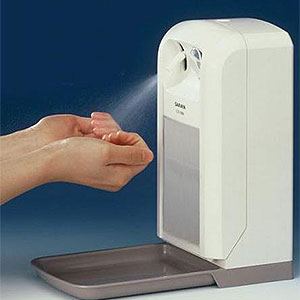
Hand washing is the first line of defence against infections. Learn more
Investing time and effort into your workers’ health is a great investment. This translates to return on investment (ROI) because productive employees are an asset.
Losing time and money due to absenteeism is a common problem that few workplaces can address. Hiring external help in cases of severe illnesses creates an avoidable extra cost. Whereas, healthy workers complete tasks on time.
When workers are absent from work, this causes disruption. Most workplaces are fast-paced environments. The need to beat deadlines and complete projects is imminent.
So, investing in good products and in-house training sessions saves you the trouble. Get managers or volunteers to educate your workers on proper hand hygiene methods.
It’s in your best interest to make these sessions as interactive as possible. Show videos and send out internal memos on hand hygiene importance. This makes the information stick.
‘’We believe that engaged people deliver exceptional results. Wellbeing for us is about what’s going to engage people – what’s important to them? If they’re going to contribute to Z they need to be in a place of strength to do that.’’ — Julian Hughes, GM Health & Safety, Z Energy
Encourage workers to maintain hand hygiene by making it fun and memorable at no extra cost.
Roll out a slogan-making competition to really get your employees engaged in this noble cause. Workers can come up with hand-hygiene slogans and the best can become the slogan of the week.
Using the slogan among themselves reminds them of hand hygiene importance. This slogan can be a simple as ‘’clean hands are safe hands.’’
Essential in Building Resistance and Immunity
Throughout the workday, we come into contact with many items. This includes our faces, bodies and food. We are bound to get sick when we don’t take care of ourselves.
As the old saying goes, prevention is better than cure. Emphasising hand hygiene importance is significant in boosting immunity.
So, the more you wash your hands, the less likely you are to catch a disease.
You will end up spending less money on antibiotics used to treat illnesses. Reducing the overuse of antibiotics saves workers money.
Good hand care causes the body to build resistance. This makes employees healthier, not only as individuals but also in their families. They are less likely to spread bacteria contracted from the workplace to others.
This creates happy relationships in the workplace and healthy families. When workers are healthy, they are happier.
“The groundwork of all happiness is health.” — Leigh Hunt.
Additionally, when clients relate with happy workers, they feel more at home. This increases their loyalty to your business, making them stick around even longer.
Healthier employees are keen on proper engagement with clients. This creates impressionable results.
Promotes Good Etiquette Practices
[b3_row]
[b3_column lg=”8″ md=”12″ sm=”12″ xs=”12″ ]
Proper hand hygiene education creates good etiquette practices in the workplace. Workers will comprehend that the state of their hygiene can affect others. Creating hand hygiene awareness at work extends to their homes. This leads to the creation of a healthier society in general.
Thus, hand hygiene importance is best enforced through the creation of habit. Various mechanisms make this a smooth-sailing process.
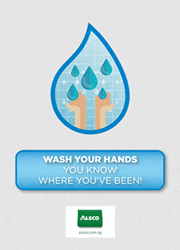
For starters, the use of posters in the workspace and washrooms comes in handy. These remind workers of the importance of hand hygiene, as well as educate them on proper hand hygiene techniques, such as how to rub in hand sanitiser well.
These posters state interesting facts, too. They remind us where our hands have been and why washing them is necessary. They are key in repeating the hand hygiene practices taught in training sessions.
[/b3_column]
[b3_column lg=”3″ md=”12″ sm=”12″ xs=”12″ ]
[/b3_column]
[/b3_row]
Are you ready to change the face of your workplace hand hygiene? It’s time to clean up your act and take the first step. Finding an expert is easy, especially one with good recommendations and price quotes.
“…they are always willing to go the extra mile to help us out when we get stuck.” — Lyndsey Morrison-Barnes, Resort Manager, Paihia Beach Resort & Spa
Photo: Mike Mozart
Why Your Office Bathroom Is Missing The Mark (and How To Fix It)
Sometimes working in an office is not an easy task because of limited space. This often includes the office bathroom.
Bathrooms are already quite an intimate setting for everyone.
So leaving your clean bathroom at home to get to a dirty one at work can be a traumatising experience all on its own.
Looking for a clean bathroom outside of the office is time-consuming. It wastes work hours and drains a significant amount of energy.
This list of five office bathroom supplies is what employees need to feel happy and comfortable in their workplace environment.
They spend a significant portion of their lives in this environment, so it’s worth attending to their wellbeing if you want them to be productive.
Washroom Fix: Air Freshener
This neutralises bad smells and makes the environment better to work in. Walking into an office bathroom that always smells like fresh roses is a signal to the employee that their employer cares about them and values them.
Automatic air fresheners are a popular option these days. They release scents discreetly and regularly without human intervention.
They have little need for servicing for up to 8 weeks. This reduces the spread of germs caused by handling air fresheners by users.
According to research, aromatherapy improves employee productivity. Certain scents, such as cinnamon and peppermint, boost employees’ attention and focus.
Washroom Fix: Hand Wash and Sanitiser
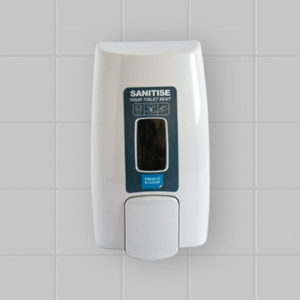
Powerful, alcohol-based Hand sanitiser
Some employees have a legitimate fear of bathroom sinks or surfaces. Who wouldn’t? It’s well-known that bacteria can come from any surface in an indoor ecosystem.
Hand hygiene products are definitely an office bathroom supply that employees need.
All you have to do is place your hands underneath the sensor. A well-calculated amount of the product comes from the machine on to your palms.
The beauty of automated hand hygiene products is that you don’t need to press any button to get the product out.
These dispensers are available in any colour or design to match your bathroom decor. This way, your office bathroom gets a stylish upgrade.
Client interaction is the norm in the workplace. Workers interact with others and touch various things during work hours.
Without a proper office hand hygiene system, the health of workers is at great risk.
Washroom Fix: Toilet Sanitiser
You may be wondering if toilet sanitisers are effective. Demand for these products is on the rise, as toilet seat sanitiser kills 99.99% of bacteria found on the toilet seat. This is important as the surface of the seat is in direct contact with the skin.
The fact that you must place your posterior where others have placed theirs can be confronting. When you think of it that way, you then realise how serious it actually is.
Sitting on a contaminated toilet seat can expose you to pathogens and cause illnesses. So it’s important to use both toilet sanitiser and hand hygiene products to ensure proper hygiene of all workers.
Washroom Fix: Feminine Hygiene Units
Your female employees are busy enough with work and home life, and feminine hygiene shouldn’t add to their stress levels. Sometimes women forget to pack essentials in their work bags, such as sanitary pads, leading to many an ‘uh-oh’ moment.
Sanitary pad dispensers in the office bathrooms can be a very welcome addition in these situations and will allow your female employees to continue working without interruption to their day.
Female employees also need a discreet and hygienic way to dispose of used sanitary products – feminine hygiene units are an essential bathroom item that should be installed and maintained in every female workplace washroom.
Washroom Fix: Posters On Bathroom Etiquette
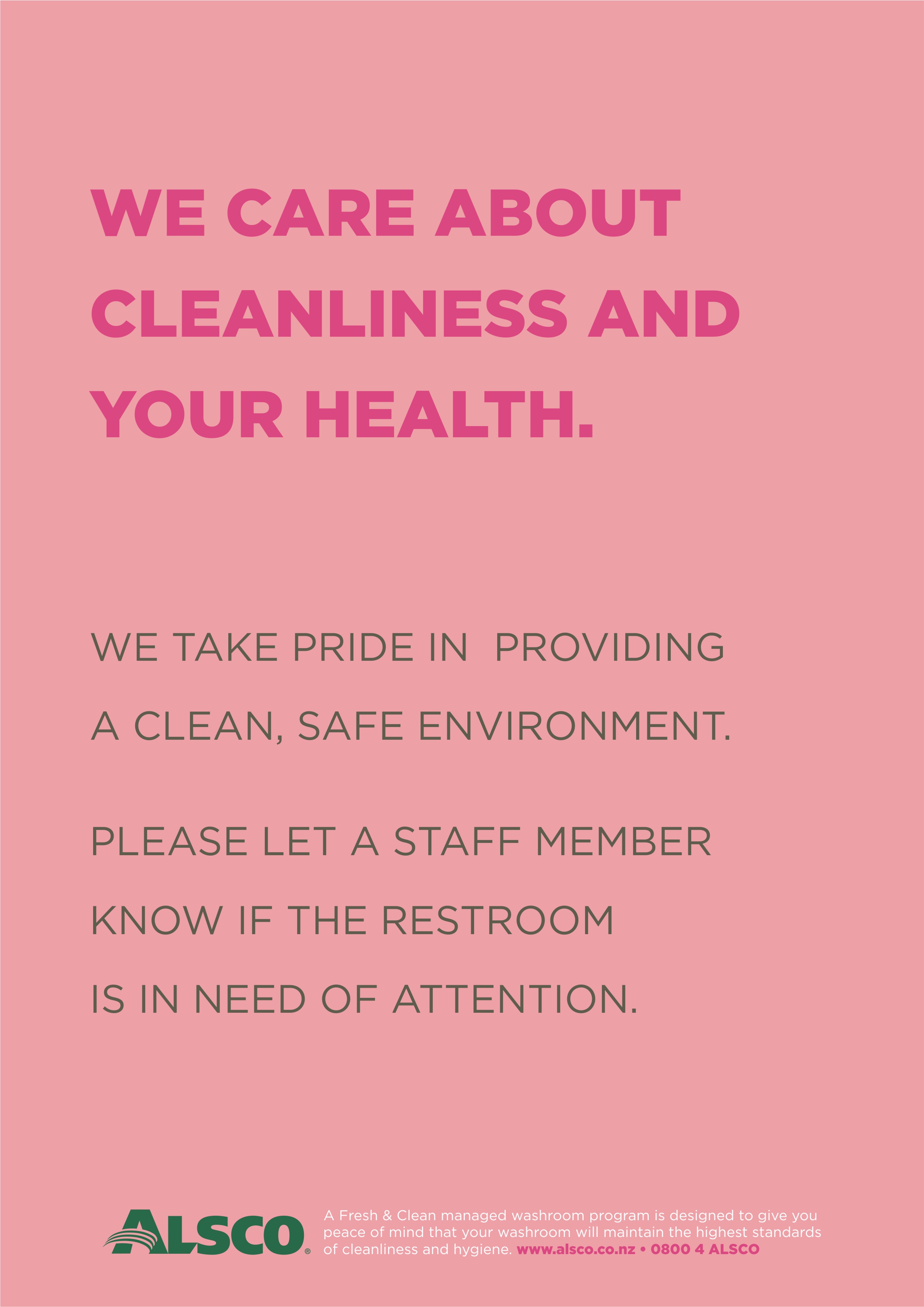
Reminders on the walls are useful in maintaining good hygiene practices among workers.
Mistakes are part of human nature, and so is forgetfulness. After a stressful day, sometimes we rush without flushing or even washing our hands.
Hey, it happens sometimes.
This is why we need reminders to help instil proper bathroom etiquette culture.
These posters are available for free online, saving you money and time.
Why Office Bathroom Supplies Matter
There are many reasons why your office bathroom is important. Washroom supplies play an important role in improving bathroom etiquette.
Good washroom habits can help improve work and personal relationships. Both employers and employees use office bathrooms. Your cleanliness says a lot about you to your workmates.
We all have a basic need for a clean and healthy environment. This is important in protecting yourself and others from health risks.
Washrooms are an Essential Part of Being Human
Studies show that an adult spends an average of one hour and forty-two minutes in the bathroom every week. Imagine how much we spend in the bathroom during our entire lifetime.
Using the bathroom is an essential part of life.
A survey showed that 94% of people would not go back to a place with a dirty bathroom. Dirty bathrooms lead to loss of company business in the long run.
Keeping your office bathroom clean is part of doing business.
Health Risks Affect Business
Good office bathroom hygiene means fewer sick days for workers.
When the health of workers is at risk, they take more sick days. When workers don’t show up at work, the impact on the business can be quick and damaging.
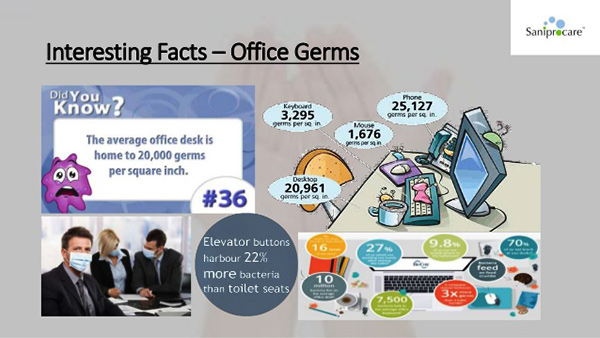
Image from: Saniprocare Hand sanitizer – HOCl
Efficient office bathroom supplies ensure proper hygiene, a healthy working environment and fewer sick days.
Hygiene Affects Employee Productivity
Dirty bathrooms generally make people uncomfortable, whether it’s in a private dwelling, public facility or the workplace.
The location of some office bathrooms is near the general working space. A bad odour may diffuse and linger around the work area. This makes it difficult for employees to work or concentrate. Clients can also be affected.
Every time a client walks out due to poor workplace hygiene, it kills the morale of an employee and affects their motivation and productivity.
Bathrooms are the Face of the Office
A study showed that 89% of people use office bathrooms as an indicator of how the office values employees? So future employees are not going to be keen on joining companies with poor washroom hygiene.
Don’t let your washrooms be your Achilles’ Heel.
Change the face of your office washroom today by engaging the experts in washroom hygiene.
“You service our branch with an awesome attitude…”
Shaan Antunovich, Manager, Education Action.
First-class service is only one call away!
How to Turn Hand Hygiene into a Workplace Priority
Many studies show the link between workplace hand washing and the success of a business.
Since most people spend more time at work than at home, hand hygiene in the workplace is a major area of concern.
In some workplaces, hand hygiene is not a popular topic. Filing complaints about it can, therefore, be difficult.
Management may not think it is a priority when, in fact, it should be.
In the workplace, you can encounter many different kinds of germs that pose a health risk. Improper hand hygiene causes workers to fall ill, making them less productive at work. It can even contribute to the downfall or success of a business.
Proper hand hygiene is instrumental in reducing 80% of bacteria from the hands. This lessens the risk of contracting common hand-to-mouth diseases, such as influenza. Prioritising hand hygiene ensures the good health of your workers.
The hygiene of your business speaks volumes. It is a form of non-verbal communication to others about how much you value your workers and their health. This helps in keeping up a good reputation for your business.
Prioritising Workplace Hand Hygiene
Hand sanitisers that eliminate 99.99% of bacteria.
This may sound like it entails a boring process of showing workers how to wash their hands. In fact, and hygiene is more than hand washing on its own. It is an integral part of living a healthy lifestyle.
The process of prioritising hand hygiene is fun, interactive and informative. Here are four easy ways to do it.
Communication Is Key
The only way to know if your workplace hand hygiene needs work is by communicating with your workers. Find out whether your current hand hygiene regime is effective.
Face-to-face communication causes the temptation to stray off-topic. Instead, use workplace communication channels, such as email, to distribute hand hygiene surveys.
These surveys help gauge workers’ hand hygiene knowledge and their perception of it. A great example is the perception survey by the World Health Organisation (WHO). In these surveys, workers rate their perception of the workplace hand hygiene practices.
Knowing the appropriate changes to make is all in the feedback.
Send out updates on hand hygiene implementations via internal memos. This shows the workers that their opinions are important in effecting change. Keep track of your updated hand hygiene changes by maintaining communication with workers throughout the process.
Incentives, such as paid vacations, encourage workers to improve their hand hygiene. After a time, the habit will stick.
‘’A long healthy life is no accident. It begins with good genes, but it also depends on good habits.’’
— Dan Buettner.
This is a win-win situation. Your workers stay healthy, while your business thrives from having productive workers.
In-House Training Sessions
This is an informative and interactive session. They are usually conducted by human resource managers. To shake things up, other workers can conduct the training. This can be on a rotation basis or by picking names from folded pieces of paper in a jar.
Conducting training sessions on hand hygiene is not as common, and that is the beauty of it. Interestingly enough, in-house training is an effective method of education. It reflects the true culture of the workplace by using examples that workers can relate to. Your workplace stays two steps ahead in ensuring the good health of workers.
During these sessions, it’s important to show videos on proper hand hygiene practices. These videos should be catchy and send out the right message. They should use both humour and scientific facts to pass the message.
Be Creative
You can conduct many sessions and distribute many surveys, but your workers may still not get the point. Some may even forget what they’ve learned. So, how can you make it work? By creating a unique experience for your workers. Hand hygiene doesn’t need to be boring just because it is a serious topic.
Play around with the concept of hand hygiene in your workplace to make it memorable. Using funny posters can help with this. Quirky visual reminders help in relaying the message while making it humourous.
According to research, humour makes concepts easier to learn and remember. Making workers giggle makes hand hygiene concepts memorable.
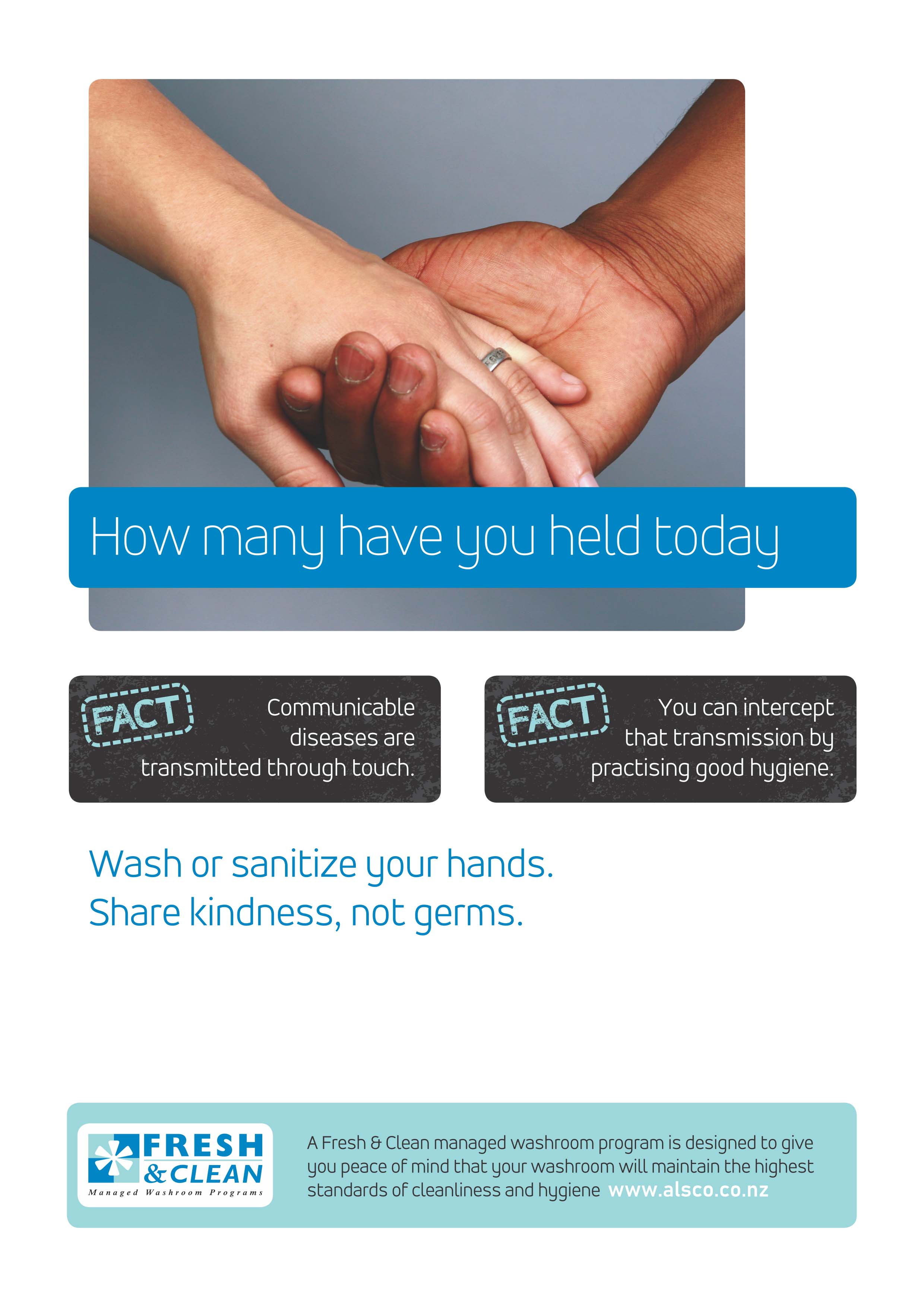
Use posters that remind workers why it is important to pay attention to good hand hygiene. These posters usually have hand hygiene facts. These kinds of posters provide facts about why proper hand hygiene is instrumental in living a healthy life.
Collaborate with workers to come up with hand hygiene slogans or catchphrases. You can make a competition out of it, and ask them to come up with the best slogan. The best slogan wins a prize. This is a creative way to increase participation in hand hygiene matters.
Incorporating these slogans into customised posters makes the message relatable to your workers. This is a simple and cost-effective way to prioritise hand hygiene.
Place these posters near hand hygiene products to make sure they are visible. This is a convenient positioning to promote fast action. Once the worker sees the poster, it prompts them to wash or sanitise their hands.
Desktop Hand Hygiene
Hand hygiene is not only important in the workplace washroom, but also in the workspace. You can provide hand sanitiser dispensers in the work area to encourage cleanliness.
Studies show that 70% of people who wash their hands use sanitiser instead of hand wash due to the convenience. Placing a small amount on your palms and rubbing it in is easier than running to a sink to wash your hands.
Hand sanitiser placement should be within easy reach and sight. Preferable placement is in communal areas in the workplace, such as in the lunchroom.
When workers see the product in front of them, they are more likely to use it as often as they can. This fosters a good habit of sanitising hands during the workday. This reduces the use of paper towels, which some workers use to open doors and hold telephones with.
Prioritising hand hygiene can be time-consuming. With proper help from hand hygiene experts, it is a smooth experience. They are ready to assist with your hand hygiene needs by advising and providing the right products for your workplace.
Transforming your workplace hand hygiene will happen in no time!
Photo: yanalya
4 Ways to Make Hand Hygiene a Priority in the Workplace
When was the last time you thought about office cleanliness? Considering how much time is spent at the office, workplace hygiene is underrated.
We spend over 70% of our lives at work, so it’s important to pay attention to hygiene. As you focus on increasing productivity and profitability, how often do you consider the effect of health and hygiene on workplace performance?
Various studies into the source of germs at work have led to interesting findings. If you are sitting at your desk, you might suddenly feel the urge to leave it. Did you know that the work desk can be 400x dirtier than the average toilet seat?
Everything from your equipment to your desk surface is responsible. The biggest culprits are the keyboard, office phone and your mouse.
The good news is that with a little more emphasis on hand hygiene, the high germs zones are easily contained.
If everyone becomes aware of how important it is to keep their space and equipment safe, the workplace will instantly become healthier.
Importance of Hand Hygiene at the Office
- Creates a Great Working Atmosphere
Every office has a hygiene culture. Do you remember the last time there was a flu outbreak at the office? How fast did it spread? The speed at which it spreads is an insight into your general hygiene habits. It’s time you became intentional about hygiene.
Employees who are confident in their co-worker’s hygiene habits are more comfortable with physical contact e.g. handshakes and hugs. This is shown to improve workplace relations, closeness and cohesion.
- Prevents the Spread of Disease
80% of infectious disease is spread by hand. Awareness of what you do with your hands will reduce your exposure to these germs. Avoid touching your face or mouth, as this exposes you to inhale or inject the germs. Therefore, it is important to maintain great hand hygiene as a preventive measure.
Since many people eat at their desks, keeping great hand hygiene prevents food poisoning and stomach upsets from questionable hygiene. Loss of productive time through preventable disease is bad for your bottom line and overall employee well-being.
- Leaves a Good Impression on Visitors
A beautiful office with washrooms that smell good creates a great first impression. It shows that the office cares about its people, and in turn, will also care for their customers or partners.
Good hand hygiene is also visible in the appearance of the employees. When they look presentable and neat, it creates a positive company image.
How to Create a Hand Washing Culture
1. Make It a Visible Priority

a. Create stickers and place at strategic points
It is proven that people take things that they can see more seriously. This is due to a psychological tendency to increase the perceived importance of a subject matter when it is visible and noticeable. Alsco has some free high quality and printable posters that you can use around your office today.
Therefore, to reinforce your commitment to workplace wellness, you could place wellness stickers at strategic areas around the office. Some great spots include the washroom sink area, the toilet cubicle, the staff kitchen area, near the staff meeting room and in all office shared spaces.
2. Appoint Hygiene Coaches to Make It Fun and Sustainable
Nothing has a greater effect on people than other people. We all have the instinct to fit in. Play on the need to belong to introduce a new culture. Creating a peer hygiene champion will make the process fun and remove the pressure of implementation from one person or department.
a. They Will Spread the Word to Their Friends
Your hygiene coaches will become catalysts to conversations. Since they interact with the rest of the staff in different circles, they will be able to initiate awareness of bacteria and contamination. Word of mouth is the most powerful weapon in internalising the importance of handwashing.
The hygiene coaches can also create cool and contextually relevant rallying calls that can be used as cues to initiate handwashing. This will create a domino effect that leads the office staff to incorporate handwashing into day-to-day conversations. Eventually, this creates a culture of cleanliness.
b. They Will Help Implement, Enforce and Improve the Programme
The beauty of having diverse people in a program is the ability to get different ideas. Your office can get as creative as possible when imagining fun ways to create awareness on the importance of hand hygiene.
Since most people are proven to be visual learners, the hygiene coaches can prepare slides or a presentation that illustrates the importance of hand hygiene. They could also illustrate how to easily improve your daily hygiene habits.
3. Create a Well-Stocked Washroom
a. Maintain Washroom Hygiene, Design and Ambience
With all the emphasis on hygiene, the most important factor to encourage compliance is a conducive washroom. Are you proud of your washroom? Can you proudly point your top client to use the public washroom at work? If your answer is no, you have some work to do.
Things to consider when creating a good washroom include the number of washing stations, odour control, toilet seat cleansers and presence of wellness communication.
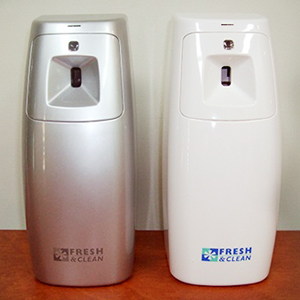
Alsco’s Fresh & Clean service can take the headache out of odour control if you sign up for our rental service.
b. Get Reliable and Standard Hygiene Supplies
After ensuring that the core facilities are in order, you need to consider the supplies that require replenishing or maintenance. This includes soap, hand sanitiser, paper towels, toilet cleanser, odour sprays and disposal bins. The key to long-term winning is consistency. Therefore, get a reliable hygiene vendor to service your washroom weekly.
Do you know the proper standards you are legally expected to maintain in the workplace? It is important to know the regulatory framework in your country and keep the hygiene up to standard.
Since the laws are tweaked regularly, it will be a good idea to consider outsourcing compliance with a reliable vendor.
Alsco’s Fresh & Clean will help you maintain your washroom supplies while always keeping up with any change in compliance laws.
4. Improve Hygiene Around the Office
a. Strategically Placed Hand Sanitisers
Outside the washroom, there are ways to ensure hand hygiene is at the forefront. Strategically place hand sanitisers in core areas at the office. This could be in the kitchen, the office lobby or the washroom exit. Choose areas that can encourage people to prevent exposure to germs from eating or physical contact.
Out of sight, out of mind. The presence of the hand sanitiser will constantly remind people to consider their hygiene. It will act as the non-verbal cue that reminds your team to get clean.
Get a sanitiser dispenser that is automatic to prevent contamination or wastage.
b. Get Office Cleaning Services
Besides handwashing, regular maintenance of the office facilities prevents a build-up of germs and bacteria. Ensure that you get cleaners with high standards that will disinfect high contact areas like doors and desks.
Regular servicing of office equipment is also advisable. The high germ areas were found to be on the office phone, keyboards and mouse. Get a technical team that will clean the office machines professionally to prevent damage.
Encourage healthy hygienic workspaces for a more productive office. Your colleagues will thank you and productivity will increase for the better. There’s no need to do the heavy lifting to coordinate it all.
Just call Alsco and we’ll always deliver quality hygiene supplies to your doorstep in a timely fashion.
In case of an emergency, don’t worry. We are quick to respond, with no extra charge!
Workplace Hygiene: 4 Ways Germs Spread and Kill Your Workplace Productivity
Have you ever visited a workplace washroom and suddenly no longer felt the desire to go? A dirty toilet can put you off, and worse, cause you bladder infections for holding it in for too long simply because you don’t want to use the unhygienic office toilet.
Your workplace hygiene and cleanliness is of the utmost importance. It isn’t just for creating a good impression, but also for ensuring that your employees’ safety, health and wellbeing is being safeguarded.
Maintaining a clean and hygienic workplace goes hand in hand with your employees’ productivity.
One way to ensure workplace hygiene is to stop germs from spreading. Maintain clean and hygienic washrooms, and you’ll be one step closer to a germ-free workplace.
To have a hygienic and clean washroom, you’ll need properly maintained toilets. Ensure that your employees have hand washing and drying facilities, provide the required consumables and have effective odour control mechanisms in place.
Have your washroom hygiene taken care of by qualified personnel through Managed Washroom Services.
Learn what germs are and four ways they can spread, killing your workplace productivity.
What Are Germs?
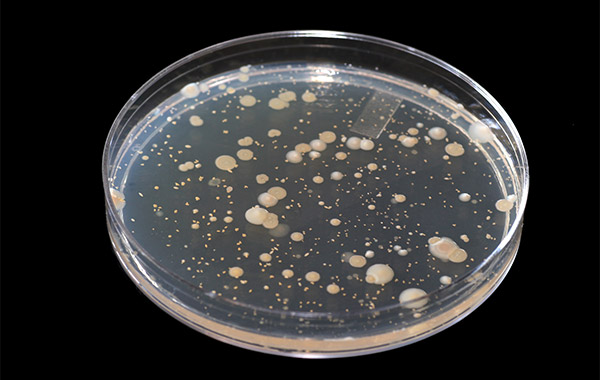
Image from: Freepik by stockvault
Germs are tiny microorganisms that can only be seen under a microscope. There are two types of disease-causing germs, bacteria and viruses. Most germs, such as Salmonella and hepatitis A, cause illnesses in humans.
Germs, just like humans and animals, need moisture, warmth and food to survive. They can access all these from various places, including food scraps, faecal matter, rubbish and our bodies, too.
However, human bodies harbour many helpful bacteria, including good gut bacteria, which allows our bodies to utilise the nutrients in the food we consume while making waste from what’s leftover.
There are also good germs found in our environment, including the Lactobacillus germ. It ferments milk, turning it into yoghurt. There are also other germs that break down vegetable matter into compost.
You’ll encounter many harmful germs all over your workplace. They kill your employees’ productivity in these four ways:
#1 Way Germs Are Spread and Kill Your Workplace Productivity: Airborne
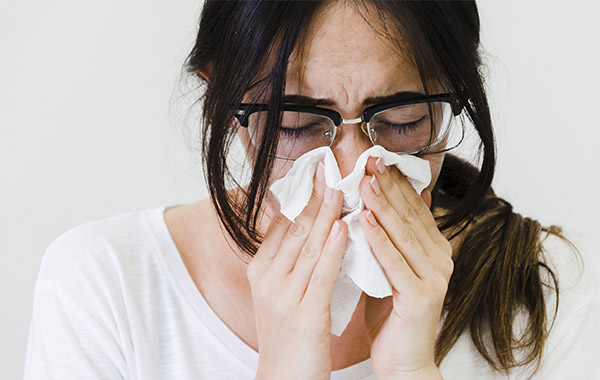
Image from: Freepik
The air you are breathing in right now could be full of harmful bacteria and viruses. When people sneeze or cough around you without covering their mouths, they expose you and everyone in the workplace to harmful germs.
There is also the ‘sneeze effect’ in washrooms, meaning that a flush can spread germs around a stall, over the toilet paper and up to six metres from the toilet bowl. The sneeze effect can make germs spread to your hands and later onto other surfaces.
The initial ‘sneeze effect’ study was done by Dr Charles Gerba in 1975, and he entitled it Microbiological Hazards of Household Toilets. It demonstrated that when a toilet was flushed, it produced a cloud that could remain airborne for a maximum of two hours, travelling up to eight feet up and around the toilet.
He recommended that people should refrain from storing their toothbrush in the open and instead lock it up in a cabinet. You should also put the toilet lid down before flushing.
Other ways to deal with the sneeze effect is by:
- Cleaning the washroom regularly and after a user had diarrhoea or vomited in it.
- Keeping the wall and ceilings around the toilet clean.
- Cleaning thoroughly, especially under the bowl’s rim and the bottom side of your toilet seat.
#2 Way Germs Are Spread: Contaminated Surfaces and Objects
Viruses and bacteria can survive on surfaces for up to 24 hours. Studies have also shown there are germs living on your computer keyboard as well as the mouse.
As you go about your work, you are likely to pick up some of the bacteria and pass it to your mouth or nose.
Washroom surfaces are one of the most contaminated areas in your workplace. People are exposed to bodily fluids and other wastes such as feminine products. If not properly maintained, these can spread germs.
Other surfaces full of germs include:
- Doorknobs
- Kitchen sponges
- Faucet handles
- Refrigerator handles
#3 Way Germs are Spread: Skin Contact
Skin contact is a common way germs are spread around the workplace, as every time you shake hands with a colleague, you are risking spreading or coming into contact with germs.
Even holding open a door for a colleague as a show of courtesy exposes you to germs!
Your hands carry up to 80 million bacteria per square centimetre after using the toilet. You can then transfer these germs from your hands to more than five surfaces or even 14 other objects in the office.
These germs can make you and/or your co-workers sick, keeping them out of the office as they recuperate either at home or the hospital. The result is decreased productivity in the office.
#4 Way Germs are Spread: Contaminated Food
Communal kitchens are breeding grounds for bacteria. Undercooked food and dirty kitchen surfaces are the biggest culprits. Kitchens receive high human traffic and the higher the number of people, the more germs there will be.
Norovirus is another threat in kitchens. Around 16% of people carry the norovirus without exhibiting any symptoms. They’ll feel healthy, but they might be spreading the microorganisms to other surfaces, including the kitchen, which in turn makes other people sick.
Why Good Hand Hygiene Is Important for Your Employee Productivity
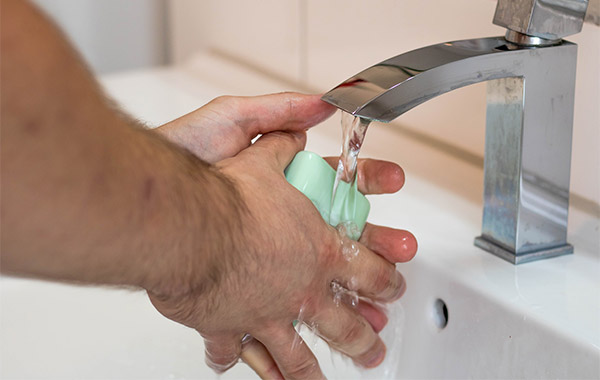
To minimise employees’ sick leaves and their productivity, you should start with good hand hygiene.
Why Hand Hygiene Is Paramount in the Workplace
People become ill from using shared washrooms. Bacteria and viruses common in washrooms are the biggest culprits.
Common stomach infections are caused by Salmonella, Gastrointestinal viruses, respiratory organisms and Escherichia coli. When your employees are exposed to bad health conditions, they become less productive.
There is also the risk of spreading illnesses to other healthy co-workers. Handwashing is considered the most basic step in becoming more healthy.
You can improve your overall workplace productivity by practising good hand hygiene.
According to various studies, regular and proper handwashing greatly reduces cases of people getting sick with diarrhoea and respiratory diseases. For companies, hand washing results in higher productivity and fewer employee sick days.
When Should You Wash Your Hands While at Work?
There are people who don’t know the importance of proper hand hygiene to stop the spread of harmful germs that can make people ill. Here are some instances when you should wash your hands while at work to stay healthy and ensure the health of others around you.
- After visiting the washroom
- After coming into contact with old printed materials
- Before and after meetings
- After using shared equipment
- After using borrowed devices or tools
Maintain High Levels of Hand Hygiene to Increase Workplace Productivity
Proper hand hygiene offers an easy, effective and affordable way to stop the spread of germs and keep your workers healthy. A healthier working environment makes your employees more productive.
Make use of posters to remind your employees of the importance of handwashing.
By promoting good hand hygiene, you will benefit from good employee health and your business productivity.
How to Keep Germs From Spreading
To stop germs from spreading and killing your workplace productivity, consider cleaning the most affected areas. These include the kitchen area and your washrooms where germs are more likely to spread.
Disinfect your kitchen and washroom and have it sanitised frequently. Train your staff to always dry surfaces such as chopping boards and worktops after cleaning them.
Leaving these surfaces damp helps germs to thrive and even multiply if the moisture is enough.
Encourage your employees to practice good hand hygiene. They should always wash their hands before handling food and after visiting the toilet among the other aforementioned instances.
This will help stop germs from spreading and affecting your workplace productivity negatively.
Embrace Good Hygiene and Sanitation
Maintaining a clean and hygienic workplace doesn’t have to be rocket science, as you don’t have to worry about every little detail.
If you are in New Zealand, let Alsco take care of all your workplace washroom needs. We have vast experience in delivering exceptional managed rental services for different industries.
Our services include:
- Hygiene
- Linen
- Uniforms
- Consumables
- First aid
- Floorcare
- And more
Get in touch with Alsco today for a customised quote to suit your business needs.
Photo: Free-Photos
12 Unexpected Benefits of Workplace Wellness Programmes
The history of workplace wellness originated from Bernardini Ramazzini, an Italian physician.
He is believed to be among the first people to write about the work exposure effects that employees face, Including occupational diseases.
Bernardini believed that putting preventative measures into place would improve employees’ well-being.
Nowadays, the industrial revolution caused various new health issues and injuries due to the way work were designed and framed.
Here are 12 unexpected benefits from workplace wellness programmes.
Unexpected Benefit #1: They Enhance Behaviour and Minimise the Risk of Lifestyle-Related Illnesses
Many employees spend the better part of their days sitting at a desk. This can lead to many lifestyle-related diseases. However, wellness programs can help break that monotonous routine. Employees benefit from sport-related programmes by keeping some of these illnesses at bay.
Rand Health Quarterly published a study report on Workplace Wellness Programmes. The report concluded that a wellness program can minimise risk factors. It could also enhance healthy behaviours if it involves lifestyle management interventions.
It also found that these effects were clinically meaningful and sustainable over time. This confirms that wellness programmes can help contain a lifestyle-related illness epidemic. Lifestyle-related illnesses are a major driver of premature mortality and morbidity.
Health behaviour change is hard to meet. These programmes can motivate employees to engage in long-term behaviour change. Therefore, they are more valuable than traditional health interventions, which are less effective. Most traditional methods focus on individual willpower.
Unexpected Benefit #2: Meditation-Focused Programmes Could Minimise Stress

Many workers report dealing with a lot of stress at their workplaces, which can cause mental health problems.
Develop a wellness program that focuses on mindfulness and you’ll notice a huge reduction in workplace stress.
The Journal of the American Medical Association published a study on the benefits of meditation and concluded that people can reduce depression, stress and anxiety through meditation.
The best part is that meditation is an inexpensive art to practise. All you need is a quiet conference room and free guided mindfulness meditations.
Unexpected Benefit #3: Enhance Employment and Employees’ Retention
Many employees will want to stay at a job where their health and well-being is a priority. Employees are more motivated when their employer cares about their quality of life. This includes programs that address their financial, physical, social and emotional health.
This sort of attention encourages loyalty, and employees will be more likely to stay with your company for a long time. Make sure all your employees are aware of the programme and know how to be part of it, whether it’s via yoga classes or simply a gym discount.
Unexpected Benefit #4: Building Camaraderie Among Workers

Some wellness programmes offer employees chances to come together and form teams. When your employees interact in activities besides their job, they create strong friendships. This helps them work well when put in teams at work.
Unexpected Benefit #5: Increases Employee Morale
When your employees feel appreciated, they become enthusiastic and passionate about their job. Happy and satisfied employees equal happy clients.
Unexpected Benefit #6: Enhances the Quality of Life and Sense of Well-being
Workplace wellness programs advocate for smoke-free environments. They also help improve sleeping patterns and reduce back issues. Your workers might also benefit from weight loss and go back home in a positive state.
Some programs advocate for healthy eating. When you eat healthier foods and do relaxing exercises, you’ll feel energised and fresh.
When your employees exercise and stop smoking, they avoid some illnesses. This leaves them with a better quality of life and a healthy outlook.
Unexpected Benefit #7: Reduce Healthcare Costs
The best way to save on healthcare costs is by offering your employees lower insurance premiums. This is possible if they are willing to stay healthy. Wellness programmes can help them with that. Here are more benefits:
- Happier insurance companies: When your employees are healthier, even the insurers are happy, as they don’t have to pay for any claims.
- Lower premiums for your employees: They will get healthy and save money at the same time.
- Better health: Your employees will also enjoy longer, healthier lives. They won’t need to use a lot of money taking care of their health.
- Low health costs: Healthier employees with equal lower health care costs and insurance fees.
Unexpected Benefit #8: Better Company Culture
Wellness programs bring employees and their employers together at an informal gathering. They can feel at ease in interacting with each other outside the office. You’ll get to know your employees better and build a new company culture.
Unexpected Benefit #9: Attract Talented Employees
Talented workers are no longer chasing after money when applying for a job. They understand the importance of balancing work and personal life. Since they know wellness programmes can help with this, they are likely to apply to a job that offers them.
Unexpected Benefit #10: Employees Get Fit and Fulfill Their Goals
More than 62% of employees in New Zealand agree that wellness programs help increase productivity. When employees exercise regularly and eat healthily, they become more productive. Poor health behaviours lead to chronic diseases and higher health risks.
People set new resolutions every year. These resolutions include going to the gym and living healthier lives, but most of the time, their tight work schedules won’t allow them to follow through. They end up pushing their health-related goals onto the next year.
Wellness programmes give employees the chance to get fit by taking part in various activities. It could either be gym memberships or joining sports or walking clubs. Such activities help them get their mind and body healthier and achieve their goals. With fulfilled goals, your employees will concentrate more on their job.
Unexpected Benefit #11: High Job Satisfaction

Workplace wellness programs influence worker satisfaction. In fact, 3 out of 4 employers agree that their programmes have improved worker satisfaction.
70% of employees participating in these programs were more satisfied with their jobs.
The International Foundation of Employee Benefit Plans also carried out another Survey Report. They found out that employees were 67% more satisfied when offered these programmes.
Unexpected Benefit #12: Boost Market Valuation
A report published by the Journal of Occupational and Environmental Medicine concludes that companies that invest in their workers’ health and well-being had higher market valuation. They compared them with other firms that were publicly traded. Wall Street investors affirmed these findings. Their argument is that these programmes may play a role in a company’s stock performance.
Invest in a wellness programme to enjoy an outstanding financial performance. Such initiatives take time, which is why you need to plan and put them in place now.
The Sum and Substance
Should you invest in workplace wellness programmes? The above 12 benefits make it appear so.
Healthy and happy employees are more productive. This is a win-win situation for your business. Workplace wellness initiatives increase employee morale, productivity, retention and reduce health risks.
There is a clear connection between your business performance and good employee performance. An effective programme should take care of your workers’ total well-being. All these benefits surpass the costs.
As you invest in a good wellness programme, remember what matters more: providing a clean and hygienic workplace for your employees is crucial.
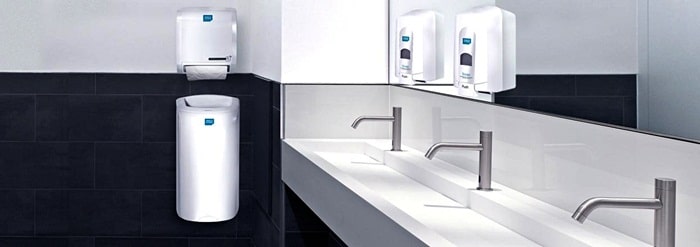
Maintaining clean and hygienic washrooms motivates your workers to maintain the hygienic levels. They also pay attention to their personal hygiene. This has a positive effect of boosting staff morale, wellness and productivity. Your brand reputation and culture will also benefit.
Image: Freepik by @yanalya
Image: Freepik by @yanalya
Image: Freepik by @yanalya
Image: Freepik by @pressfoto
How to Save Yourself When Everyone Else in Your Office is Getting Sick
There is nothing worse than having to report to work feeling under the weather. But almost everybody will go through this at some point in their professional lives.
In fact, according to the Business NZ Wellness in the Workplace 2017 Survey, the average number of time employees took off work due to illness was 4.4 days at a time.
The survey also shows that New Zealand has lost about 6.6 million working days to sickness between 2012 and 2017. Companies lose up to $1,000 per employee on sick leave. This translates to a direct loss of over $1 billion in 2016 alone.
While companies encourage employees to stay home when unwell, studies have shown that up to 40% of staff will still show up sick. The report shows that employees are usually absent due to sickness or taking care of a sick family member.
In order to be a productive employee, your wellness must come first. It’s important to save yourself when your colleagues are feeling unwell. There are a few tips and tricks you can turn to for your wellness at work.
Take the Shot
During flu season, there is usually a mass immunisation drive in most countries. The flu shot is usually administered to prevent you from catching the virus. It will be best for you to line up and take the shot in order to protect yourself from that sneezing deskmate at work.
There are outbreaks that happen from time to time depending on which part of the world you are in. Conditions like Meningitis, Hepatitis and many other contagious diseases can take you down. Keep your ear open for vaccination drives to make sure you are virus-free.
Have Your Hand Sanitiser Ready
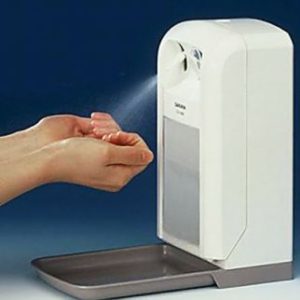
The best way to keep your hands germ-free is to thoroughly wash them as many times as possible during working hours. However, if you are unable to do so, have some alcohol-based hand sanitiser handy. A rub of sanitiser on your hands will keep germs from pitching camp and making you ill.
You can put in a request to your company to provide hand sanitisers. Alsco New Zealand offers heavy-duty sanitisers which are soft on the skin but tough on germs.
A sure way of keeping yourself sick-free is to avoid touching your face, biting your nails or working on a desk that you have not taken the time to wipe down – these are some of the ways that you can transfer germs to your eyes, mouth and nose and risk becoming sick.
Encourage a Sick Colleague to Take Time Off
This may sound a little mean but think of it as doing a greater good. If you encounter a colleague who is showing signs of sickness, encourage them to take some time off in order to be more productive and prevent spreading it to the rest of the team.
A good team leader or manager should also reinforce the wellness policy in the workplace and remind staff members to take much needed time off to recuperate. Employees must take advantage of their right to time away from work due to injury or illness in order to be more productive upon their return to work.
Seek an Alternate Workspace
There are those colleagues who will stick it out at work even when they are feeling sick. In such a case, you can find another workspace to get your work done. It can be an empty desk elsewhere or an available office space.
During the flu season, you can request a work-from-home day to stay away from sick colleagues. This is obviously dependent on the employee policy in place at your workplace. This workday from home is best taken when you feel you are coming down with something.
Take Care of Yourself if You Start Feeling Unwell
The moment you start feeling the sniffles coming on, take extra care of yourself. It can involve going to bed earlier, staying hydrated, taking vitamin supplements, eating more citrus fruits for that extra vitamin C or getting some medication to alleviate the symptoms. At this point, it’s also better to request some time off to take care of yourself. Remember, you’re more valuable to your family and workplace when you’re healthy.
Promoting Health And Wellness in The Workplace
According to a Regional Public Health (RPH) Guide to Promoting Health and Wellness in The Workplace, companies should consider having a Health and Wellness policy in place to ensure that employees give their best while on duty.
Wellness programmes promote job satisfaction, physical fitness, nutritional benefits, energy, high morale and less sickness or injury in the workplace. Some of the ideas the companies can try include:
- Let’s Get Physical: According to the RPH report, sickness in the workplace can be exacerbated by being sedentary in the workplace. Companies should have a physical activity plan in place. It can be fitness programmes, no-elevator days and encouraging staff to get off their seats at regular intervals during the day. In short, just get moving!
- Eating Right: Companies can have healthy meal options in place for employees. This means discouraging vending machine snacks. Companies can liaise with a local vendor who can deliver or prepare healthy meals for staff members. They can also have memos that talk about healthy eating hacks around the office to encourage healthy eating.
- Smoking Zones: In an ideal workplace, there would be no smoking allowed on the premises. However, companies usually try and accommodate their smoking team members. In such a case, make sure that the smoking zones are far away from the main workspaces. Second-hand smoke impacts health just as direct smoking does.
- Mental Wellness is a Must: Aside from physical injuries or illness, one of the things on a steady rise in mental illness. Stress, anxiety, depression and other mental illnesses have started to impact many people, especially in the workplace.
Mental wellness can be promoted by recognising work well done from time to time. Having a professional counsellor hired in-house or sourced from outside the company to come and speak to staff members is a great way to promote mental wellness.
- What Else?: Another thing companies can do to promote health and wellness is to have breastfeeding and baby care facilities on site. Many parents have anxiety issues if they can’t attend to their young children’s needs in a way that doesn’t negatively impact their working day.
Most importantly, encourage all team members to check in with each other. This is a great way of monitoring any changes to team mental wellness. Promote discussion on the topic to remove the taboo.
And encourage good hygiene by printing some eye-catching workplace hygiene posters and placing them in the washroom and around the office.
[b3_row class=”hygiene-posters-tile”]
[b3_column lg=”4″ md=”12″ sm=”12″ xs=”12″ ][/b3_column]
[b3_column lg=”4″ md=”12″ sm=”12″ xs=”12″ ][/b3_column]
[b3_column lg=”4″ md=”12″ sm=”12″ xs=”12″ ][/b3_column]
[/b3_row]

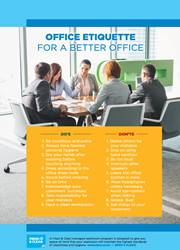
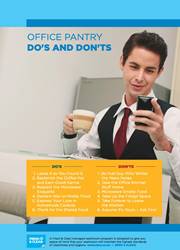
Photo courtesy of Freepik
How Can You Be Prepared for an Earthquake in the Workplace?
Earthquakes come in suddenly and without a warning. That is why you need to make sure that you are prepared for an earthquake in the workplace.
To be prepared for the earthquake, you need to do the following:
- Educate employees about the actions that need to be taken during earthquakes.
- Provide an earthquake emergency kit for your workplace and business vehicles.
- Make sure you have a business contingency plan.
In February 2011, there was a massive earthquake in Christchurch, New Zealand. The epicentre was only 10 km away from the business district. The consequences of this earthquake were devastating and over 180 people died that day.
Earthquakes are not uncommon occurrences in New Zealand and that is why New Zealand workplaces need to be prepared in order to avoid the tragic outcomes that happened in Christchurch. When an earthquake of such magnitude happens, somebody will get hurt.
To sanitise those injuries, make sure everybody is comfortable until the rescue team arrives and ensure there are enough supplies to keep everybody safe, you need an earthquake survival kit for NZ workplaces.
Alsco New Zealand offers such an emergency earthquake kit as a part of our rental program.
What Happens Before an Earthquake?
We already said that the only thing you can do to prevent an earthquake disaster is to get prepared. There are several things that any business owner in New Zealand can do to be ready:
- Find out whether your workplace building is structurally strong enough to sustain earthquakes.
- Do your best to secure all non-structural elements of your workplace building, to make it safer (windows, doors and similar objects).
- Educate your employees about the right things to do during earthquakes.
- Offer an earthquake preparedness kit for every workplace.
- Inspire your employees to keep their own personal emergency kit for earthquakes.
The New Zealand law requires for every workplace to have an Emergency Plan. It is a health and safety requirement. This plan covers different natural disasters and earthquake is definitely one of them.
You should have an emergency earthquake plan that covers the entire company and your employees should have their own personal emergency plans.
Workplace plan should be in place to secure people working in your company. The next priority is to secure your company’s property and assets. However, the list doesn’t stop there.
It is also important to have a forecast about how to resume your services and how they can help the industry in general, the civil services and then how to maintain your business. In other words, your business continuity plan should be in place when the earthquake stops.
Your workplace emergency plan should include some sort of leadership chain. In the situation of emergency, people need to know whom to seek and listen to for further instructions. Select those among your staff who have proper training and experience in such situations.
All employees should have proper training about what to do in case of emergency situations due to an earthquake. This doesn’t have to be a long and detailed procedure, but it should fit your workplace environment.
It should cover things like where to store heavy boxes or to avoid using the elevators and stairs. They should know where the nearest earthquake preparedness kit is and what is inside it.
This plan should also contain some of the general rules of conduct in case of an earthquake. Your employees should be reminded not to run outside, where to get cover and how to react. The training should be repeated every six months.
Where Is the Safest Place to Take Shelter During an Earthquake?
Contrary to what may seem logical to you, the best place you can be is the place you find yourself during an earthquake. This is another way of saying that you should not try and rush outside or anywhere else once the earthquake starts.
Once an earthquake starts, you only have a couple of seconds to react. The safest places within your workplace should be identified in your emergency plan. Advise your employees to reach them if they are the nearest possible.
The worst thing that you can do is to try to run outside. That is what causes the most injuries during earthquakes. That is why you should instruct your employees to drop down on their knees, curl up in a “turtle” position and cover their neck with a book, bag or hands.
There is a common misconception that inside of doors is the safest place to be. On the contrary – that is where the walls are the weakest, so they can come down on those who attempt to hide in that spot. Usually, the best place to hide is under a desk.
The entire Drop, Cover and Hold routine is recommended to people and businesses of New Zealand by the Civil Defence. Earthquakes will last a couple of minutes, but
What Should You Have in an Earthquake Kit?
Every earthquake survival kit for NZ workplaces should contain:
- First aid supplies
- Basic tools
- Protective gear
- Food and water
- Communication devices such as phones and radios
If your business has vehicles, there should be a smaller version of an earthquake kit in each of them, as well.
This earthquake kit list seems quite logical and all these supplies are something that you would expect in an emergency kit. The only one that can be a bit confusing is the basic tools.
Your workplace earthquake emergency kit should include pliers or wrenches because you may need to use them to prevent further disasters and dangers.
For example, you may need to shut down water valves, so the water doesn’t cover the floors in case a pipe has burst. This can present an even bigger hazard if there are torn electric wires. If they come in contact with water, there is a potential danger of electrical shock.
Putting together an emergency earthquake kit is not overly difficult, but it takes some time. Moreover, it is necessary to check it regularly and make sure nothing expired and everything works well. This is easy to forget, especially when you have a business to run.
You can leave that worry to us. Alsco New Zealand offers emergency kits that can be rented and paid through flat monthly fees. They have all you may need, labeled, packed in order and stuffed into a sturdy and resilient cabinet.
Moreover, we check, stock and restock these kits regularly – all included in your fee. Call Alsco New Zealand right now and learn all about this amazing offer.
Photo courtesy of Creative Commons
4 Ways Germs Can Kill Your Workplace Productivity
Workplace germs are scary, but are all germs bad?
Germs such as bacteria or viruses are actually very small living organisms called microorganisms (or microbes). But not ALL microbes are bad. In fact, when helpful bacteria spreads in our bodies, they protect us from illness (caused by bad bacteria). Good bacteria actually help with food absorption and aid digestion. Bad germs though can cause serious illnesses like pneumonia or the flu (influenza).
Mayo Clinic recommends implementing proper hand hygiene, which entails frequent and thorough hand washing to help protect you from illnesses like common colds and the flu.
Influenza is a common virus that impacts work productivity by causing absenteeism. It is preventable by exercising proper hand hygiene. Proper hand hygiene involves washing hands before and after meals, after touching raw and cooked food and after visiting the toilet. To curb flu, avoid hand contact to the eyes, nose or mouth, as touching is a common way of germs entering your body.
Proper hand hygiene doesn’t mean washing with soap and water only but also drying. Failing to dry hands helps spread germs because germs do breed in moist environments. Electric drying is an effective method of preventing germs but paper towels are effective in the hospital or clinic settings, for example.
Germs and Work Absenteeism
If employees don’t exercise good hand washing and drying techniques, they’ll get sick and won’t come to work. So a company’s efforts have to be directed towards replacing workers, or employees playing catch-up. And some medications can cause sluggishness and reduce morale and productivity.
Germs and Workplace Productivity
A healthy employee looks forward to coming to work. But when a workplace is germ-infested, it becomes an unsafe option. An unhygienic work environment makes workers dread work, decreasing their motivation and productivity.
Germs and Employer Losses
Studies show that employers lose billions of dollars due to ”presenteeism”. ”Presenteeism” (coming to work while sick) and absenteeism affect productivity. Treating common colds costs more than chronic illnesses. Employees lose productivity due to lack of concentration and fear of contracting illnesses. Missing work or coming to work when sick decreases effectiveness.
Most Affected Germ Areas in the Workplace
The workplace has high germ infestation due to shared spaces. Shared spaces attract germs due to cross-contamination and poor hygiene.
The following shared spaces are the most affected areas:
The Workplace Kitchen
The workplace break room is a frequented area where colleagues leave dirty dishes. Un-wiped kitchen sinks and shared washing sponges carry different types of bacteria. These bacteria are responsible for spreading diseases.
The Workplace Toilet
The toilet is probably the most used space in the workplace. Germs can cover every inch of a toilet seat. So can toilet seats cause or spread diseases like gastro?
Well, yes and no. It depends on how well a person washes their hands after using the toilet, especially if they touched a toilet seat with germs on it that are known to cause gastro-like symptoms. Good hand hygiene effectively neutralises the germs’ ability to transfer disease to another host such as a human.
Office Desks
Computers and computer keyboards are often left uncleaned in the office space. Employees often aren’t even aware of how to clean them. Even if using a cleaning contractor, a company often asks them not to touch office equipment, giving free reign to make themselves at home on keyboards and a person’s mouse.
Many employees type away at their keyboards unaware of the germs they’re working with. A simple cleaning procedure of regularly wiping down with sanitiser is recommended. Ask the IT department to issue a memo on safe computer cleaning methods.
Office Telephone
The office telephone is a commonly shared device touched by different people. Different people carry different types of germs. It’s a good idea to sterilise the mouth and earpiece regularly as part of the cleaning regime.
Doorknobs, Lift Buttons and Sink Faucets
Doorknobs attract germs because everyone touches them and they are rarely cleaned. Unless you always touch doorknobs with paper towels or some other sort of cloth, the only way to protect yourself against any germs that may be residing on the doorknob or handle is to wash and dry your hands immediately. The same applies to lift buttons and sink faucets.
Do Germs Travel?
Germs do travel. Germs such as bacteria or viruses are actually very small living organisms called microorganisms (or microbes). Many microorganisms, though not all, can survive outside of the host environment.
Think of a sick colleague who has coughed into their hands in an office setting but didn’t sanitise their hands. To survive and thrive, these microorganisms only need moisture, warmth and food. Microorganisms can multiply in one person, escape that person’s body in some way (e.g., coughing) and then must find their way into another host before they die due to lack of food, water or too much light exposure.
Direct physical contact (like a handshake) helps germs spread faster. Consider for example, if Colleague A coughed into their hands and shook the hands of Colleague B.
And Colleague B doesn’t wash their hands or sanitise immediately. Colleague B risks infection if Colleague B touches her/his face, mouth or nose.
How to Prevent Germs from Spreading in the Workplace
There are various strategies an employer can use to prevent the spread of germs in the workplace. They include:
- Cleaning work areas or surfaces often. Germs lurk in often touched places like desktops. Wiping down work surfaces with disinfectant wipes helps prevent germs from spreading.
- Creating a hand-washing policy. Promote good hand hygiene, including regularly washing hands with water and soap; particularly after handshakes, visiting the toilet, and before and after snacks. Alcohol-based hand sanitisers offer the best protection. Health organisations like the World Health Organization (WHO) and the Center for Disease Control and Prevention (CDC) stress the importance of good hand hygiene.
- Installing alcohol-based sanitisers – these reduce bacteria populations and the transmission of viruses like Staphylococcus aureus. Companies like Fresh & Clean generally carry a wide array of alcohol-based hand rubs (including foams, liquids and gels). Studies show that implementing hand hygiene programmes using alcohol-based sanitisers reduces illnesses.
- Not going to work when sick – The flu spreads, so one droplet from a sneeze is often enough to trigger a chain reaction and cause an entire department to miss work. It’s recommended to stay home to allow yourself to heal. Forcing yourself to go to work only increases the chances of cross-contamination and compromises the health of your colleagues – which in turn actually negatively impacts the business’s productivity.
- Avoiding touching your face after contact with office objects like telephones or desks. Transferring germs onto the face and close to the mouth, nose and eyes increases the likelihood of contamination.
- Teaching your colleagues. Encourage and educate your colleagues on the importance of clean hands. Persuade your workmates to clean up after themselves and look after their own personal hygiene – for the benefit of everyone as well as themselves – often referred to as herd immunity.
In conclusion, proper hand hygiene enhances the cleanliness of the workplace. The hands are the biggest dirt-carriers. Good and proper hand hygiene helps prevent about 80% of diseases.
According to the CDC, human hands spread germs through surfaces and human contact. Proper hand hygiene increases productivity and workers can appreciate a healthy working space free from germs.
Fresh & Clean places hand-sanitisers in easy-to-access areas of the work-space. This enables people to sanitise their hands before and after meal breaks, and after touching kitchen sinks, office telephones, doorknobs and lifts.
Employers and employees should be aware of germs in the workplace – because being aware help saves time and money. Employees just need to remember to always rub their hands using a quality soap dispenser or sanitiser for at least 18 to 20 seconds and then use an automatic hand dryer professionally maintained by a provider such as Fresh & Clean.
Why Is First Aid Kit Important?
Appropriately stocked workplace first aid kit is important for the health and safety of your employees. Its importance is in the fact that it offers the suitable supplies needed to treat the injury that has been sustained or to offer initial treatment that buys the time until the patient can reach the nearest medical facility.
For this to happen, the first aid kits need to be properly stocked, placed in locations that increase their visibility and clearly marked by signs and posters. Also, your employees need to be informed about the location and the contents of the first aid kits.
Maintaining the first aid kit requires regular checks to see if the cabinet is working properly and can easily be opened. All the perishable supplies need to be checked and replaced before their expiry date.
Alsco New Zealand rented first aid kits don’t need your attention in this way. Once you rent them, all the stocking and restocking is done by us. Rent your workplace first aid kits from Alsco NZ.
There are other reasons why an appropriate workplace first aid kit is important. These include:
- Enables self-help – In some situations, a person that sustains an injury is alone. There is nobody around and they have no contact with the first aiders. In that situation, the first course of action is the self-help, so the patient can be well enough to seek proper treatment.The well-stocked first aid kits are essential in those situations. Something like this usually occurs when the person is driving or works in a remote workplace with difficult access.
- Helps prevent excessive blood loss – Excessive bleeding is extremely dangerous. Significant blood loss can lead to unconsciousness, shock and eventually can be fatal. That is why it is important to dress the open wound as soon as possible.If the wound requires stitching, it should be done by professionals. However, the first aid kits have everything needed for the blood loss to be slowed down so that there is enough time for the professional medical personnel to administer advanced medical assistance.
- Facilitates everyday work – There will always be small injuries at work. Restaurant workers, for example, will often cut or burn themselves. If there is no first aid kit to quickly solve that minor setback, the employee will not be able to continue working with food.That is why your first aid kit needs to have adhesive dressings available in different sizes and shapes, so they can help sanitise those cuts and other minor workplace injuries.
- Prevents liability – According to the Health and Safety at Work Regulations it is employer’s duty to provide first aid facilities and the first aiders. The law says that there has to be first aid equipment in the workplace and that it has to be accessible for all employees.
- Demonstrates care for the employees – By boosting the first aid efforts and going well above the minimum legal requirements for the first aid, you are sending the message to the employees that you genuinely care about their workplace being. Saving on security and workplace safety doesn’t yield a healthy workplace environment and doesn’t send a positive message to the employees. Therefore, show that you care and ensure the best possible first aid kits.
- Boosts workplace morale – When employees know that their safety is the priority in the workplace, they feel more comfortable working in such an environment. That is the message that is being sent by positioning the first aid kits and AEDs in appropriate places. Additionally, first aid courses and training bring people closer to each other and boost the sense of team spirit and empathy. This can be introduced by offering your employees training about how to use the first aid kits.
- Saves time and money – Yes, you should not save money when it comes to safety. However, there are situations that can be solved equally well in one way or another. Minor cuts and injuries are such situations. Going to the ER for a minor cut or scrape, just because there is no proper wound dressing in the facilities means waiting healthcare money and time. Having a first aid kit available and treating such minor wound quickly.
- Buys the time in case of emergency – Ideally, at the moment the injury occurs, there is medical personnel to provide assistance. However, that is rarely the case, especially in the workplace. Unfortunately, the injuries and the emergencies don’t wait for anybody. The first aid kits supplies make it possible to provide a “good enough” treatment instantly which allows the patient to wait until the ambulance arrives.
- Prevents the escalation of the injury – Bleeding out means that the injury will only get worse. It can even have fatal results. Open wounds will get infected if not treated properly. The same goes for serious cuts and grazes. That is why first aid kits help you contain and minimise the negative effects of workplace injuries.
When First Aid Is Needed?
First aid is needed in a wide range of situations that go from minor cut and bruises to the serious instances of threatening open wounds and illnesses. Some of these situations include:
- Cuts, grazes and scrapes
- Joint dislocations, twists and injuries
- Hits and bumps
- Loss of consciousness and collapses
- Open wounds and blood loss
- Burns and cold injuries
There are other situations in which the first aid is appropriate. Whenever there is a situation that can be helped with an item from the first aid kit, it is the time to use it. However, this means that the first aid kits need to be restocked after every such situation.
Alsco New Zealand takes that weight off your shoulders, as our rental service includes regular stocking and restocking of the first aid supplies.
We install the first aid kits you rent from us, but that is not the end of our work. We will come to check if they are properly stocked and if the cabinets are operational. We will take care of the expired supplies and replace them with the fresh ones which makes your first aid kit usable.
Contact Alsco New Zealand and be prepared for all first aid emergencies.
Photo courtesy of Freepik


