Trusted by 237K+ Business Worldwide. Find a Location
Trusted by 237,000+businesses worldwide across 250 locations delivering uniforms, linens and more. Find a Location Near You


Delivering Excellence Since 1910
Contact Us
Flying Start for Alsco Kingsland Design Project
An exciting project to enhance an area of unused open space on New North Road is off to a flying start.
An enormous mural has been painted on the wall of the Alsco building by Auckland artists Charles and Janine Williams. The artists chose two Putangitangi ducks moving forward in unity to symbolise the lifelong partnership between Maori and European.

Paradise ducks

First discovered by Captain Cook in Dusky Sound in the 1770s and known as Paradise ducks, Putangitangi stay together for life and they would have been endemic in swampy parts of Auckland in colonial days.
Often working till midnight to complete the project, the well-known artists completed the mural in 5 days straight in the hot January sun. The challenging project involved painting over brick, corrugated iron, drainpipes and guttering on the building frontage.
Neighbour Dulux NZ provided paint for the dramatic transformation, Albert-Eden Local Board funded the artwork and Kingsland Business Society managed the project.
Cabbage Tree Swamp

Inspiration for the design came from the painting Cabbage Tree Swamp c1880 from the sketchbook of John Backhouse. Cabbage Tree Swamp was an early name for the suburb of Kingsland, including the area which now houses Eden Park. Triangles showing pieces from the Cabbage Tree Swamp watercolour represent windows into the past showing a snapshot of past interaction between the two cultures, including the exchange of land, trade and purchases.
Gavin Smith from Alsco said the artwork is already attracting a lot of attention and positive discussion. “We see heaps of cars slowing down to look too.”
Blessing ceremony
 A blessing ceremony was held on January 19th at 9.30 am and over the coming months, a pocket park currently being developed for the site in a private/public partnership will be installed.
Why Use Alsco Uniforms and Workwear?
Few managers dispute the fact that a quality uniform is the number one way to protect employees from heavy soil, grease and grime, or to present a crisp, clean, dignified image to customers.
Today Alsco has literally millions of customers of all sizes around the world who have come to rely on us to make them look better and operate more efficiently with a Managed Workwear Program.
Here are a few of the reasons why securing uniform services from Alsco makes such good sense.
Economy and Value
With Alsco’s managed workwear program there is no costly initial investment. Our systems allow you to reduce uniform and image wear to a convenient, predictable budget item. Alsco takes care of the day to day management including washing, repairing and presentation, eliminating this time-consuming task from your staff and management. We get your new employees into a clean, fresh uniform from virtually day one.
Quality and Flexibility
Our workwear comes in a wide selection of fabrics, styles and colours, from tough overalls to smart corporate image wear, cotton drill for hot humid environments to polyester/cotton blends for stain resistance and lighter weight requirements.
We offer you the expertise of our in-house design department, and a guarantee of superior, quality garments, personalised company identity and short lead times on additional uniforms.
Service and Support
We will repair, maintain and replace your uniforms, size your people (or teach you how to size workwear), install secure locker systems, soiled garment bins and provide standard operating procedure wall charts, assign specific individuals to manage accounts and regularly meet with customers to ensure the best solution is always achieved.
The bottom line is:
Alsco can tailor an effective program to suit your specific needs.
We do the work while you maintain total control. Contact us now to get started!
Prepare Your Workplace For any Civil Defence Emergency
[intro]For the very first time, New Zealand businesses can access emergency equipment in the form of customised modules.[/intro]
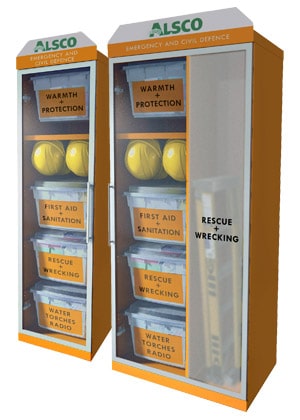 Introducing unique fully managed modular civil defence systems.
The modules are contained within safe, sturdy floor cabinets with clear glass doors, enabling staff to ‘grab and go’, depending on the nature of the emergency (and in case of evacuation).
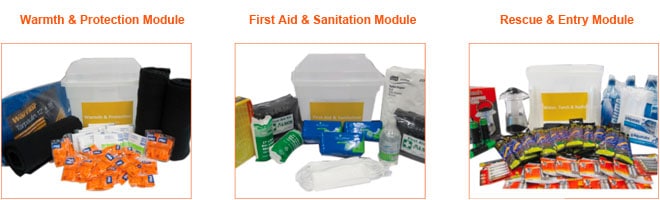
Alsco’s Emergency Response Systems provide Warmth and Protection Modules, Safety Helmets, First Aid and Sanitation Modules, Rescue and Entry Modules, Water Torch and Radio Modules, Fire and Spill Kit Modules and Food Modules.
Cabinets and Modules can be expanded according to staff numbers, floor space and existing emergency equipment.
Prepare your workplace for any civil defence emergency.
- Sturdy floor cabinets
- Transparent glass doors
- Customised ‘Grab and go’ modules
Does Your Business Meet New Zealand OH&S Guidelines?
To meet the requirements of the Health and Safety in Employment Act (1992):
1.3 – “All practicable steps” should be taken by employers (and others) to provide properly maintained first aid equipment
9.0 – First aid equipment is suitably marked and easily accessible
9.1 – Marking used should be a white cross on a green background
9.2 – There is at least one kit on each floor of a multi-level workplace
9.2 – An additional kit should be provided where there are more than 50 employees and every 50 employees thereafter
9.3 – It is essential that first aid equipment be checked regularly
9.3 – Items are to be replaced before the expiry date on the packets
9.2 – Each work vehicle should be provided with a first aid kit
Why Buy When You Can Rent Your First Aid Kit?
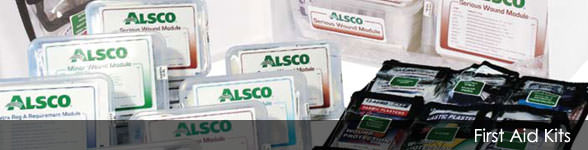
Alsco’s Managed Rental Program for First Aid Kits gives you and your employees instant peace of mind. We follow through and check your kits on a regular basis for out of date items, and replenish when necessary. There are no additional charges. You can have total peace of mind.
8 reasons to use Alsco’s Managed Rental Program
| Rent | Buy | |
|---|---|---|
| Re-stocked regularly | Always | Sometimes |
| OH&S Compliant | Always | Sometimes |
| Full range of kits | Available | Available |
| Hospital-grade supplies | Always | Sometimes |
| Up-to-date Service Logs | Always | Sometimes |
| Value for money | Always | Sometimes |
| One fee for everything | Yes | Never |
| Injury Specific supplies | Yes | Sometimes |
Sometimes’ isn’t good enough. In 2014, there were 226,100 claims of work-related injuries* in New Zealand. This is an injury occurring every 9.4 hours worked. With Alsco’s Managed Rental Program for First Aid Kits, you can be sure that you’ll have the first aid supplies you need, specific to injuries, on hand every time.
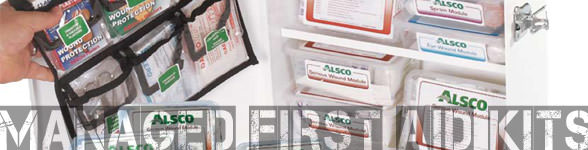
An Alsco Managed Service has many advantages:
- Agreed maintenance schedule by our friendly, professional team with a proven service record
- High quality “hospital grade” first aid supplies that are never out of date
- Peace of mind knowing that all your first aid kits are auditable to OH&S guidelines
- Sturdy, highly visible, wall-mounted cabinets for immediate identification and ease of access
- Proven method of documenting usage and “outages”
- Service record on the kit that is easily visible for auditing purposes
- Value for money and easy budgeting with a set fee inclusive of consumables
What makes Alsco’s First Aid kits better than the rest?
- Each item in Alsco’s first aid kits are colour coded for specific injuries, ensuring you select the correct first aid kit for your required situation.
- A removable door liner is exchanged each service.
- Well labelled, transparent packaging allows you to find the right supplies when you’re in a hurry.
- A service card in each cabinet is used to log service dates.
- Each kit has a logical, standard layout that makes it simple and easy to use.
Why Use Alsco Floorcare?
Over two-thirds of all moisture, dirt and grime that enters your premises are carried in by shoes. This not only makes cleaning a never-ending, expensive task but also accelerates the wear and tear on floor coverings – resulting in unsightly floors and costly repairs and maintenance.
Here are some good reasons why you should consider an Alsco managed floorcare program.
- Economy and Value: A convenient, economical rental program will provide the benefits of clean flooring, reduced cleaning time and assist in employee comfort and safety for no upfront capital investment.
- Quality and Flexibility: A quality service and floorcare program that may include a combination of message mats, advertising mats, anti-fatigue mats and cleaning mops to fit the size and scope of your business.
- Selection and Service: Customers can choose a floorcare program to suit their particular needs and budget. An Alsco representative will deliver clean, effective mats and take away the soiled ones based on your selection requirements and timeframes.

Benefits of Managed Garment System
Garment Tracking
Our customers receive a simple, fail-proof method of tracking and monitoring the movement of garments in and out of their premises and invoicing them accordingly.
Alsco has developed a solution through the use of Barcode labels. They hold a unique number that is assigned to individual garments. Once the number is allocated, the system stores the following information:
- Wearer or Pool Name
- Account name
- Department
- Garment style and size
- Garment age
- Number of washes
- Last pick-up and delivery
Tracking
Each time the uniform is scanned its information is stored in our data management system. From this information, we are able to produce invoices and management reports on actual usage, as well as individually tailored reports to meet your requirements.

The garment tracking system has been developed internally and tested extensively, ensuring a safe and reliable service. After careful consideration of your organisational requirements gained through site inspections and information provided by your local branch, we believe a managed personalised garment system is the correct solution for your needs.
A managed personalised garment system operates by allocating each individual employee their own garments and personalised locker. The garments are allocated unique barcode numbers that are linked to the wearer and cross-referenced to their locker number.
Our Service Delivery Person will deliver the garments into each employee’s personal locker and scan their soiled uniforms to provide usage reports.
Supply Stock
Each managed garment wearer will be issued with sufficient circulating stock to ensure they have clean uniforms available for the start of each shift. For example, if a wearer requires 5 changes of clean garments per week, Alsco will issue that wearer with an inventory of 11.
The reason why we invest in that level of inventory is to keep 5 in lockers, 5 in the laundry and one being worn. You will then simply be invoiced the unit price per garment multiplied by the agreed number of changes per week.

This managed personalised garment system provides you with the following services inclusive of the unit price per garment;
- Sufficient inventory of the garment;
- Correct sizing and fitting of current and new employees;
- Every garment laundered to AS4146:2000 or better;
- Delivery of clean garments into personalized lockers;
- Removal of soiled garments;
- Specific wearer barcode labelling;
- Repairs undertaken when necessary;
- Garment replacements that are due to wear and tear;
- Size changes on garments when necessary;
- Soiled garment bins;
- General tidying of change rooms;
- Management reporting;
- Overall system management.
Managed First Aid Systems
Workplace injuries happen to 600 people and kill one New Zealander each week. Apart from the human toll, the effect on a small or medium-sized enterprise can be terminal.
According to Gavin Smith, the designer of a tailor-made managed first aid system, although the New Zealand workplace is getting safer, what is required for businesses to comply with Occupational Safety and Health (OSH) is getting tighter and more robust.
Managed first aid systems
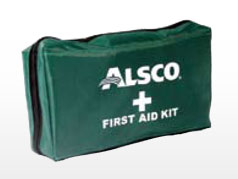 Gavin, New Zealand manager at Fresh and Clean, part of ALSCO, specialists in managed first aid systems, says an increasing number of Australasian businesses are now opting for this type of system, where they contract their first aid kit management to an all in one rental service because the DIY approach doesn’t meet the stringent OSH or Australian state requirements.
He explains: ‘Most businesses will have a first aid box somewhere and usually they are completely disorganised and dysfunctional. I visited a South Island engineering firm a month ago. They were prepared for a paper cut at best. If a major cut or injury occurred they wouldn’t have been able to deal with it.’
OSH Guidelines for businesses
Gavin has summarised the five pages of OSH Guidelines for businesses to meet the requirements of the Health and Safety in Employment Act (1992) into eight points:
- ‘All practicable steps’ should be taken by employers (and others) to provide properly maintained first aid equipment.
- First aid equipment is suitably marked and easily available.
- Marking used should be a green cross on a white background.
- There is at least one kit on each floor of a multi-level workplace.
- An additional kit should be provided where there are more than 50 employees and every 50 employees thereafter.
- It is essential for first aid equipment to be checked regularly.
- Items are to be replaced before the expiry date on the packets.
- Each work vehicle should be provided with a first aid kit.
He explains: ‘Most people fall over at the first step. Many businesses will have bought a kit five years ago and forgotten all about it. Secondly, they will most likely have put it somewhere and in an emergency, no one can find it. Thirdly, you’d be amazed at how many still have a red cross on them. When we do a first aid kit audit we find that most kits have not been checked recently. The rules have changed too; everything has now to be single-use. You can’t just have a bottle of eyewash for example. They have to be single, sealed, sterile packs.’
Managed first aid system – An American example
Gavin developed a managed first aid system after being told about an American version by ALSCO chief, Tony Colenso. ‘Our CEO had seen the concept of a managed first aid system in the US. Broadly spoken we are a health, safety and image company and it seemed to us that this would be a natural evolution for our overall service. I looked at how we could develop a scheme for our existing customer base and we started with a pilot service in Wellington in 2002.’
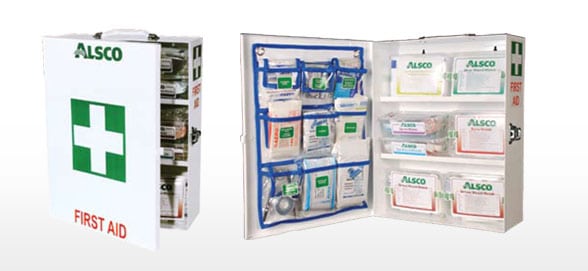
Several other suppliers will sell businesses a first aid kit but checking the contents and replacing used items is either too expensive or left to the client to manage by ordering supplies online.
Gavin explains: ‘A lot of businesses don’t realise how much they spend managing their kits and the people to manage them. It’s a false economy. They don’t know if their kit is being serviced to the correct standards if it has been allocated to a staff member or what their auditing ability internally is. But many businesses now prefer to have it done for them and know that they are meeting all the OSH requirements. A rental programme for around a dollar a day per kit removes the need to check the kit yourself and the servicing of our kits takes less than two minutes for one of our trained operatives.’
Checked and restocked
Gavin designed the ALSCO kit with an exchangeable liner with clear plastic pockets for day to day use. The contents are checked routinely and restocked. The entire liner is replaced every three months whether used or not. The contents are reprocessed offsite and ALSCO has established a network of organisations such as the SPCA, zoos, animal shelters and Rotary, for offshore disaster relief, to take the expired products.
There are also six modules in each kit for accidents and specific injuries, covering all the items for a reasonably sized incident allowing someone to grab and run to the accident site with everything they may need.
Gavin points out: ‘We developed the kits in New Zealand with our own liner and modules. There is no prescriptive use in NZ but Australia has adapted the kit to suit the separate state compliance requirements. If the modules are opened or missing or the expiry date is exceeded we replace them and if a specific module is used we will enquire and check that it has been logged in the accident book, which is part of the OSH requirement. Very often we are the first to point out to the client that the accident book needs updating. Inside the door of each kit is a sheet which is signed at each service as well as an online record.’
There are now more than 4,000 kits in use in New Zealand and the service has been operating in Australia for three years with around the same number signed up there. New Zealand clients include a wide range of organisations such as the Ministry of Health, Hollywood Bakeries, Department of Corrections, Ministry of Fisheries, Auckland City Council, a number of other district councils and libraries, the Olympic pool at Newmarket and Parliament House.
Four versions of kit available
In New Zealand, there are four versions of kit available; large for up to 50 employees; small for up to 15 employees, plus a food version of each (with blue plasters which are visible and metal detectable). There are supplementary kits for smaller offsite, vehicles, executive workplaces. The company also offers additional equipment such as defibrillators and eyewash stations
Gavin explains that even a small business never knows quite what it might need in the event of an accident. Last August an Mt Eden physio who had just taken delivery of an ALSCO defibrillator used the unit to save the life a man who had been electrocuted while erecting flagpoles on Normanby Ave outside the gym where the physio worked.
Gavin says: ‘He was at the man’s side within three minutes and without the defibrillator, the man could have died. He had only just rented the defibrillator from us and had just been trained in its use the month before.’
Free no-obligation compliance audits
In early 2012 ALSCO is to start offering free no-obligation compliance audits to small and medium-sized enterprises to see if they are compliant with OSH first aid requirements.
Gavin adds: ‘We have grown this Kiwi developed service so that we are the only true national provider. We have started to pick up national organisations as well as smaller owner-managed businesses because of the need to standardise systems. We do offer peace of mind but at the end of the day it’s about doing what’s right.’
Exciting New Range Launched!
The Cutting Edge range has been designed for ‘today’s’ chefs in ‘today’s’ kitchens. Comfortable to wear over long, hot periods and strong enough to withstand the rigours of daily laundering, this range also complies to strict hygiene regulations.
The Cutting Edge range
The Cutting Edge range of jackets, pants and aprons are lightweight and comfortable. The chefs’ jackets are available in both contemporary and classic designs.
The Cutting Edge range is available in a choice of styles that can be personalised with trims and embroidery whilst also meeting food industry hygiene regulations (HACCP).
Dry Hands are Safe Hands
An awareness that microorganisms on a person’s hands can be a source of cross-infection and a means by which infectious diseases can be transmitted has been appreciated for over 100 years and followed on from the studies of Dr I.P. Semmelweis who dramatically cut the death rate from infection in his delivery ward by insisting on strict hand washing and disinfection.
There is no shortage of scientific papers in the medical literature on the subject but close inspection will show that the emphasis has always been on the effect of handwashing and disinfection on microbial numbers on the hands –not on what happens after washing.
Washing hands is only a small part of the hygiene story
Research by Dr Tom Miller and colleagues Daniel Patrick and Glenne Findon from the Department of Medicine at the University of Auckland and published in the influential journal, Epidemiology and Infection, have produced startling results showing that hand washing is only part of the hand hygiene story.
According to Dr. Miller hand drying after washing is an additional and critical factor limiting the spread of infection by touch contact.
This topic is particularly important in crowded workplaces, such as restaurants and schools.
Interested in the best hand hygiene practices in school washrooms? Read through the linked guide and learn everything you should know about making schools safe environments for all our children and school staff.
Here’s why it all matters so much.
When items are touched by hands that have been washed but not dried properly many thousands of microorganisms can still be transferred. Dr Miller quotes figures of 60,000 microorganisms being transferred to the skin of a person being touched with damp hands and 40,000 microorganisms being transferred to samples of food. Moisture left on the hands acts as a bridge allowing alarmingly high numbers of bacteria to be transferred by touch contact, says Dr Miller.
These figures contrast with the situation when the hands are carefully dried after washing. With proper hand drying, the numbers transferring with touch contact can be reduced to less than 100.
The research, which used a recyclable textile (cloth) dispensing unit to dry the hands, has important implications for hand hygiene practices in situations where infection control is a priority. Hospitals are an obvious target but the basic principles apply equally well to other hygiene sensitive areas such as food outlets, childcare centres, rest homes for the elderly and in the family home where a caregiver might be moving between a sick member, food preparation and other domestic tasks.
One outcome of the research is that hand drying is now regarded as an integral part of hand hygiene and most international guidelines for hand hygiene practices include a requirement for hand drying.
Best practice for hand drying
Studies carried out in the Department of Medicine, the University of Auckland in recent years by Dr Tom Miller and Daniel Patrick have shown hand drying following a careful hand wash is a critical factor that determines the effectiveness of a hand hygiene practice. The research identified moisture on the hands as a potent “microbial mobilizer” and demonstrated that the degree to which microorganisms can be spread by touch contact is closely related to the level of moisture on the hands when touch contact occurs. In practical terms, hygiene facilities need to include a readily assessable hand basin, running water soap and an efficient means of hand drying.
Experiments carried out using recyclable cloth towelling dispensers have shown cloth towelling to be an effective means of hand drying. However, because the cloth is becoming progressively damp as water is removed, it is difficult to remove moisture to a level that can be considered “safe.”. The researchers have gone on to develop and test a dual-system hand drying protocol that they consider to be “Best Practice”. In the dual system that was evaluated, a cloth towel from a dispensing unit was used first to remove the bulk of water left on the hands after washing. In the second phase, hands were held under a hot air towel to remove residual moisture.
Recommendations arising from the research are that the hands be dried for 10 seconds with the cloth towel followed by a further 10 seconds under an air towel. The protocol has been promoted as the 10/10 procedure. Evidence supporting the 10/10 concept is compelling. Experiments that involved subjects handling skin, food and utilities with wet hands or hands dried using the dual system,10/10, protocol demonstrated just how effective careful hand drying can be at reducing microbial transfer by touch contact.
| Contact surface | Wet hands | dual drying, 10/10 procedure |
|---|---|---|
| Skin | 71,000 microorganisms | 330 microorganisms |
| Food | 11,700 microorganisms | 1,600 microorganisms |
| Utilities | 2,500 microorganisms | 85 microorganisms |
Microbial numbers contaminating skin, food and utilities were therefore reduced 99.5%, 84% and 90% respectively when subjects dried their hands using the dual system, cloth and air towel combination. In the absence of an air towel, it is recommended that residual moisture is removed using a fresh, dry section of a cloth towel. i.e. two 10 second dries using the cloth towelling.


